
Introduction
Recovery after surgery · Preparing for surgery
Preparing for surgery: what to expect before your operation
Last updated: 17 October 2026.

Dr Sean LeoOrthopaedic Surgeon, Singapore
Clinic enquiries · Not an emergency service
Illustrative image

Preparing for surgery is a set of practical steps, agreed with your team.
Preparing for surgery is a set of practical steps, agreed with your team.
Preparing for surgery is a set of practical steps, agreed with your team.
Preparing for a planned operation brings together a health review and any tests, a plan for your usual medicines, a stated time to stop eating and drinking, arrangements at home, and help for the first days. The exact instructions are always the ones your surgical team and hospital give you.[1][2][3]
Safety note: This webpage is not an emergency or urgent-care service. If something feels wrong before your operation, contact your care team promptly.
What’s covered on this webpage
Follow the route in order, or jump to the stop you need. Stops you have read are marked.
Your own team’s instructions come first.
Your own team’s instructions come first.
Your own team’s instructions come first.
Hospitals send specific instructions, such as a fasting time, a medicine plan and an arrival time. The details vary with the operation and the person, so your hospital’s letter comes first.
The sections below set out what to expect and what to ask. Where they differ from your hospital letter, follow the letter. If the letter is unclear, ask. Asking is not a fuss.
The instructions that apply to you are the ones you were given.

Getting ready in the weeks before surgery.
Getting ready in the weeks before surgery.
Getting ready in the weeks before surgery.
Most early preparation is a conversation with your team.
| What to sort out | When | Who decides |
|---|---|---|
| Health review and tests | A few weeks before, usually[1] | Your team |
| Usual medicines | Advice before the day[1] | Your team |
| Smoking | Discussed before surgery[1][2] | You, with support |
| Home set-up | Before the day | You and your helpers |
| Walking aids | Before the day | Your surgeon |
| Eating and drinking | Time in your letter[1] | Your hospital |
A health review and any tests
A pre-operative assessment usually takes place a few weeks before planned surgery. It checks you are well enough for the operation and the anaesthetic.[1]
It can involve blood tests, an X-ray, an electrocardiogram (ECG, a tracing of the heart’s electrical activity) and a fitness test.[1] Tell the team about all your medicines, health conditions and allergies, and any past reaction to an anaesthetic.[1]
Your medicines: a conversation, not a decision you make alone
The team needs your full list: prescription medicines, over-the-counter medicines, herbs, vitamins and supplements.[3] They ask in particular about blood thinners and diabetes medicines.[3]
If you use a GLP-1 medicine or a related medicine such as tirzepatide (for example semaglutide, tirzepatide or liraglutide, sold as Ozempic, Wegovy, Mounjaro, Saxenda or Victoza) for diabetes or weight loss, tell your surgical and anaesthetic team before your operation.[4][5][6] These medicines slow how fast your stomach empties, so your team may change your fasting instructions or how your anaesthetic is given.[4][5]
Your team then advises which usual medicines to keep taking and which to pause.[1]
Safety note: Only your surgical and anaesthetic team can tell you whether to take, leave or change any medicine. If you are unsure about a medicine, ask before the day.
Stopping smoking and staying active
Stopping smoking is a standard part of getting ready, and it can help your recovery.[1][2] If you smoke, your team will talk it through with you.
Keep as active as you comfortably can. Make sure conditions such as diabetes, high blood pressure or anaemia are managed as well as possible.[1] These steps can help your recovery. They do not guarantee a result.[1]
The week before
The week before
The week before: home, help and getting around.
Setting up your home
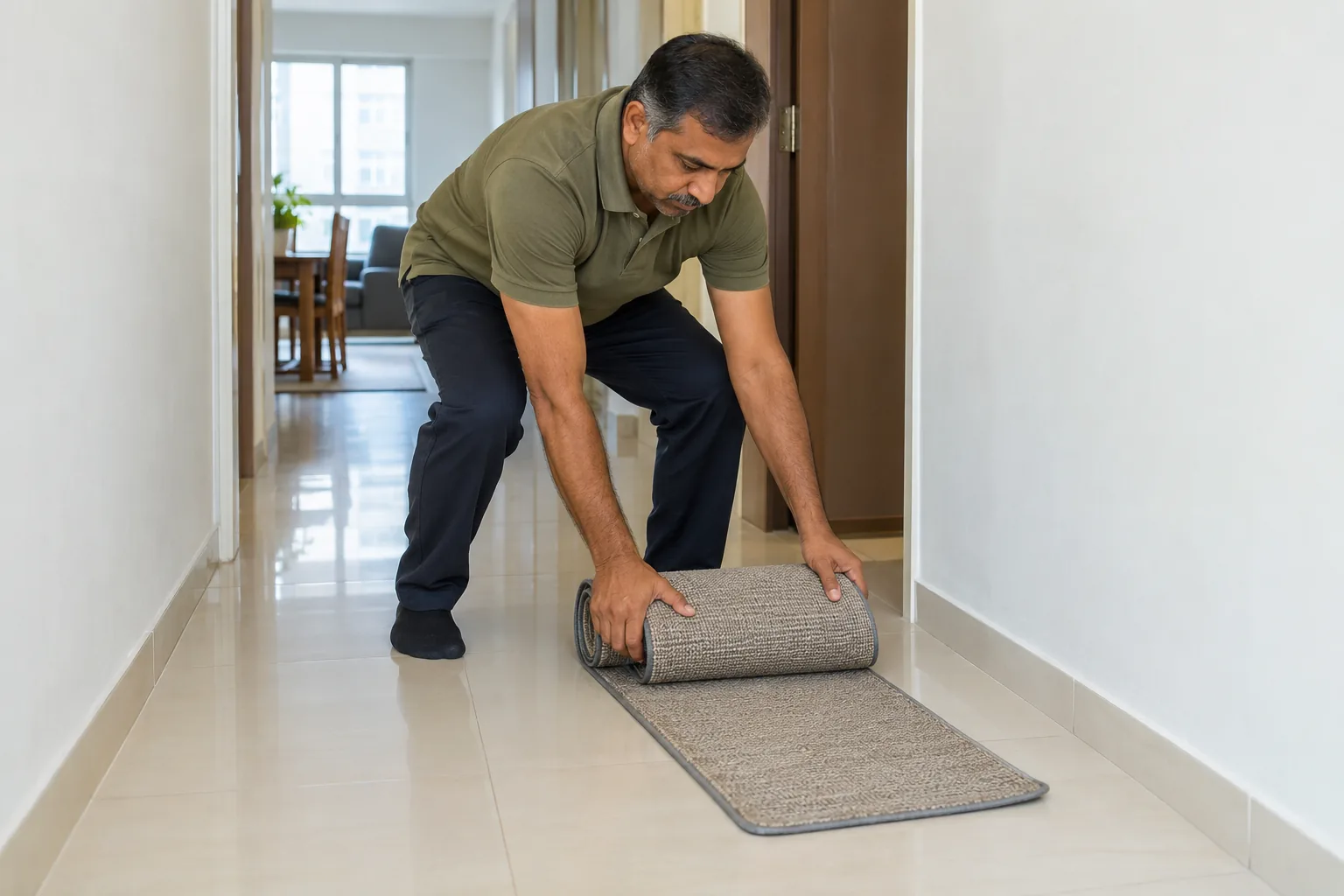
- Remove loose rugs.
- Clear boxes, cords and anything else you could trip over.
- At night, keep lights on, wear your glasses and use non-skid shoes if you get out of bed.[3]
Serious falls happen when people try to manage alone and do not ask for help.[3]
Walking aids: which, and for how long, is your team’s call
Some operations need crutches, a frame or sticks for a time. Your team gives instructions on how much weight to put through the leg after some operations.[3] Ask which aid, if any, you need and for how long.
Your team will tell you when to reduce and stop each aid. This video explains when crutches help and when they do more harm than good.
Help, transport and the first night home
After a general anaesthetic, someone needs to collect you by car or taxi and stay with you.[1] For at least 24 hours:[1]
- do not drive or ride a bike
- do not drink alcohol
- do not make important decisions
Effects can last around 24 hours. That is typical, not a fixed rule.[1] Your hospital’s own instructions govern.
Preparing yourself, not just your home
Write worries down as they come. Keep a note of your questions. Bring one organised person to appointments if you can. These matter as much as the rugs and the handrails.
The day before and the morning of surgery.
The day before and the morning of surgery.
The day before and the morning of surgery.
Fasting: why, and how the timing is set
You stop eating and drinking before an anaesthetic so that your stomach is empty. This is for safety. The hospital gives you an exact time, usually a few hours before.[1]
Safety note: Follow your hospital’s fasting letter exactly, including whether you may drink anything at all before your operation. If anything is unclear, call your hospital before the day.
Bring your list of medicines[3] and anything else the hospital asked for.

Anaesthesia, in plain words.
Anaesthesia, in plain words.
Anaesthesia, in plain words.
Anaesthesia stops you feeling pain during an operation. There are four main kinds.[1]
- A general anaesthetic means you are asleep and feel nothing during the operation.
- A local anaesthetic numbs a small area while you stay awake.
- A regional anaesthetic numbs a larger part of the body while you stay awake.
- Sedation leaves you relaxed but not unconscious.
A general anaesthetic is used if other types are not suitable.[1] You may meet the anaesthetist at your pre-operative assessment.[1] An anaesthetist is a specialist doctor who leads the anaesthetic team. They stay with you throughout and monitor your heart rate, blood pressure and oxygen levels.[1]
Day surgery or a hospital stay?
Day surgery or a hospital stay?
Day surgery or a hospital stay?
Some operations are done as day surgery, so you go home the same day. Others involve one or more nights in hospital. The plan depends on the operation, your general health and the support waiting at home.
Going home the same day does not mean the operation was minor. Staying overnight does not mean something went wrong.
Good questions to ask before the day.
Good questions to ask before the day.
Good questions to ask before the day.
Your team expects questions. Worth writing down:
- Which medicines do I keep taking, and which do I pause? When, exactly?
- When do I stop eating and drinking?
- What time do I arrive, and where?
- Will I go home the same day, and how will I get there?
- Who do I call if something changes, such as a new illness?
- When is my follow-up?[3] Who arranges it?
Bringing a second person to listen is a sensible habit. To arrange a consultation, see the contact page.

Structure / Patient / Goal
Structure / Patient / Goal
Deciding together
Structure / Patient / Goal
S
Structure: what is being planned?
Structure is the operation planned and what it asks of your body around that time.
P
Patient: who are you, as a whole person?
Patient means you as a whole person. Your conditions, medicines, home and helpers all shape how you prepare.
G
Goal: what do you want to be able to do afterwards?
Goal is what you want to get back to. It shapes what ready means for you.
Your plan

Where to go next.
Where to go next.
Where to go next.
- Recovery after surgery, by type of operation.
- Your own procedure page, which holds the protocol for your operation. Start from the knee, hip or foot and ankle hub.
- What recovery involves after any operation.

OrthoKinetics Recovery Reflection
Recovery reflection
What does being prepared actually change?
A prepared home, a person to collect you and a written list of questions are how a general plan becomes yours.
What does asking for help say about you?
Needing help with the practicalities is part of the plan of care. It does not say you cope badly.
You have done what you can for today. Let the plan carry the rest.
Illustrative image

 With you through the seasons
Meet Dr Sean Leo
Meet Dr Sean Leo
A consultant orthopaedic surgeon whose clinical focus is the knee, sports injuries and the lower limb.
- Dr Sean Leo is a consultant orthopaedic surgeon. OrthoKinetics is his professional brand; clinical services are provided through OrthoSports Orthopaedic & Sports Surgery at Mount Elizabeth Novena Specialist Centre and Connexion, Farrer Park Hospital.
- His clinical interests include sports injuries, including those in adolescent athletes; ligament reconstruction; realignment surgery; cartilage repair and joint-preservation approaches; knee replacement; and technology-assisted hip and knee surgery.
- The consistent aim is to return people to meaningful function and activity while avoiding unnecessary downtime.
- Qualifications: MBBS, MRCS (Ed), MMed (Ortho), FRCSEd (Ortho).
More detail: Meet Dr Sean Leo
- Training and career: Dr Leo trained in medicine at the National University of Singapore and served in the Singapore Armed Forces Medical Corps from 2000 to 2012, where his work included the care of soldiers in physically demanding roles. He completed postgraduate orthopaedic training in 2009 and a one-year clinical fellowship at Royal North Shore Hospital in Sydney, Australia, before joining Changi General Hospital as an orthopaedic consultant in 2012, where he later held the positions of Senior Consultant and Director of the Hip and Knee Service. With seniority, his educational contribution has evolved towards mentorship and support for junior doctors.

A consultant orthopaedic surgeon whose clinical focus is the knee, sports injuries and the lower limb.
A consultant orthopaedic surgeon whose clinical focus is the knee, sports injuries and the lower limb.
A consultant orthopaedic surgeon whose clinical focus is the knee, sports injuries and the lower limb.
- Dr Sean Leo is a consultant orthopaedic surgeon. OrthoKinetics is his professional brand; clinical services are provided through OrthoSports Orthopaedic & Sports Surgery at Mount Elizabeth Novena Specialist Centre and Connexion, Farrer Park Hospital.
- His clinical interests include sports injuries, including those in adolescent athletes; ligament reconstruction; realignment surgery; cartilage repair and joint-preservation approaches; knee replacement; and technology-assisted hip and knee surgery.
- The consistent aim is to return people to meaningful function and activity while avoiding unnecessary downtime.
- Qualifications: MBBS, MRCS (Ed), MMed (Ortho), FRCSEd (Ortho).
Questions people often ask
Common questions about preparing for surgery
Common questions about preparing for surgery
When do I need to stop eating and drinking?
Your hospital gives you an exact time, usually a few hours before.[1] Your letter also says whether you may drink anything, and that instruction comes first.
Can I keep taking my regular medicines before surgery?
Your team advises which to keep taking and which to pause.[1] Decide with them, not alone.
Who should come with me on the day?
After a general anaesthetic, someone needs to collect you and stay with you.[1]
Costs and insurance
Costs and insurance
Practicalities
Cost, MediSave and insurance

A cost estimate for surgery can be given only after a consultation and assessment, once a surgical plan has been developed.
Each individual condition is unique. Implants used, time taken and other factors contribute to the overall estimate. The estimate will be provided to you by the clinic should you decide on surgical management, and will also be used to assist in obtaining pre-authorisation from insurance where applicable. Insurance coverage and out-of-pocket costs depend on the individual policy and the insurer’s decision. No coverage is guaranteed.
A surgical estimate separates surgeon, anaesthetist, hospital or facility, implant and consumable costs, and the MOH publishes national fee benchmarks for common procedures. For how costs, MediSave and insurance work in Singapore, see Costs, insurance and MediSave, explained.
Insurance panels. Dr Sean Leo, Orthopaedic Surgeon, is on the specialist panels of Great Eastern (GE Panel), HSBC Life (HSBC Life Shield) and Singlife (Singlife Shield), and on the Prudential Panel. AXA Insurance Singapore became part of HSBC Life in 2023, and former AXA Shield plans are now HSBC Life Shield plans.
Corporate health plans. Dr Leo is on the panels of both Alliance Medinet and iXchange, which administer medical benefits for many company health plans. If your company plan uses either panel, you can see Dr Leo as a panel doctor.
If your company uses a different panel. Some company plans still let you see a doctor of your choice outside their panel, then claim reimbursement. This varies from plan to plan, as may the co-payment, so please check your benefits with your company’s HR department.
Panel arrangements change from time to time, so please confirm with your insurer or your company’s plan administrator before your appointment.
Dr Leo is on the panels shown. If your insurer is not listed, you may ask whether co-management with an Orthosports surgeon partner on that panel is clinically and administratively appropriate. Orthosports surgeon partners are collectively on the panels of all Shield plans.
To discuss your own situation, arrange an assessment through the appointment section.
Arrange a consultation: the appointment section is further down this page.
Sources
References
References
- NHS. General anaesthetic (page last reviewed 29 November 2024; read at source 15 October 2026). https://www.nhs.uk/tests-and-treatments/general-anaesthesia/
- National Institute for Health and Care Excellence (NICE). Perioperative care in adults. NICE guideline NG180, Recommendations (published 2020; updated 2025; read at source 15 October 2026). https://www.nice.org.uk/guidance/ng180/chapter/Recommendations
- American Academy of Orthopaedic Surgeons (AAOS). Patient Guide to Safe Orthopaedic Surgery. OrthoInfo (read at source 15 October 2026). https://www.orthoinfo.org/treatment/patient-guide-to-safe-surgery
- Medicines and Healthcare products Regulatory Agency (MHRA). GLP-1 and dual GIP/GLP-1 receptor agonists: potential risk of pulmonary aspiration during general anaesthesia or deep sedation. Drug Safety Update (28 January 2025; read at source 17 October 2026). https://www.gov.uk/drug-safety-update/glp-1-and-dual-gip-slash-glp-1-receptor-agonists-potential-risk-of-pulmonary-aspiration-during-general-anaesthesia-or-deep-sedation
- Eli Lilly and Company; Novo Nordisk. MOUNJARO (tirzepatide) and WEGOVY (semaglutide) US prescribing information, FDA-approved labels (Mounjaro label revision 11/2024; Wegovy 2026 label; read at source 17 October 2026). https://www.accessdata.fda.gov/drugsatfda_docs/label/2024/215866s010s015s022lbl.pdf ; https://www.accessdata.fda.gov/drugsatfda_docs/label/2026/215256s033lbl.pdf
- Novo Nordisk. OZEMPIC (semaglutide), SAXENDA (liraglutide) and VICTOZA US prescribing information, FDA-approved labels (Ozempic revised 05/2026; Saxenda revised 02/2026; Victoza revised 10/2025; read at source 17 October 2026). https://www.novo-pi.com/ozempic.pdf ; https://www.novo-pi.com/saxenda.pdf ; https://www.novo-pi.com/victoza.pdf
Final next step
Final next step
Next step
Final next step
Reading about a problem is a starting point. An assessment brings together the history, an examination where needed and any useful tests, and helps you and your clinician decide what to do next. How much physical examination is needed is a matter of clinical judgement. It may be limited when pain makes an examination unreliable, or when imaging clearly shows a problem that matches the symptoms, such as a fracture seen on an X-ray or an MRI scan that clearly shows an injury consistent with the symptoms. The Singapore Medical Council and the UK General Medical Council both allow remote medical consultations, where a physical examination is not possible, with safeguards: the doctor must be clear about the limits of an opinion formed without an examination, and whether an in-person examination is needed, or referral to other services, is left to the clinical judgement of the attending doctor.
If an injury may need urgent attention, use the urgent-signs list for the area involved. For a knee injury, use the knee urgent-signs list; for a foot or ankle injury, use the foot and ankle urgent-signs list; for a shoulder injury, use the shoulder urgent-signs list.
Was this page helpful?
Arrange a consultation
Appointments are arranged through the OrthoSports clinic team. Send your details below, or message or call the clinic.
Leave your details and the clinic team will reply to arrange a time.
Message the clinic on WhatsApp
-
38 Irrawaddy Road, #10-41 Mount Elizabeth Novena Specialist Centre, Singapore 329563 Map for Orthosports@Novena (opens Google Maps)
-
1 Farrer Park Station Road, #15-17 Connexion, Singapore 217562 Map for Orthosports@Connexion (opens Google Maps)
WhatsApp is for clinic enquiries only. It is not an emergency service and is not monitored for urgent care. Website or messaging contact is not an emergency-response service. For a medical emergency, use your local emergency service.
- WhatsApp is for clinic enquiries only. It is not an emergency service and is not monitored for urgent care. Website or messaging contact is not an emergency-response service. For a medical emergency, use your local emergency service.
- OrthoKinetics does not provide emergency or urgent care through this webpage or its WhatsApp contact.