Introduction
Hip care · Hip arthritis
Osteoarthritis of the hip
Specialist orthopaedic surgeon · hip problems

Dr Sean LeoOrthopaedic Surgeon, Singapore
Clinic enquiries · Not an emergency service
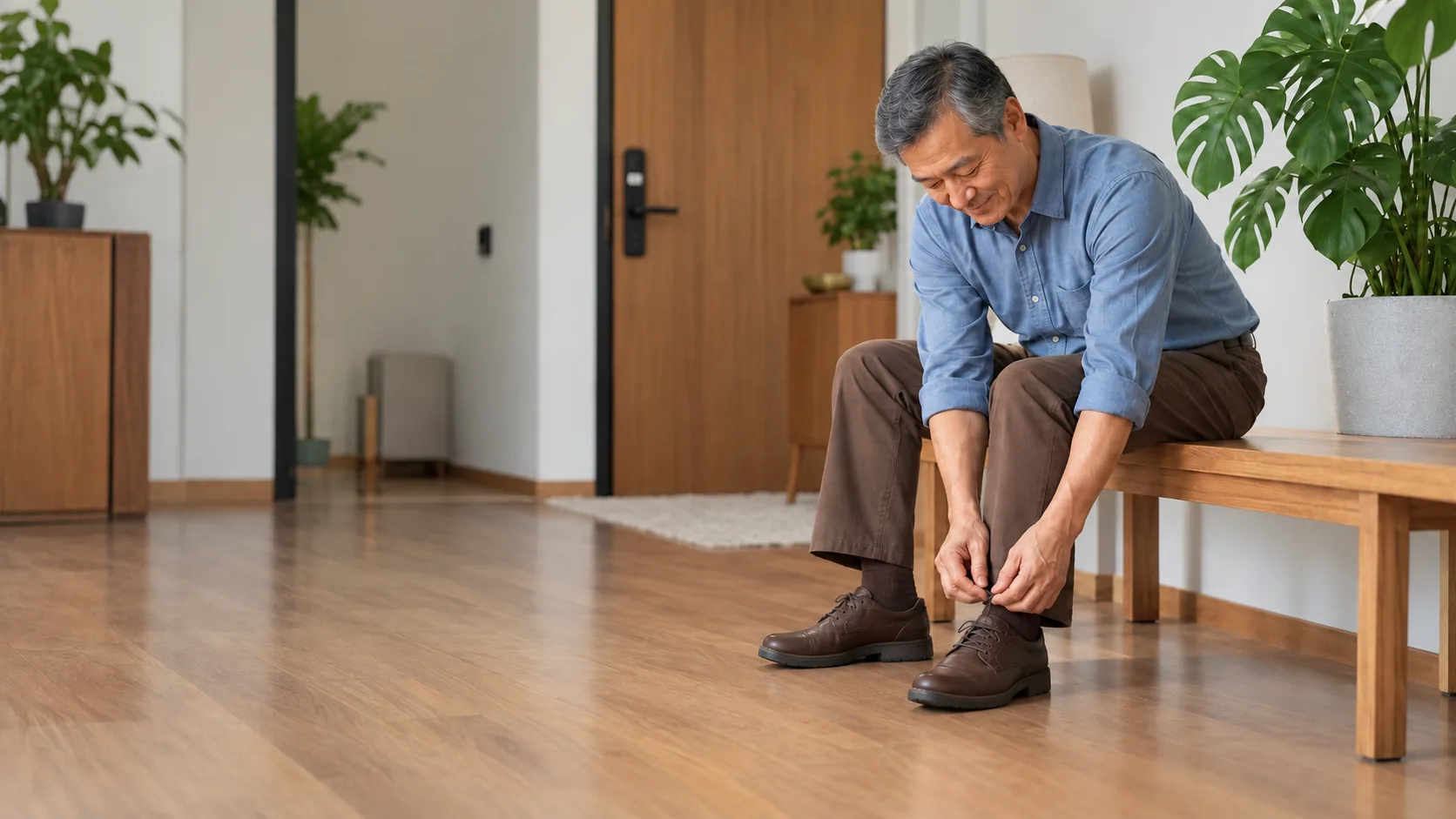
Illustrative image

Osteoarthritis of the hip is wear-and-tear arthritis of the hip joint.
Osteoarthritis of the hip is wear-and-tear arthritis of the hip joint.
Osteoarthritis of the hip is wear-and-tear arthritis of the hip joint.
- Osteoarthritis of the hip is wear-and-tear arthritis of the hip joint, where the smooth cartilage that cushions the joint thins and roughens over time, causing groin pain and stiffness.[1][2]
- Most people are managed without surgery. Regular exercise and a healthy weight are central, with pain relief as support, and surgery is one later option.[3]
- Osteoarthritis is common, and it varies a great deal from person to person.[1][2]
- OrthoKinetics is Dr Sean Leo’s professional brand. Clinical care is provided through OrthoSports Orthopaedic & Sports Surgery. Dr Sean Leo is a specialist orthopaedic surgeon who cares for hip problems.
What’s covered on this webpage
Follow the route in order, or jump to the stop you need. Stops you have read are marked.
The hip is a ball-and-socket joint lined with smooth cartilage.
The hip is a ball-and-socket joint lined with smooth cartilage.
The hip is a ball-and-socket joint lined with smooth cartilage.
The hip is one of the body’s largest joints. It is a ball-and-socket joint. The ball is the femoral head, the upper end of the thighbone, and the socket is the acetabulum, which is part of the large pelvis bone.[1]
Smooth, protective cartilage covers the ends of the bones.[2] It is this cartilage that wears away in osteoarthritis.[1]

The cartilage gradually wears away, and the joint becomes painful and stiff.
The cartilage gradually wears away, and the joint becomes painful and stiff.
The cartilage gradually wears away, and the joint becomes painful and stiff.
In osteoarthritis, the cartilage in the hip joint gradually wears away over time. As it wears, it becomes frayed and rough, and the protective joint space between the bones decreases. This can result in bone rubbing on bone.[1]
Osteoarthritis usually develops slowly, and the pain it causes tends to get worse over time. It does not necessarily always get worse, though.[1][3] “Wear and tear” is a familiar label for this, but it is shorthand and does not tell the whole story.[1]
Osteoarthritis has no single specific cause. Some things may make you more likely to develop it, including increasing age, a family history of osteoarthritis, and a previous injury to the hip joint. Obesity may also add to the risk, and being a woman is another factor.[1][2] The exact cause is not known.[2]
It usually starts with groin or thigh pain and stiffness.
It usually starts with groin or thigh pain and stiffness.
It usually starts with groin or thigh pain and stiffness.
The most common symptom of hip osteoarthritis is pain.[1] It is most often felt in the groin or thigh, and it can spread to the buttock or the knee.[1] Pain felt in the knee can therefore come from the hip.
Stiffness often goes with it. Pain and stiffness may be worse in the morning, or after sitting or resting for a while.[1] Osteoarthritis of the hip can make everyday activities harder, such as bending over to tie a shoe or rising from a chair.[1]
How much it affects you varies a great deal. For some people the symptoms are mild and come and go. Others have more continuous problems that make everyday activities difficult.[2]
These are typical patterns, not a checklist. Groin or thigh pain does not on its own tell you what is causing it.

Is this osteoarthritis, or could it be something else
Is this osteoarthritis, or could it be something else
Is this osteoarthritis, or could it be something else?
Hip pain does not always mean osteoarthritis. Wear-and-tear is one cause of hip arthritis. Loss of blood supply to the bone is a different problem with a different cause, and it is assessed separately. If that is your question, the hip hub points you to where it is covered.
A hip problem that starts after a fall or injury is a different situation again. Severe hip pain after a fall or injury, or being unable to walk or put weight on your leg, needs urgent attention, because a broken hip needs treatment in hospital straight away.[4][5] The hip fracture page covers that.
Safety note: This webpage is not an emergency service. If you have severe hip pain after a fall or injury, or you cannot put weight on your leg, seek urgent medical care.[5]
Sorting out which cause applies is what an assessment is for. It cannot be done reliably from a description on a webpage.
When should I get this assessed?
When should I get this assessed?
When should I get this assessed?
Many people manage hip pain on their own for a while. Pain that keeps coming back, is getting worse, or is getting in the way of your daily activities is a reasonable reason to be assessed. So is being unsure what is causing it.

Assessment starts with the story and an examination.
Assessment starts with the story and an examination.
Assessment starts with the story and an examination.
A doctor can usually diagnose osteoarthritis from your symptoms and an examination. The story that points that way is pain that gets worse the more the joint is used, and morning stiffness that is short-lived, lasting less than about half an hour.[2] Stiffness that goes on longer in the morning can be a sign of a different joint condition, such as rheumatoid arthritis.[2]
X-rays and blood tests are not usually necessary. They may be used to rule out other possible causes.[2]

Most hip osteoarthritis is managed without surgery.
Most hip osteoarthritis is managed without surgery.
Most hip osteoarthritis is managed without surgery.
There is no cure for osteoarthritis, but there are a number of treatments to help relieve the symptoms.[3]
The main treatments fall into three groups. Lifestyle measures are one: maintaining a healthy weight and exercising regularly. Medication is used to relieve pain. Supportive therapies help make everyday activities easier.[3]
Exercise is one of the most important treatments for people with osteoarthritis, whatever your age or level of fitness.[3]
The three groups of treatment in a little more detail
- Lifestyle measures: maintaining a healthy weight and exercising regularly.[3]
- Medication: to relieve your pain.[3]
- Supportive therapies: to help make everyday activities easier.[3]
Which of these suits you depends on your own situation, and it is worked out at assessment.
When is surgery considered?
When is surgery considered?
When is surgery considered?
Surgery for osteoarthritis is only needed in a small number of cases, where other treatments have not been effective or where daily life is seriously affected.[3] Even then, surgery cannot be guaranteed to get rid of your symptoms altogether, and you may still have some pain and stiffness.[3]
Joint replacement, also known as arthroplasty, is most commonly done to replace hip and knee joints.[3] The hip replacement page covers that operation.
Structure / Patient / Goal
Structure / Patient / Goal
Deciding together
Structure / Patient / Goal
S
Structure: what is affected?
Structure is the hip joint itself: its cartilage, how much the joint space has narrowed, and what the assessment shows.
P
Patient: how does it affect you?
Patient means you as a whole person. Your pain and stiffness, how active you are, your general health, your weight and your preferences all shape which options are reasonable.
G
Goal: what are you hoping to return to?
Goal is what matters to you, whether that is getting through the day more comfortably, keeping up the activities you enjoy, or something more specific. A useful plan starts from a clear purpose.
Your plan
No single factor decides the plan alone, and one scan or one symptom does not determine it.
Osteoarthritis is managed over time, and it does not always get worse.
Osteoarthritis is managed over time, and it does not always get worse.
Osteoarthritis is managed over time, and it does not always get worse.
There is no cure for osteoarthritis, but the condition does not necessarily get any worse over time.[3] It usually develops slowly, and the pain it causes tends to worsen over time. Both statements hold, and the course differs from person to person.[1][2][3]
For some people the symptoms stay mild and come and go. Others have more continuous problems.[2] Exercise is one of the most important treatments whatever your age or level of fitness, so staying active is part of the plan.[3]

Treatment relieves symptoms; there is no cure.
Treatment relieves symptoms; there is no cure.
Treatment relieves symptoms; there is no cure.
The treatments for osteoarthritis are there to relieve symptoms.[3] There is no cure for it.[3]
The condition can also get worse over time, and the pain tends to worsen.[1] Symptoms vary greatly from person to person.[2]
Surgery has its own limits, which are covered in the surgery section above.

OrthoKinetics Recovery Reflection
Recovery reflection
What changes when a condition has no finish line?
Many health problems come with an ending in mind: the fracture heals, the operation is done, the season starts again. Osteoarthritis is managed over time instead, so waiting for it to be over can mean waiting indefinitely. A different question gives you something to act on today: what would you like your days to make room for?
How much of your attention does a long-term condition need?
A long-term condition asks for regular attention, and it does not need all of it. It can help to decide how much it gets, and to keep the rest for everything else in your life.
A condition with no finish line still leaves room for a full week.
Illustrative image

 With you through the seasons
Meet Dr Sean Leo
Meet Dr Sean Leo
A consultant orthopaedic surgeon whose clinical focus is the knee, sports injuries and the lower limb.
- Dr Sean Leo is a consultant orthopaedic surgeon. OrthoKinetics is his professional brand; clinical services are provided through OrthoSports Orthopaedic & Sports Surgery at Mount Elizabeth Novena Specialist Centre and Connexion, Farrer Park Hospital.
- His clinical interests include sports injuries, including those in adolescent athletes; ligament reconstruction; realignment surgery; cartilage repair and joint-preservation approaches; knee replacement; and technology-assisted hip and knee surgery.
- The consistent aim is to return people to meaningful function and activity while avoiding unnecessary downtime.
- Qualifications: MBBS, MRCS (Ed), MMed (Ortho), FRCSEd (Ortho).
More detail: Meet Dr Sean Leo
- Training and career: Dr Leo trained in medicine at the National University of Singapore and served in the Singapore Armed Forces Medical Corps from 2000 to 2012, where his work included the care of soldiers in physically demanding roles. He completed postgraduate orthopaedic training in 2009 and a one-year clinical fellowship at Royal North Shore Hospital in Sydney, Australia, before joining Changi General Hospital as an orthopaedic consultant in 2012, where he later held the positions of Senior Consultant and Director of the Hip and Knee Service. With seniority, his educational contribution has evolved towards mentorship and support for junior doctors.

Questions people often ask
Common hip osteoarthritis questions
Common hip osteoarthritis questions
What is osteoarthritis of the hip?
Osteoarthritis of the hip is wear-and-tear arthritis of the hip joint. The smooth cartilage that cushions the joint gradually wears away, becoming frayed and rough, and the joint becomes painful and stiff.[1][2]
Is my groin pain osteoarthritis of the hip?
Pain in the groin or thigh is the most common symptom of hip osteoarthritis, but it does not on its own tell you the cause. A doctor can usually diagnose osteoarthritis from your symptoms and an examination, so assessment is the way to find out.[1][2]
Can hip osteoarthritis be treated without surgery?
Yes, and most of it is. There is no cure, but a number of treatments help relieve the symptoms. Lifestyle measures such as a healthy weight and regular exercise are central, with pain-relief medication and supportive therapies alongside.[3]
What are the early signs of hip osteoarthritis?
It usually develops slowly. Pain, most often in the groin or thigh, together with stiffness that can be worse in the morning or after resting, is the typical pattern. Symptoms vary a lot from person to person.[1][2]
Is exercise good for hip osteoarthritis?
Exercise is one of the most important treatments for people with osteoarthritis, whatever your age or level of fitness. What suits you is worked out at assessment.[3]
What is wear-and-tear arthritis of the hip?
It is another name for osteoarthritis of the hip. The cartilage in the hip joint gradually wears away over time, although “wear and tear” is a shorthand rather than the full picture.[1]
When does hip osteoarthritis need surgery?
Only in a small number of cases: when other treatments have not been effective or when daily life is seriously affected. Even then, surgery cannot be guaranteed to get rid of your symptoms altogether.[3]
Costs and insurance
Costs and insurance
Practicalities
Cost, Medisave and insurance

Ask the clinic team for current information about fees, panel status, pre-authorisation and expected payment arrangements. Insurance coverage and out-of-pocket costs depend on the individual policy and the insurer’s decision; no coverage is guaranteed.
A cost estimate for surgery can be given only after a consultation and assessment, once a surgical plan has been developed. Each individual condition is unique — implants used, time taken, and other factors contribute to the overall estimate. The estimate will be provided to you by the clinic should you decide on surgical management, and will also be used to assist in obtaining pre-authorisation from insurance where applicable.
Insurance panels. Dr Sean Leo, Orthopaedic Surgeon, is on the specialist panels of Great Eastern (GE Panel), HSBC Life (HSBC Life Shield) and Singlife (Singlife Shield), and on the Prudential Panel. AXA Insurance Singapore became part of HSBC Life in 2023, and former AXA Shield plans are now HSBC Life Shield plans.
Corporate health plans. Dr Leo is on the panels of both Alliance Medinet and iXchange, which administer medical benefits for many company health plans. If your company plan uses either panel, you can see Dr Leo as a panel doctor.
If your company uses a different panel. Some company plans still let you see a doctor of your choice outside their panel, then claim reimbursement. This varies from plan to plan, as may the co-payment, so please check your benefits with your company’s HR department.
Panel arrangements change from time to time, so please confirm with your insurer or your company’s plan administrator before your appointment.
Dr Leo is on the panels shown. If your insurer is not listed, you may ask whether co-management with an Orthosports surgeon partner on that panel is clinically and administratively appropriate. Orthosports surgeon partners are collectively on the panels of all Shield plans.
Specific benefits, pre-authorisation, reimbursement and cashless treatment depend on the individual policy and insurer approval and are not guaranteed.
Arrange a consultation: the appointment section is further down this page.
Sources
References
References
- American Academy of Orthopaedic Surgeons (AAOS). Osteoarthritis of the Hip. OrthoInfo. Available at: https://orthoinfo.aaos.org/en/diseases–conditions/osteoarthritis-of-the-hip
- NHS. Osteoarthritis. Available at: https://www.nhs.uk/conditions/osteoarthritis/
- NHS. Osteoarthritis: Treatment and support. Available at: https://www.nhs.uk/conditions/osteoarthritis/treatment/ (last reviewed 20 March 2023)
- NHS. Broken hip. Available at: https://www.nhs.uk/conditions/broken-hip/ (last reviewed 29 July 2026)
- NHS. Hip pain in adults. Available at: https://www.nhs.uk/symptoms/hip-pain/ (last reviewed 20 November 2025)
Final next step
Final next step
Next step
Final next step
Reading about a problem is a starting point. An assessment brings together the history, an examination where needed and any useful tests, and helps you and your clinician decide what to do next. How much physical examination is needed is a matter of clinical judgement. It may be limited when pain makes an examination unreliable, or when imaging clearly shows a problem that matches the symptoms, such as a fracture seen on an X-ray or an MRI scan that clearly shows an injury consistent with the symptoms. The Singapore Medical Council and the UK General Medical Council both allow remote medical consultations, where a physical examination is not possible, with safeguards: the doctor must be clear about the limits of an opinion formed without an examination, and whether an in-person examination is needed, or referral to other services, is left to the clinical judgement of the attending doctor.
If a hip problem may need urgent attention, such as after a fall or if you cannot bear weight, seek urgent medical care.[5]
Was this page helpful?
Arrange a consultation
Appointments are arranged through the OrthoSports clinic team. Send your details below, or message or call the clinic.
Leave your details and the clinic team will reply to arrange a time.
Message the clinic on WhatsApp
-
38 Irrawaddy Road, #10-41 Mount Elizabeth Novena Specialist Centre, Singapore 329563 Map for Orthosports@Novena (opens Google Maps)
-
1 Farrer Park Station Road, #15-17 Connexion, Singapore 217562 Map for Orthosports@Connexion (opens Google Maps)
WhatsApp is for clinic enquiries only. It is not an emergency service and is not monitored for urgent care. Website or messaging contact is not an emergency-response service. For a medical emergency, use your local emergency service.
- OrthoKinetics does not provide emergency or urgent care through this webpage or its WhatsApp contact.