
Introduction
Shoulder care hub · Dr Sean Leo
Shoulder problems in Singapore: assessment and treatment options

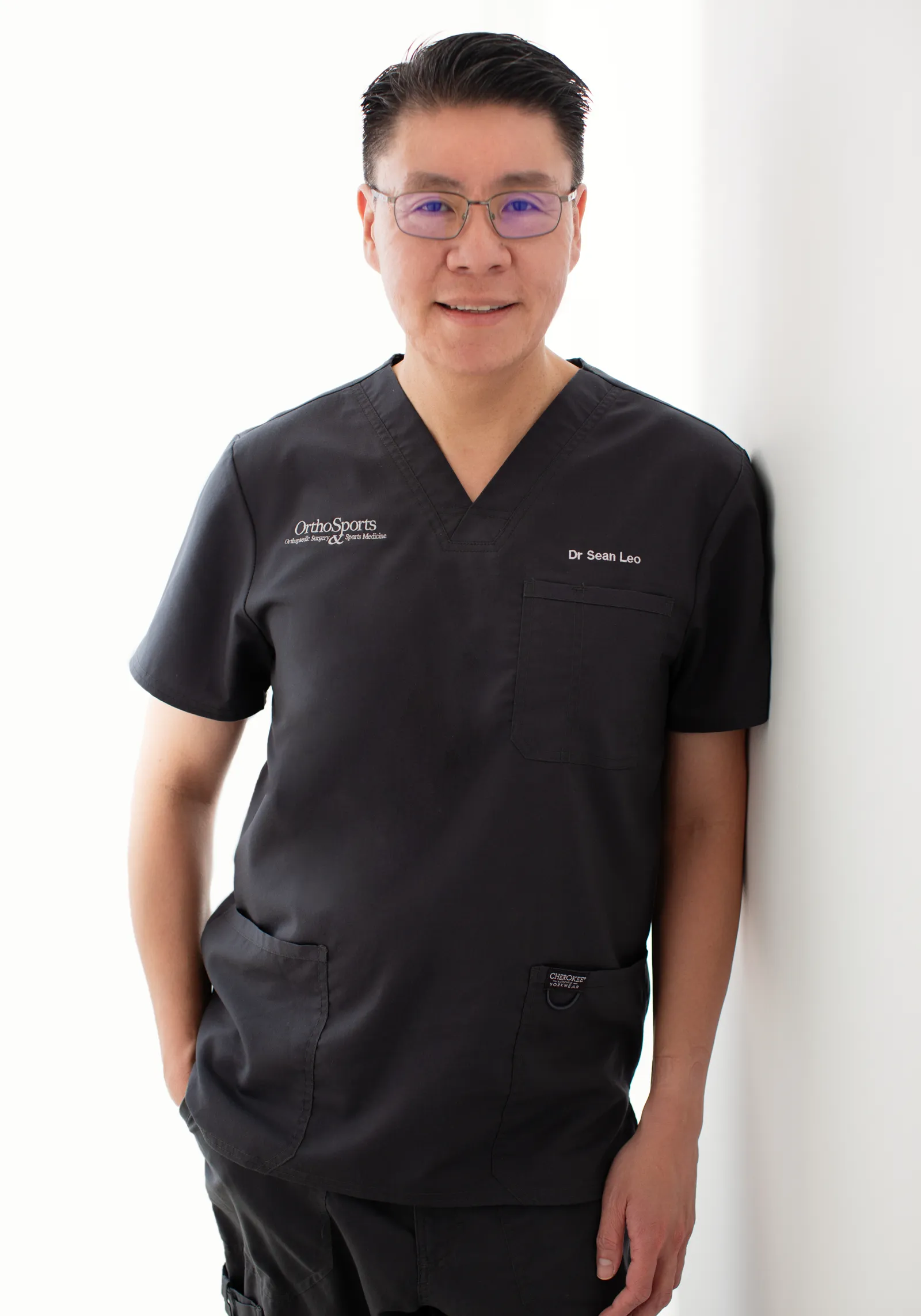
Dr Sean LeoOrthopaedic Surgeon, Singapore
Clinic enquiries · Not an emergency service
Illustrative image

Start here
Start here
Start here
Start by understanding the shoulder problem, not choosing a procedure.
Shoulder pain can come from more than one structure, and the same words, such as “shoulder pain”, can describe quite different problems. This page helps you describe the concern, understand how it is assessed and find relevant educational pathways without asking you to diagnose yourself.
Seeing a specialist orthopaedic surgeon about a shoulder problem does not mean surgery has already been decided. The purpose of assessment is to understand the problem and discuss reasonable options for your situation.
OrthoKinetics is Dr Sean Leo’s professional brand. Clinical consultations and treatment are provided through OrthoSports Orthopaedic & Sports Surgery.
What’s covered on this webpage
Follow the route in order, or jump to the stop you need. Stops you have read are marked.
When should a shoulder problem be assessed
When should a shoulder problem be assessed
When should a shoulder problem be assessed?
Routine assessment may help when a concern persists or limits movement
A shoulder problem may be worth assessing when it continues, recurs or limits your movement, work or sport. Describing what happened, how the shoulder behaves and what you can no longer do gives useful context.
Some concerns are decided by assessment, not by feel
Assessment includes screening for a rare serious cause, such as a tumour or infection, rather than assuming the problem is a common shoulder condition.[1]
A tear that happens suddenly, for example in a fall, usually causes intense pain. There may be a snapping sensation and immediate weakness in the upper arm.[2] A shoulder dislocation usually happens after an injury such as a fall or a motor vehicle collision.[3] Either is a reason to be seen promptly. Neither is something to work out from a web page.
Urgent concerns need an urgent-care route
- OrthoKinetics does not provide emergency or urgent care through this webpage or its WhatsApp contact.
The urgent-care guidance at the end of this page applies to the whole shoulder region.

What does a shoulder assessment look at
What does a shoulder assessment look at
What does a shoulder assessment look at?
Assessment brings together the history of the problem, examination of the shoulder and any tests that are useful for the question being considered. The exact assessment varies with the concern.
How the problem started and how it behaves
You may be asked when the problem began, whether a sudden injury started it or it built up gradually, and how it has behaved since. A fall or another injury points the assessment in a different direction from a slow build-up.
Movement and strength
Examination looks at how far the shoulder moves, both when you move it yourself (active movement) and when someone else moves it for you (passive movement), and at how strong it is.[1][2] Stiffness and weakness are different patterns. The difference helps point the assessment in the right direction, but it is worked out by examination, not by self-diagnosis.[1][4][2]
Imaging when it can answer a useful question
X-rays show bone clearly but not soft tissue such as the rotator cuff. MRI (magnetic resonance imaging) or ultrasound can show soft tissue, and they are used only when they can answer a useful question.[2] A scan is one part of an assessment; it does not select treatment by itself.
A simple assessment sequence
- Describe how the problem began and how it affects you.
- Examine movement and strength as relevant.
- Consider targeted tests only where they may add useful information.
- Discuss the working possibilities, reasonable options and uncertainty.
Use symptoms to describe the problem, not diagnose it.
Use symptoms to describe the problem, not diagnose it.
Use symptoms to describe the problem, not diagnose it.
Pain, stiffness, weakness and a snapping sensation are useful descriptions. They do not confirm which structure is responsible, and more than one concern may contribute to a person’s experience. It also helps to say which everyday movements are affected, such as reaching, lifting or carrying.
Pain
Shoulder pain is one of the most common physical complaints and can arise from several structures, including the rotator cuff tendons and muscles, and the bursa.[5] The word “pain” alone does not point to one of them. Describe where you feel it, when it appears, what changes it and how it limits you.
Stiffness (loss of movement)
Stiffness means the shoulder will not move as far as it should. In frozen shoulder (adhesive capsulitis), pain and loss of movement build up gradually, and movement is lost both when you move the arm yourself and when someone else moves it.[1][4] Stiffness is a description of what you notice. It does not tell you the cause.
Weakness
Weakness, for example when lifting or rotating the arm, is a common symptom of a rotator cuff tear.[2] Weakness and stiffness can overlap, and the two problems can occur together.
A snapping sensation
A snapping sensation in the upper arm, together with immediate weakness, can happen at the moment of a sudden tear from a fall.[2] Note exactly what you were doing and what changed afterwards. A snapping sensation is a signal to be assessed; it is not a diagnosis.

Shoulder pathways
Shoulder pathways
Pathways
Find the relevant shoulder pathway.
These links organise educational information by broad concern. Choosing a card does not confirm a diagnosis or mean that its treatment applies to you.
Where is the pain, and what might it point to?
This is a way of describing the problem, not a way of diagnosing it. Note where in the shoulder you feel the pain, whether it travels down the arm, and which movements or times of day bring it on. Pain felt at the shoulder can also come from somewhere else, the neck included,[5] which is another reason the location alone does not decide the cause. The cards below organise information by broad concern; an examination is what links a pattern of symptoms to a structure.
As a broad pattern, frozen shoulder is mainly stiffness with loss of movement,[1][4] while a rotator cuff problem is mainly weakness with lifting or rotating.[2] The two are told apart by examination, not by reading a card.

Shoulder pain
Use this pathway for information about shoulder pain that can arise from several structures — the rotator cuff, the bursa or the neck.[5] Reading it cannot confirm which structure is causing your pain.

Frozen shoulder (adhesive capsulitis)
Use this pathway for information about gradual, progressive shoulder stiffness and loss of movement, and how it is assessed and managed. Reading it cannot confirm that you have frozen shoulder (adhesive capsulitis).
Understand frozen shoulder (adhesive capsulitis) and treatment options

Rotator cuff tear
Use this pathway for information about shoulder weakness and a possible rotator cuff tear, and the treatment options, which usually begin without surgery. Reading it cannot confirm that you have a tear.

Shoulder dislocation and instability
Use this pathway for information about a shoulder that has come out of joint, usually after an injury, and how instability is managed. Reading it cannot confirm that your shoulder has dislocated.

Shoulder impingement
Use this pathway for information about shoulder pain that comes on when you raise your arm, where the tendons and bursa near the top of the shoulder can become irritated (impingement). Some people know this as a bone spur problem. Reading it cannot confirm that your symptoms are impingement.
Understand shoulder impingement and treatment options
Related pages: the knee hub for knee concerns and the sports injury hub for injuries that happen in sport.

What tests can and cannot show
What tests can and cannot show
What tests can and cannot show
Tests can add information to a shoulder assessment, but no universal sequence applies to every person. Findings need to be considered alongside the history, examination and goals before treatment is discussed.
X-ray, MRI and ultrasound
X-rays give clear images of bone. They do not show soft tissues such as the rotator cuff, so a plain X-ray of a shoulder with rotator cuff pain is usually normal.[2] A normal X-ray therefore does not rule out a rotator cuff problem.
MRI or ultrasound can show soft tissues such as the rotator cuff tendons, including the location and size of a tear.[2] Ultrasound can be quicker to arrange than MRI, but how accurately it diagnoses a rotator cuff tear depends on the quality of the person performing the scan.[2] This applies to the rotator cuff. It should not be read as a rule for every shoulder condition.
No single test decides treatment
A scan shows what is there. It does not decide what to do about it. That depends on the whole assessment.
Treatment follows the diagnosis and the person.
Treatment follows the diagnosis and the person.
Treatment follows the diagnosis and the person.
A treatment discussion should compare reasonable non-operative and operative options where relevant. The choice depends on the problem, the person and the purpose of treatment; specialist review does not imply surgery.
Frozen shoulder (adhesive capsulitis)
Most people with frozen shoulder improve with relatively simple treatments to control pain and restore motion.[4] It generally gets better over time without surgery, although it may take up to 3 years.[4] Improvement is often incomplete, and much of it happens early.[6] The idea that frozen shoulder always resolves fully on its own is not supported by the evidence.[6] A guideline notes that at 12 to 18 months, mild to moderate stiffness and pain may persist, although many people report little or no disability.[1]
Rotator cuff tear
In about 80 to 85% of patients, nonsurgical treatment relieves pain and improves function in the shoulder, according to the American Academy of Orthopaedic Surgeons (AAOS) patient guidance. That figure is approximate.[2] Surgery may be recommended if pain does not improve with nonsurgical methods. It may also be considered in specific situations, such as a large tear where the surrounding tissue is of good quality, significant weakness and loss of function, or a recent acute injury.[2]
Other problems
Treatment for a shoulder dislocation or for shoulder impingement depends on the assessment. The pathway pages explain the choices for each condition.

Structure / Patient / Goal
Structure / Patient / Goal
Deciding together
Structure / Patient / Goal
S
Structure: what is affected?
Structure covers the diagnosis and the condition of the relevant bone, joint, tendon, muscle or other tissue. It includes what the assessment shows and what a test adds when testing is useful.
P
Patient: how does it affect you?
Patient means you as a whole person. Symptoms, health, function, preferences and practical circumstances can affect which options are reasonable.
G
Goal: what are you hoping to return to?
Goal describes what matters to you, such as daily independence, work, recreation or sport. A useful plan needs a clear purpose.
Your plan
Structure / Patient / Goal helps organise benefits, burdens, limitations and uncertainty, without suggesting that one scan, one symptom or motivation alone can determine the outcome.

Rehabilitation, repair and stabilisation describe different aims.
Rehabilitation, repair and stabilisation describe different aims.
Rehabilitation, repair and stabilisation describe different aims.
These are not steps in a mandatory ladder. They describe different treatment purposes, and not every shoulder concern fits neatly into one category. Repair and stabilisation are separate discussions, not the automatic next step after rehabilitation.
Rehabilitation: restoring movement and function
Rehabilitation is the non-operative mainstay of care. For frozen shoulder, the aim is to control pain and restore motion.[4] For a rotator cuff tear, nonsurgical treatment aims to relieve pain and improve function.[2] Rehabilitation is often where treatment starts, not a step down from something else.
Repair: when a torn structure needs restoring
Repair means surgery to restore a torn structure. For a rotator cuff tear it may be recommended if pain does not improve with nonsurgical methods, or in specific situations such as a large tear where the surrounding tissue is of good quality, or a recent acute injury.[2] It is a separate decision, not the automatic next step.
Stabilisation: keeping the joint in position
The shoulder is the most mobile joint in the human body.[3] The labrum runs around the edge of the shoulder socket and acts as a bumper that helps hold the bones in the proper position.[3] Stabilisation is about the stability of the joint. How it is best restored after a dislocation is a question for assessment and is covered on the dislocation pathway page.
Age alone does not decide which aim applies.
Technology supports a plan; it does not replace one.
Technology supports a plan; it does not replace one.
Technology supports a plan; it does not replace one.
Any technology used in shoulder care supports a treatment plan rather than replacing one. A scan or any other tool does not decide what happens next; the assessment and the plan do. Technology is not presented as better for every patient.

What happens next?
What happens next?
What happens next?
Prepare for a shoulder assessment
Bring relevant reports or images if you have them, details of previous treatment and a current medicine list. Consider noting which everyday movements matter most and what you want to understand.
Billing and insurance questions
Ask the clinic team for current information about fees, panel status, pre-authorisation and expected payment arrangements. Insurance coverage and out-of-pocket costs depend on the individual policy and the insurer’s decision; no coverage is guaranteed.
A cost estimate for surgery can be given only after a consultation and assessment, once a surgical plan has been developed. Each individual condition is unique — implants used, time taken, and other factors contribute to the overall estimate. The estimate will be provided to you by the clinic should you decide on surgical management, and will also be used to assist in obtaining pre-authorisation from insurance where applicable.

Insurance panels. Dr Sean Leo, Orthopaedic Surgeon, is on the specialist panels of Great Eastern (GE Panel), HSBC Life (HSBC Life Shield) and Singlife (Singlife Shield), and on the Prudential Panel. AXA Insurance Singapore became part of HSBC Life in 2023, and former AXA Shield plans are now HSBC Life Shield plans.
Corporate health plans. Dr Leo is on the panels of both Alliance Medinet and iXchange, which administer medical benefits for many company health plans. If your company plan uses either panel, you can see Dr Leo as a panel doctor.
If your company uses a different panel. Some company plans still let you see a doctor of your choice outside their panel, then claim reimbursement. This varies from plan to plan, as may the co-payment, so please check your benefits with your company’s HR department.
Panel arrangements change from time to time, so please confirm with your insurer or your company’s plan administrator before your appointment.
Dr Leo is on the panels shown. If your insurer is not listed, you may ask whether co-management with an Orthosports surgeon partner on that panel is clinically and administratively appropriate. Orthosports surgeon partners are collectively on the panels of all Shield plans.
Specific benefits, pre-authorisation, reimbursement and cashless treatment depend on the individual policy and insurer approval and are not guaranteed.
OrthoSports appointment route
Arrange a consultation: the appointment section is further down this page.

 With you through the seasons
Meet Dr Sean Leo
Meet Dr Sean Leo
A consultant orthopaedic surgeon whose clinical focus is the knee, sports injuries and the lower limb.
- Dr Sean Leo is a consultant orthopaedic surgeon. OrthoKinetics is his professional brand; clinical services are provided through OrthoSports Orthopaedic & Sports Surgery at Mount Elizabeth Novena Specialist Centre and Connexion, Farrer Park Hospital.
- His clinical interests include sports injuries, including those in adolescent athletes; ligament reconstruction; realignment surgery; cartilage repair and joint-preservation approaches; knee replacement; and technology-assisted hip and knee surgery.
- The consistent aim is to return people to meaningful function and activity while avoiding unnecessary downtime.
- Qualifications: MBBS, MRCS (Ed), MMed (Ortho), FRCSEd (Ortho).
More detail: Meet Dr Sean Leo
- Training and career: Dr Leo trained in medicine at the National University of Singapore and served in the Singapore Armed Forces Medical Corps from 2000 to 2012, where his work included the care of soldiers in physically demanding roles. He completed postgraduate orthopaedic training in 2009 and a one-year clinical fellowship at Royal North Shore Hospital in Sydney, Australia, before joining Changi General Hospital as an orthopaedic consultant in 2012, where he later held the positions of Senior Consultant and Director of the Hip and Knee Service. With seniority, his educational contribution has evolved towards mentorship and support for junior doctors.

OrthoKinetics Recovery Reflection
Recovery reflection
What is it to lose the reach you never used to notice?
The shoulder rarely gets credit until it stops cooperating. Reaching to a high shelf, pulling on a coat, lifting a bag into the car, fastening something behind you: each is a small act of range that usually goes unnoticed. When the shoulder limits them, the change is felt in the texture of the day as much as in any particular movement.
Which everyday reach would you most like back?
Naming a specific movement gives the picture some shape. It might be washing your hair, reaching into a cupboard or carrying shopping. Knowing what reach matters most to you is a useful way to describe how the shoulder is affecting your life, and it helps keep the conversation about what counts to you.
Range at the shoulder is measured in ordinary reaching, and the reach you miss most is a good place to begin describing the problem.
Illustrative image

Questions people often ask
Common shoulder questions
Common shoulder questions
What causes shoulder pain?
Shoulder pain can arise from several structures, including the rotator cuff and the bursa, so the words “shoulder pain” do not point to one cause.[5] The pathway cards on this page organise information by broad concern. Choosing a card is navigation, not a diagnosis.
When should I see a specialist orthopaedic surgeon about shoulder problems?
A shoulder problem may be worth assessing when it continues, recurs or limits movement, work or sport. If you are concerned that a problem needs prompt attention, for example after a fall, use the urgent-care guidance at the end of this page rather than relying on this webpage or its WhatsApp contact.
Is my shoulder pain coming from my neck?
Pain felt at the shoulder can sometimes have a source elsewhere, including the neck.[5] This page cannot tell you which it is. Working that out is part of assessment, and it is one reason the assessment looks at the whole picture and not the shoulder alone.
What is the difference between frozen shoulder (adhesive capsulitis) and a rotator cuff tear?
Frozen shoulder (adhesive capsulitis) comes on gradually as pain and stiffness, with loss of movement both when you move the arm and when someone else moves it.[1][4] A rotator cuff tear more often shows as weakness when lifting or rotating the arm.[2] The two can overlap, and the difference is settled by examination.
Do I need surgery for a rotator cuff tear?
Often the starting point is non-operative treatment. In about 80 to 85% of patients, nonsurgical treatment relieves pain and improves function, according to AAOS patient guidance, and that figure is approximate.[2] Surgery is considered in specific situations. The rotator cuff tear page explains the choices in more detail.
How do I know if my shoulder is frozen?
Frozen shoulder (adhesive capsulitis) usually begins with gradually increasing pain and then loss of movement, and it is described in stages, often called freezing, frozen and thawing.[1][4] Stiffness alone does not confirm it. Examination does. The frozen shoulder (adhesive capsulitis) page gives more detail.
How long does shoulder recovery take?
It depends on the problem and the person, so no single timeline applies. For frozen shoulder (adhesive capsulitis), full recovery may take up to 3 years, and some stiffness may persist past a year.[1][4] Improvement is often incomplete, and much of it happens early.[6] The condition pages give more detail for each problem.
Is my shoulder dislocated or just strained?
A shoulder dislocation can be complete or partial and usually happens after an injury such as a fall or a motor vehicle collision.[3] Whether a shoulder is dislocated is decided by assessment, not by how it feels. If you think it may be, use the urgent-care guidance at the end of this page. The shoulder dislocation page gives more detail.
Sources
References
References
- Kelley MJ, Shaffer MA, Kuhn JE, et al. Shoulder Pain and Mobility Deficits: Adhesive Capsulitis. J Orthop Sports Phys Ther. 2013;43(5):A1-A31. doi:10.2519/jospt.2013.0302.
- American Academy of Orthopaedic Surgeons. Rotator Cuff Tears. OrthoInfo. https://www.orthoinfo.org/diseases–conditions/rotator-cuff-tears
- American Academy of Orthopaedic Surgeons. Shoulder Dislocation. OrthoInfo. https://www.orthoinfo.org/diseases–conditions/dislocated-shoulder
- American Academy of Orthopaedic Surgeons. Frozen Shoulder. OrthoInfo. https://www.orthoinfo.org/diseases–conditions/frozen-shoulder
- American Academy of Orthopaedic Surgeons. Shoulder Impingement/Rotator Cuff Tendinitis. OrthoInfo. https://www.orthoinfo.org/diseases–conditions/shoulder-impingementrotator-cuff-tendinitis
- Wong CK, Levine WN, Deo K, et al. Natural history of frozen shoulder: fact or fiction? A systematic review. Physiotherapy. 2017;103(1):40-47. PMID: 27641499. doi:10.1016/j.physio.2016.05.009.
Final next step
Final next step
Next step
Final next step
Reading about a problem is a starting point. An assessment brings together the history, an examination where needed and any useful tests, and helps you and your clinician decide what to do next. How much physical examination is needed is a matter of clinical judgement. It may be limited when pain makes an examination unreliable, or when imaging clearly shows a problem that matches the symptoms, such as a fracture seen on an X-ray or an MRI scan that clearly shows an injury consistent with the symptoms. The Singapore Medical Council and the UK General Medical Council both allow remote medical consultations, where a physical examination is not possible, with safeguards: the doctor must be clear about the limits of an opinion formed without an examination, and whether an in-person examination is needed, or referral to other services, is left to the clinical judgement of the attending doctor.
Signs that need urgent help
Some symptoms should not wait for a routine appointment. Each item below says where to go.
After an injury
- After a fall or other injury, the shoulder looks out of place or has changed shape, you cannot move your arm, or the shoulder is painful, bruised or swollen. Go to an emergency department or call 995.
- After an injury, the arm or hand is numb, tingling, cool to the touch, or has turned white or purple. Go to an emergency department or call 995.
- After a fall, you have intense pain, a snapping feeling and sudden weakness in your upper arm. Arrange a prompt assessment.
At any time
- A joint, such as the shoulder, is suddenly very painful, hot, red and swollen (redness may be harder to see on darker skin), especially with a fever or feeling generally unwell. Go to an emergency department or call 995.
- You have chest pain that feels tight or like squeezing, or chest pain that spreads to your arm, neck or jaw, or you have severe difficulty breathing. Go to an emergency department or call 995.
- Your shoulder symptoms come with fever, night sweats or weight loss. Arrange an urgent same-day assessment.
If you are admitted by the doctor at the urgent care centre of one of these private hospitals, the Parkway Pantai hospitals (Mount Elizabeth Orchard, Mount Elizabeth Novena, Gleneagles and Parkway East), Farrer Park Hospital and Thomson Medical Centre, you may ask for Dr Sean Leo to be your attending orthopaedic surgeon. If you are instead discharged and referred for orthopaedic follow-up, you may contact the clinic to arrange an appointment. Both are subject to the hospital’s admission processes and to Dr Leo’s availability.
Arrange a consultation
Appointments are arranged through the OrthoSports clinic team. Send your details below, or message or call the clinic.
Leave your details and the clinic team will reply to arrange a time.
Message the clinic on WhatsApp
-
38 Irrawaddy Road, #10-41 Mount Elizabeth Novena Specialist Centre, Singapore 329563 Map for Orthosports@Novena (opens Google Maps)
-
1 Farrer Park Station Road, #15-17 Connexion, Singapore 217562 Map for Orthosports@Connexion (opens Google Maps)
WhatsApp is for clinic enquiries only. It is not an emergency service and is not monitored for urgent care. Website or messaging contact is not an emergency-response service. For a medical emergency, use your local emergency service.
- OrthoKinetics does not provide emergency or urgent care through this webpage or its WhatsApp contact.