Introduction
Knee care · Front of the knee
Anterior knee pain (runner’s knee): what it means and where it comes from
Dr Sean Leo · Orthopaedic Surgeon (Specialist in Orthopaedic Surgery) · Clinical Interest: Knee Conditions, Injuries & SurgeryMBBS, MRCS (Ed), MMed (Ortho), FRCSEd (Ortho)
Written by Dr Sean Leo, a consultant orthopaedic surgeon whose clinical focus is the knee, sports injuries and the lower limb.
Last updated: 15 October 2026.

Dr Sean LeoOrthopaedic Surgeon, Singapore
Clinic enquiries · Not an emergency service
Illustrative image

Pain at the front of the knee has many names and several causes.
Pain at the front of the knee has many names and several causes.
Pain at the front of the knee has many names and several causes.
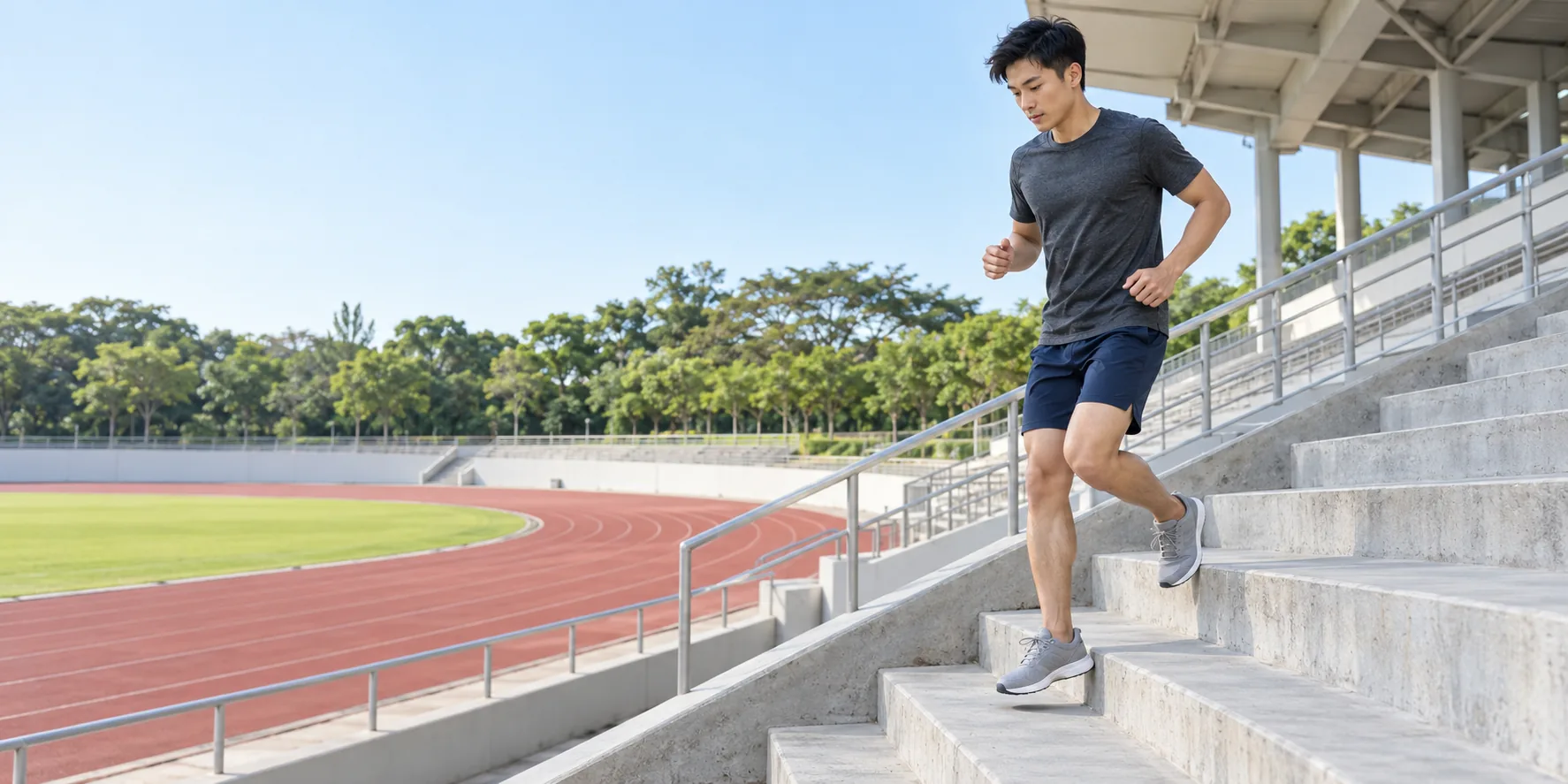
Pain around or behind the kneecap is often called runner’s knee. It usually comes on when a bent knee takes load, such as on stairs, in squats or after long sitting.[1] Care usually starts with load management and strengthening exercise.[1] An assessment separates the common causes from those that need specific treatment.
Describing your pain well is a real contribution to an assessment. Seeing an orthopaedic surgeon about your knee does not mean surgery has already been decided.
OrthoKinetics is Dr Sean Leo’s professional brand. Clinical consultations and treatment are provided through OrthoSports Orthopaedic & Sports Surgery.
What’s covered on this webpage
Follow the route in order, or jump to the stop you need. Stops you have read are marked.
Why does this pain have so many names
Why does this pain have so many names
Why does this pain have so many names?
“Anterior knee pain” is a place, not a condition. Anterior means front. The phrase covers pain at the front of the knee, whatever the cause.
“Runner’s knee” most often names patellofemoral pain, which is pain around and behind the kneecap.[3] People use the name loosely, though, and it may also be applied to other knee problems. The looseness is part of the story. It is not a mistake to be fixed.
Whatever the name, one pattern sits at the centre. The pain is around or behind the kneecap. It is worse with squatting, stairs, long sitting and after a rise in activity.[1] Patellofemoral pain is the most common cause of knee pain in adolescents and young adults.[1]
A familiar name is not a diagnosis. Three websites can give you three names for the same ache.

The front of the knee in brief
The front of the knee in brief
The front of the knee in brief
Several structures sit close together here. The kneecap (patella) glides in a groove at the end of the thigh bone.[3] Behind it is a smooth cartilage surface. Below it, the patellar tendon links the kneecap to the shin bone. Above it, the quadriceps tendon links the thigh muscles to the kneecap. In front lies a small fluid-filled cushion, the bursa.
Where front-of-knee pain comes from
Where front-of-knee pain comes from
Where front-of-knee pain comes from
Find where it hurts most. The table lists common sources and where each is covered. It routes you; it does not diagnose you.
| Where it hurts | What it can feel like | Where to read next |
|---|---|---|
| Just below the kneecap | Pain at the tendon between kneecap and shin, often after repeated running or jumping[2] | Patellar tendonitis |
| Just above the kneecap | Pain at the tendon that joins the thigh muscles to the kneecap | Quadriceps tendonitis |
| Around or behind the kneecap | Ache worse with stairs, squats and long sitting[1] | This page, and the kneecap pages if the knee slips or gives way |
| Behind the kneecap, surface | Softening of the cartilage behind the kneecap (chondromalacia patella)[3] | Cartilage repair surgery |
| Front of the knee, warm and swollen | A warm, red knee, worse with kneeling or bending, fits bursitis[2] | Assessment |
| A growing child or teenager | Front-of-knee pain in someone still growing | Assessment |
Below the kneecap
Pain just below the kneecap, between the kneecap and the shin, after repeated running or jumping fits a tendon problem.[2] That territory belongs to the patellar tendonitis page. Start there.
Above the kneecap
Pain just above the kneecap involves the tendon that joins the thigh muscles to the kneecap. The quadriceps tendonitis page covers it.
Around or behind the kneecap
This is patellofemoral pain, the pattern at the centre of runner’s knee. It is a clinical pattern, not a verdict on your cartilage. A clinician reaches it by combining your story with an examination and by considering other causes of front-of-knee pain.[1] The next section covers what usually helps.
If the kneecap has slipped out of its groove, or the knee gives way, the question changes. Read kneecap realignment surgery and MPFL reconstruction.
Softening of the cartilage behind the kneecap
Chondromalacia patella means softening of the cartilage under the kneecap.[3] What a cartilage finding means is decided at assessment, using imaging only where it can answer a useful question.[4] The cartilage repair surgery page covers the cartilage pathway.
A warm, swollen front of the knee
A warm, red knee that is worse with kneeling or bending fits bursitis, an irritated fluid-filled cushion.[2] This pattern is best examined in person.
A growing child or teenager
A child’s front-of-knee pain deserves an in-person look. Advice written for adults should not be applied to a growing knee. For general reading, see knee pain in children.
What usually helps patellofemoral pain
What usually helps patellofemoral pain
What usually helps patellofemoral pain?
Stairs and squats load the joint between the kneecap and the thigh bone more than walking on flat ground does.[3] That is why they tend to hurt first.
For patellofemoral pain, the main guideline points to an active approach. Education, adjusting activity and exercise for the hips and knees are the core.[1] Adjusting activity means changing what the knee is asked to do. It does not mean stopping for good. The guideline favours hip and knee strengthening over knee exercises alone (level B evidence).[1]
This evidence is about patellofemoral pain. It does not speak for every cause in the table above. A tendon problem or bursitis has its own care.
The guideline also notes that symptoms can recur and persist for years.[1] That is worth knowing early. It is why steady, progressed strengthening matters more than a quick fix.
Surgery is a different conversation. It is considered for specific kneecap tracking or instability problems, which have their own pages. It is not the starting point for ordinary front-of-knee pain.
Runners often ask whether running causes arthritis. The article Does running cause knee arthritis? sets out the evidence.
Why not give an exercise plan here?
The right exercises depend on which source is behind your pain, and on how your hips and knees move. An assessment answers that for your knee.
When should front-of-knee pain be assessed
When should front-of-knee pain be assessed
When should front-of-knee pain be assessed?
Front-of-knee pain is worth assessing when it continues, recurs or limits ordinary movement, work or sport. Describing what you feel, what brings it on and what you can no longer do is a good starting point.[4]
Safety note: Swelling, giving way, a knee that locks, or being unable to put weight on the leg should not wait for a routine visit. The urgent-signs list at the foot of this page says which signs need same-day or emergency care.
What can tests and scans show?
What can tests and scans show?
What can tests and scans show?
An assessment brings together your history, an examination and imaging. Imaging is used only when it can answer a useful question. A scan alone never selects treatment.[4]
Structure / Patient / Goal
Structure / Patient / Goal
Deciding together
Structure / Patient / Goal
Choosing what to do about knee pain, including whether to be assessed, is organised around three questions: the structure, the patient and the goal.
S
Structure: what is affected?
Structure covers the diagnosis and the condition of the relevant joint or tissue. It includes what the assessment shows and what a test adds when testing is useful.
P
Patient: how does it affect you?
Patient means you as a whole person. Symptoms, health, function, preferences and practical circumstances can affect which options are reasonable.
G
Goal: what are you hoping to return to?
Goal describes what matters to you, such as daily independence, work, recreation or sport. For front-of-knee pain, the goal may be relief, a return to running or stairs without pain, or simply knowing what the name means.
Your plan
Structure / Patient / Goal helps organise benefits, burdens, limitations and uncertainty. No single scan, symptom or motivation determines the outcome alone.
What happens next?
What happens next?
What happens next?
| If your description sounds like | Read next |
|---|---|
| Pain just below the kneecap | Patellar tendonitis |
| Pain just above the kneecap | Quadriceps tendonitis |
| A kneecap that slips or a knee that gives way | Kneecap realignment surgery; MPFL reconstruction |
| Cartilage behind the kneecap | Cartilage repair surgery |
| Knee pain in other places | Knee pain by location |
| Runner injuries in general | Common running injuries |
| Clicking and cracking | Popping or cracking in your knee |
| A child’s knee pain | Knee pain in children |
| All other knee problems | Knee Hub |
Choosing a route is navigation, not a diagnosis. If a sign in the urgent-signs list applies to you, use that list instead.
OrthoKinetics Recovery Reflection
Recovery reflection
How precisely can you describe your pain?
Naming a pain well is a skill. Where does it sit? What brings it on? What does it stop you doing? A knee that is described clearly is understood sooner. Try writing three plain sentences before an appointment. The words you choose are useful long before a label arrives.
Illustrative image

 With you through the seasons
Meet Dr Sean Leo
Meet Dr Sean Leo
A consultant orthopaedic surgeon whose clinical focus is the knee, sports injuries and the lower limb.
- Dr Sean Leo is a consultant orthopaedic surgeon. OrthoKinetics is his professional brand; clinical services are provided through OrthoSports Orthopaedic & Sports Surgery at Mount Elizabeth Novena Specialist Centre and Connexion, Farrer Park Hospital.
- His clinical interests include sports injuries, including those in adolescent athletes; ligament reconstruction; realignment surgery; cartilage repair and joint-preservation approaches; knee replacement; and technology-assisted hip and knee surgery.
- The consistent aim is to return people to meaningful function and activity while avoiding unnecessary downtime.
- Qualifications: MBBS, MRCS (Ed), MMed (Ortho), FRCSEd (Ortho).
More detail: Meet Dr Sean Leo
- Training and career: Dr Leo trained in medicine at the National University of Singapore and served in the Singapore Armed Forces Medical Corps from 2000 to 2012, where his work included the care of soldiers in physically demanding roles. He completed postgraduate orthopaedic training in 2009 and a one-year clinical fellowship at Royal North Shore Hospital in Sydney, Australia, before joining Changi General Hospital as an orthopaedic consultant in 2012, where he later held the positions of Senior Consultant and Director of the Hip and Knee Service. With seniority, his educational contribution has evolved towards mentorship and support for junior doctors.

Questions people often ask
Common anterior knee pain questions
Common anterior knee pain questions
Can I run with runner’s knee?
The guideline favours adjusting activity over stopping for good.[1] How much running suits your knee depends on the source of your pain, and an assessment can answer that.
How long does runner’s knee take to heal?
No single timeline fits everyone. The guideline notes that symptoms can recur and persist for years.[1] An assessment can give a view for your knee.
Do braces help runner’s knee?
Whether a brace suits you is a question for an assessment. It depends on what is causing the pain.
What is chondromalacia patella?
Chondromalacia patella means softening of the cartilage under the kneecap.[3] Whether it is present, and what it means for your knee, is decided at assessment.
Why does the front of my knee hurt on stairs?
Stairs load the joint between the kneecap and thigh bone more than flat walking does.[3] Weak hip or thigh muscles and past injuries can also contribute.[3]
Should a child’s front-of-knee pain be checked?
Yes. A growing child’s knee deserves an in-person look rather than adult advice.

Costs and insurance
Costs and insurance
Practicalities
Cost, MediSave and insurance

A cost estimate for surgery can be given only after a consultation and assessment, once a surgical plan has been developed. A surgical estimate separates surgeon, anaesthetist, hospital or facility, implant and consumable costs, and the MOH publishes national fee benchmarks for common procedures. For how costs, MediSave and insurance work in Singapore, see Costs, insurance and MediSave, explained.
Insurance panels. Dr Sean Leo, Orthopaedic Surgeon, is on the specialist panels of Great Eastern (GE Panel), HSBC Life (HSBC Life Shield) and Singlife (Singlife Shield), and on the Prudential Panel. AXA Insurance Singapore became part of HSBC Life in 2023, and former AXA Shield plans are now HSBC Life Shield plans.
Corporate health plans. Dr Leo is on the panels of both Alliance Medinet and iXchange, which administer medical benefits for many company health plans. If your company plan uses either panel, you can see Dr Leo as a panel doctor.
If your company uses a different panel. Some company plans still let you see a doctor of your choice outside their panel, then claim reimbursement. This varies from plan to plan, as may the co-payment, so please check your benefits with your company’s HR department.
Panel arrangements change from time to time, so please confirm with your insurer or your company’s plan administrator before your appointment.
Dr Leo is on the panels shown. If your insurer is not listed, you may ask whether co-management with an Orthosports surgeon partner on that panel is clinically and administratively appropriate. Orthosports surgeon partners are collectively on the panels of all Shield plans.
Benefits, pre-authorisation, letters of guarantee, panel rules and reimbursement depend on your individual policy and the insurer’s decision. Neither panel status nor co-management guarantees coverage, approval or cashless treatment.
The clinic team can assist with claim paperwork, including personal accident, hospitalisation or travel claims from other insurers, but cannot promise the outcome.
To book, use the appointment section at the end of this page.
Arrange a consultation: the appointment section is further down this page.
Sources
References
References
- Willy RW, Hoglund LT, Barton CJ, et al. Patellofemoral Pain: Clinical Practice Guidelines Linked to the International Classification of Functioning, Disability and Health. J Orthop Sports Phys Ther. 2019;49(9):CPG1-CPG95. PMID 31475628. DOI 10.2519/jospt.2019.0302
- NHS. Knee pain. https://www.nhs.uk/symptoms/knee-pain/
- Leo S. Knee pain climbing stairs? (Here’s what your body is telling you). OrthoKinetics video, 7 August 2025. https://orthokinetics.sg/videos/knee-pain-climbing-stairs-heres-what-your-body-is-telling-you/
- OrthoKinetics. Orthopaedic knee care in Singapore: assessment and treatment options. https://orthokinetics.sg/knee-specialist-singapore/
Final next step
Final next step
Next step
Final next step
Reading about a problem is a starting point. An assessment brings together the history, an examination where needed and any useful tests, and helps you and your clinician decide what to do next. How much physical examination is needed is a matter of clinical judgement. It may be limited when pain makes an examination unreliable, or when imaging clearly shows a problem that matches the symptoms, such as a fracture seen on an X-ray or an MRI scan that clearly shows an injury consistent with the symptoms. The Singapore Medical Council and the UK General Medical Council both allow remote medical consultations, where a physical examination is not possible, with safeguards: the doctor must be clear about the limits of an opinion formed without an examination, and whether an in-person examination is needed, or referral to other services, is left to the clinical judgement of the attending doctor.
Signs that need urgent help
Some symptoms should not wait for a routine appointment. Each item below says where to go.
After an injury
- The kneecap has slipped out of place and is still out, or the knee looks deformed. Go to an emergency department. If the kneecap went back into place by itself, arrange an early assessment.
- The leg looks twisted or bent, a bone is showing, there is a deep cut, or the foot or leg turns cold, pale, numb, blue or white. Go to an emergency department or call 995.
- You cannot lift your leg up with the knee kept straight, and you may feel a gap just above or just below the kneecap. Arrange an urgent same-day assessment.
At any time
- The knee is stuck and will not straighten, or it is very painful and you cannot move it or put weight on it. Arrange an urgent same-day assessment.
- The knee is suddenly very painful, hot, red and swollen, especially with a fever or feeling generally unwell. Go to an emergency department or call 995.
- One calf or thigh is newly painful and swollen. Arrange an urgent same-day assessment. If you also feel short of breath or have chest pain, call 995.
After knee surgery
- The operated knee becomes more painful, swollen or red, a wound is leaking, or you develop a fever. Contact your surgical team straight away. If you cannot reach them the same day, go to an emergency department. If you feel very unwell, go to an emergency department. If you are short of breath or have chest pain, call 995.
If you are admitted by the doctor at the urgent care centre of one of these private hospitals, the Parkway Pantai hospitals (Mount Elizabeth Orchard, Mount Elizabeth Novena, Gleneagles and Parkway East), Farrer Park Hospital and Thomson Medical Centre, you may ask for Dr Sean Leo to be your attending orthopaedic surgeon. If you are instead discharged and referred for orthopaedic follow-up, you may contact the clinic to arrange an appointment. Both are subject to the hospital’s admission processes and to Dr Leo’s availability.
Was this page helpful?
Arrange a consultation
Appointments are arranged through the OrthoSports clinic team. Send your details below, or message or call the clinic.
Leave your details and the clinic team will reply to arrange a time.
Message the clinic on WhatsApp
-
38 Irrawaddy Road, #10-41 Mount Elizabeth Novena Specialist Centre, Singapore 329563 Map for Orthosports@Novena (opens Google Maps)
-
1 Farrer Park Station Road, #15-17 Connexion, Singapore 217562 Map for Orthosports@Connexion (opens Google Maps)
WhatsApp is for clinic enquiries only. It is not an emergency service and is not monitored for urgent care. Website or messaging contact is not an emergency-response service. For a medical emergency, use your local emergency service.
- OrthoKinetics does not provide emergency or urgent care through this webpage or its WhatsApp contact.