Introduction
Sports injuries · Recovery after surgery
Post-Surgery Recovery: What Recovery Involves
Specialist orthopaedic surgeon · sports injuries
Dr Sean LeoOrthopaedic Surgeon, Singapore
Clinic enquiries · Not an emergency service
Illustrative image

Recovery after surgery is more than the time it takes to heal.
Recovery after surgery is more than the time it takes to heal.
Recovery
Recovery after surgery is more than the time it takes to heal.
- Post-surgery recovery, the period of getting back to normal after an orthopaedic or sports operation, brings together rehabilitation, eating, rest and rebuilding confidence, on top of the body’s own healing.[1][7][8]
- It moves in stages, and it is individual. When you return to work, driving or sport is judged on how you are doing, not on a calendar date.[7][10]
- Your surgeon’s instructions for your own operation come first. This page describes recovery in general terms, and each procedure has its own page, reachable from the recovery hub. Reading it cannot tell you your own recovery path.[6]
- Dr Sean Leo is a specialist orthopaedic surgeon who cares for sports injuries. OrthoKinetics is Dr Sean Leo’s professional brand. Clinical consultations and treatment are provided through OrthoSports Orthopaedic & Sports Surgery. Seeing a specialist orthopaedic surgeon about a sports injury does not mean surgery has already been decided.
What’s covered on this webpage
Follow the route in order, or jump to the stop you need. Stops you have read are marked.
When should you get help during recovery
When should you get help during recovery
When should you get help during recovery?
Your care team is your first contact when something about your recovery worries you. That means your surgeon or the healthcare team who gave you your discharge instructions. Before you leave hospital, make sure you understand the signs of complications such as infection or blood clots, and know how to reach your team quickly if you notice any of them.[6]
The signs of the two main post-surgical complications are described where they belong: wound infection and blood clots. In both cases, the route is the same: contact your care team promptly.[6][9]
Safety note: This webpage is not an emergency or urgent-care service, and reading it cannot tell you whether something is wrong. If something feels wrong, contact your care team promptly. For a new injury that may need urgent attention, see the Final next step.
If you are trying to work out whether a new injury is a broken bone or a sprain, the fractures and sprains page explains the difference.

Recovery is more than healing time.
Recovery is more than healing time.
Recovery
Recovery is more than healing time.
It is natural to think of recovery as waiting for the wound to heal. Healing is part of it. But recovery also draws on rehabilitation, on eating early after surgery, on rest, and on the psychological and social side of getting back to normal. The mix is different for every person.[1][7][8]
| Part of recovery | What it covers | In plain terms |
|---|---|---|
| Rehabilitation | Movement and exercise, guided by your surgeon and often a physiotherapist | Builds strength and helps function return[1][4][8] |
| Nutrition | Eating after surgery | Eating early supports wound healing and the return of muscle function[8] |
| Rest | Tiredness and pacing | Feeling very tired at first is normal, and activity returns gradually[1] |
| Confidence | Psychological and social factors | These can influence how a return to activity goes[7] |
A slower recovery is not a sign of too little effort. Recovery is shaped by many things, and only some of them are within your control.[7]
Recovery moves through stages.
Recovery moves through stages.
Recovery
Recovery moves through stages.
Recovery after surgery is a structured, staged process. It begins with preparation before the operation, continues through the time immediately after it, and carries on into rehabilitation.[8] Moving early and eating early are part of how recovery is helped along.[1][8]
Feeling very tired when you first get home is normal, especially after a major operation or a general anaesthetic. Activity then returns gradually, following your doctor’s advice on getting active again.[1]
These stages are a way of understanding recovery. They are not a timetable. Each procedure has its own staged protocol, covered in depth on its own page.
Recovery sections on the procedure pages
Recovery organised by your type of surgery:
- Recovery after surgery, by type of operation
- Preparing for surgery
- Knee ligament reconstruction recovery
- Meniscus and arthroscopy recovery
- Knee replacement recovery
- Cartilage repair recovery
- Kneecap stabilisation recovery
- Knee osteotomy recovery
- Hip surgery recovery
- Shoulder surgery recovery
- Foot and ankle surgery recovery
Or go straight to the page for your procedure:
Knee:
- ACL reconstruction
- Meniscus repair
- Cartilage repair
- Total knee replacement
- Partial knee replacement
- MPFL reconstruction
- Kneecap realignment
Shoulder:
Foot and ankle:

Pain and swelling are expected and can be managed.
Pain and swelling are expected and can be managed.
Pain and swelling are expected and can be managed.
After orthopaedic surgery you should expect some discomfort. Your doctors will make every effort to control pain during recovery, because moderate and severe pain can limit your recovery.[4][5]
Pain control usually combines medicines with methods that do not use medicines. Medicine that keeps you comfortable can help you start moving sooner and get your strength back more quickly.[4]
Opioid medicines are different. They carry safety concerns, so they are considered only after non-medication and non-opioid approaches have been tried and are not enough. When they are used, it is only for a short time.[4]
Early movement can also be part of managing pain. In some cases, not moving at all increases pain after surgery, which is why early motion is used for many orthopaedic problems.[5] This always sits within your surgeon’s instructions. Some operations need a period of protection first, and your surgeon will tell you which applies to you.[5][6]
Which medicines and methods are used?
Anti-inflammatory medicines, often called NSAIDs, reduce swelling and soreness and are often used alone for mild to moderate pain.[4] Acetaminophen (paracetamol) is also part of the combined approach.[4] Methods that do not use medicines can supplement them.[5]
Your surgeon considers several factors that are unique to you when planning pain control, so the choice of medicine and how long it is used is tailored to you by your treating team.[4]
Looking after your wound.
Looking after your wound.
Looking after your wound.
Follow the instructions your nurse or doctor gave you for your dressing and wound.[1] Keep the wound clean and dry, and follow your doctor’s advice about washing. You can usually have a shower about 48 hours after surgery, unless you have been advised not to. Keep the wound out of water, for example in a bath or swimming pool, until it has completely healed or your doctor says it is safe.[1]
When to change bandages and when bathing is permitted are among the written instructions you should receive when you leave hospital.[6]
Watch the wound for signs that it may be infected: increasing redness, oozing or pus-like discharge, increasing pain or tenderness, warmth, swelling or fever. If any of these appear, contact your care team promptly.[6][9] These are signs to be aware of, and they are not a checklist for diagnosing yourself.

Protection and weight-bearing come from your surgeon.
Protection and weight-bearing come from your surgeon.
Protection and weight-bearing come from your surgeon.
How you protect the operated area, how you raise it up (elevation), and whether and how much weight the operated leg can take are specific instructions. They come from your surgeon and care team, usually in writing at discharge, and they vary with the procedure.[6]
That is why there is no universal rule to look up. The instructions that apply to you are the ones you were given. If any of them are unclear, ask your care team before you leave hospital, or contact them afterwards.[6]
Video · Dr Sean Leo
Crutches: When to Use Them and When They Do More Harm Than Good
- Explains when crutches help after surgery, a fracture or a ligament injury.
- Covers why staying on crutches too long can hold recovery back.

Rehabilitation and early movement are how strength and function return.
Rehabilitation and early movement are how strength and function return.
Rehabilitation and early movement are how strength and function return.
Rehabilitation means movement and exercise, guided by your surgeon and often with a physiotherapist. It is a central part of recovery: it builds strength, restores function and supports your return to activity.[1][4][8]
Moving early after surgery, as advised, helps reduce some complications and improves muscle strength.[8] Early movement is part of recovery, not the opposite of it. It happens within your surgeon’s instructions for protection.[5][6]
Rehabilitation is guided rather than improvised. Ask your doctor what exercises you should be doing after your operation.[1] The exercises for a particular procedure are described on that procedure’s page (see the list above).
Blood clots are a risk worth knowing about.
Blood clots are a risk worth knowing about.
Blood clots are a risk worth knowing about.
Having surgery is a time when the chance of a blood clot in a leg vein is higher, especially when you cannot move around much. This is called deep vein thrombosis (DVT).[2] A clot can travel to the lungs, where it is called a pulmonary embolism, and in some cases this can be fatal.[3]
After an operation, watch for:[1][2]
- pain or swelling in one leg, often throbbing, usually in the calf or thigh;
- skin on the leg that feels hot or looks red, blue or darkened;
- veins near the surface of the leg that look larger than normal.
If you notice any of these, get medical help promptly. DVT can be dangerous, and it is a reason to be seen without delay.[1][2]
Preventing clots is a routine part of hospital surgical care. Patients are assessed for their risk, and prevention can include stockings and blood-thinning medicines. These measures may continue for a time after you go home.[3] Whether and how prevention is used for you is decided by your hospital team.
Nutrition, rest and confidence also shape recovery.
Nutrition, rest and confidence also shape recovery.
Nutrition, rest and confidence also shape recovery.
Beyond exercise, three everyday parts of recovery are worth knowing about.
Eating. Eating early after surgery supports wound healing and the return of muscle function.[8]
Rest. Feeling very tired after an operation is normal. Activity then returns gradually, on your doctor’s advice.[1]
Confidence. Psychological and social factors are part of how a return to activity goes.[7] Feeling unsure about a body that has just been operated on is understandable. It is not a personal failing, and it is something you can raise with your team. No amount of willpower alone guarantees recovery.
What these mean for your particular operation is covered in the recovery section of the page for your procedure.

What shapes how your recovery goes.
What shapes how your recovery goes.
What shapes how your recovery goes.
Two people who have the same operation can recover at different speeds. The course of recovery depends on several things: the specific surgery, your general health and circumstances, how well your pain is controlled, and psychological and social factors.[1][4][7]
Because of this, no universal timeline applies. Your doctor can give you an idea of how long recovery may take, and your return is judged for you rather than read off a chart.[1][7]
The factors that can influence recovery
- The specific surgery. Different operations come with different protection instructions.[6]
- Your general health and circumstances. Your surgeon considers factors that are unique to you and your situation.[4]
- Pain control. Moderate and severe pain can limit recovery, which is why it is treated.[4][5]
- Psychological and social factors. These can influence how a return to activity goes.[7]
No single factor decides the course on its own, and none of them is a rule that applies to everyone.
Returning to work, driving and sport is judged on you, not a date.
Returning to work, driving and sport is judged on you, not a date.
Returning to work, driving and sport is judged on you, not a date.
Criteria-based return means the decision rests on how you are doing and what your clinician finds, rather than on the number of days that have passed.[7]
Sport. Deciding when to return to sport is complex and involves weighing risk, ideally as a collaboration between you, your clinician and your coach. Return to sport is not one decision at the end of recovery. It is a continuum that runs alongside recovery and rehabilitation.[7] The research evidence that could guide these decisions is limited, which is why the judgement is made together with you.[7] For more on reducing the chance of another injury, see injury prevention tips.
Driving. There is no standard timeline for returning to driving after orthopaedic surgery. It depends on factors such as strength, range of movement and whether you are still taking opioid pain medicine. It is decided with your surgeon rather than by a fixed number of days.[10]
Work. Return to work has no single timeline. It depends on how you are functioning and what your job asks of you, and your clinician guides it.[1][4]
An estimate, not a promise. Your doctor can give you an idea of how long recovery may take. That is an estimate, not a promise.[1] A return to your previous level of activity is a goal that is discussed, not something that can be guaranteed.[7]
Structure / Patient / Goal
Structure / Patient / Goal
Deciding together
Structure / Patient / Goal
S
Structure: what was operated on?
Structure is what was operated on and how it is recovering: the area itself, what your clinician finds when it is examined, and what a test adds when testing is useful.
P
Patient: how does recovery affect you?
Patient means you as a whole person. Your symptoms, how active you are, your general health, your preferences and your circumstances all shape what a sensible recovery looks like for you.
G
Goal: what are you hoping to return to?
Goal is what matters to you, whether that is daily independence, work, recreation or sport. A useful recovery plan starts from a clear purpose.
Your plan
No single factor decides the plan alone. One scan, one symptom or one milestone does not determine it.

OrthoKinetics Recovery Reflection
Recovery reflection
What changes when you treat a question as part of your recovery, not a sign you are not coping?
Leaving hospital with a page of instructions can feel like being handed a task you are expected to understand already. Many people hold their questions back for fear of seeming to fuss. But a question about a dressing, a stair or an exercise is not a sign you are managing badly. It is how a general instruction becomes your own.
Who else is part of your recovery, and how do you let them in?
Recovery is often pictured as a private effort. In practice it is shared: the surgeon who set the plan, the physiotherapist who guides the movement, the people at home who carry a bag or notice you are tired. Saying what you need is not a step back from independence. It is part of how the work is done.
Needing help is part of how recovery works, and knowing what to ask is a skill that grows with use.
Illustrative image

 With you through the seasons
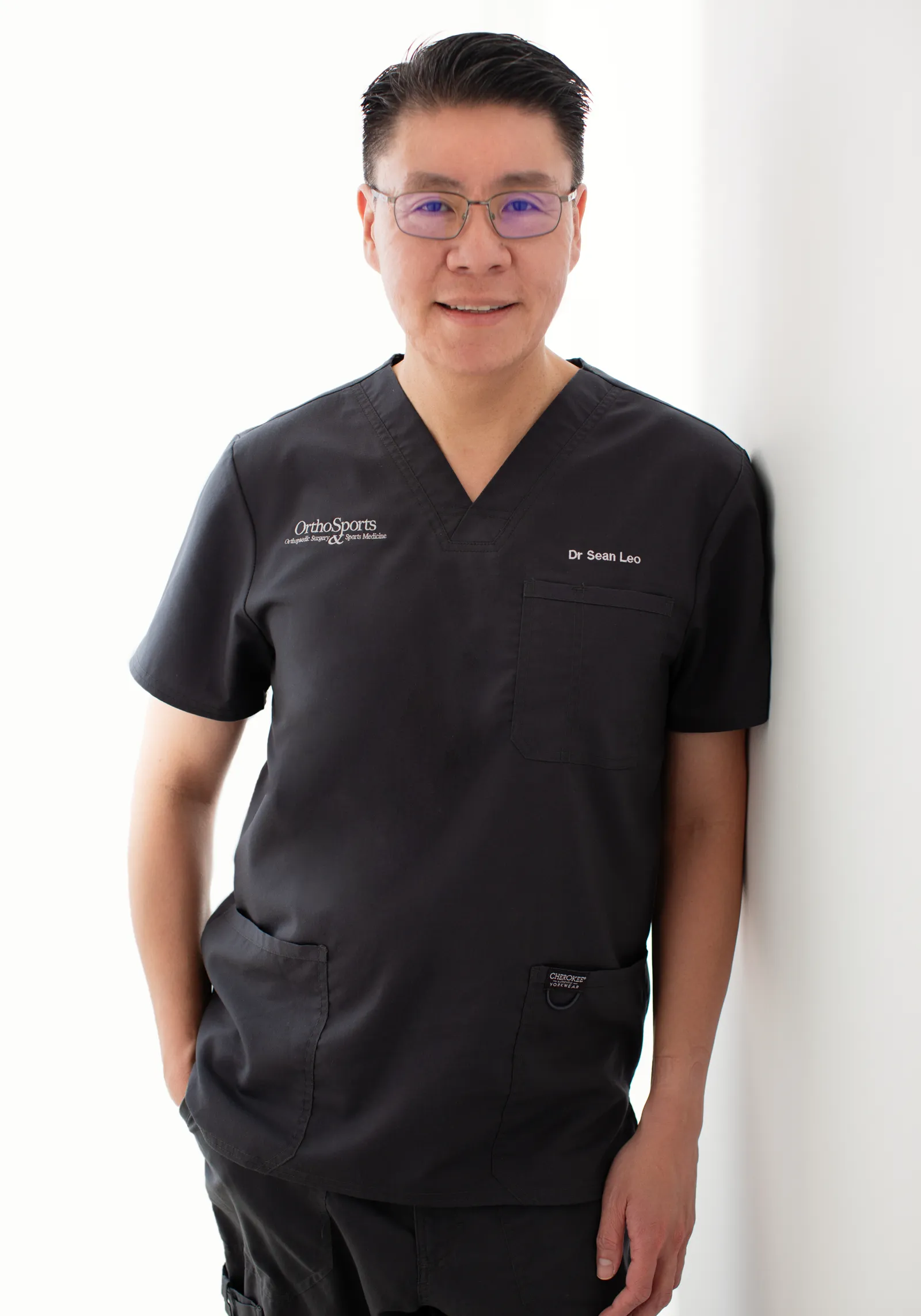
Meet Dr Sean Leo
Meet Dr Sean Leo
A consultant orthopaedic surgeon whose clinical focus is the knee, sports injuries and the lower limb.
- Dr Sean Leo is a consultant orthopaedic surgeon. OrthoKinetics is his professional brand; clinical services are provided through OrthoSports Orthopaedic & Sports Surgery at Mount Elizabeth Novena Specialist Centre and Connexion, Farrer Park Hospital.
- His clinical interests include sports injuries, including those in adolescent athletes; ligament reconstruction; realignment surgery; cartilage repair and joint-preservation approaches; knee replacement; and technology-assisted hip and knee surgery.
- The consistent aim is to return people to meaningful function and activity while avoiding unnecessary downtime.
- Qualifications: MBBS, MRCS (Ed), MMed (Ortho), FRCSEd (Ortho).
More detail: Meet Dr Sean Leo
- Training and career: Dr Leo trained in medicine at the National University of Singapore and served in the Singapore Armed Forces Medical Corps from 2000 to 2012, where his work included the care of soldiers in physically demanding roles. He completed postgraduate orthopaedic training in 2009 and a one-year clinical fellowship at Royal North Shore Hospital in Sydney, Australia, before joining Changi General Hospital as an orthopaedic consultant in 2012, where he later held the positions of Senior Consultant and Director of the Hip and Knee Service. With seniority, his educational contribution has evolved towards mentorship and support for junior doctors.
Questions people often ask
Common questions about recovery after surgery
Common questions about recovery after surgery
What does recovery after surgery involve?
Recovery is a staged process that runs from preparation before the operation, through the time after it, into rehabilitation. Moving and eating early help, feeling very tired at first is normal, and activity returns gradually on your doctor’s advice. Each procedure has its own protocol on its own page.[1][8]
How long does recovery take?
It varies, and no universal timeline applies. Recovery depends on your surgery, your health, your pain control and your circumstances. Your doctor can give you an idea of the likely course, but that is an estimate rather than a promise, and your return to activity is judged on criteria, not a date.[1][7]
Why is rehabilitation and physiotherapy so important?
Rehabilitation means movement and exercise, guided by your surgeon and often with a physiotherapist. It builds strength, restores function and supports your return to activity. Early movement helps reduce some complications and improves muscle strength. Ask your doctor which exercises you should be doing after your operation.[1][8]
How much pain is normal, and how is it managed?
Some discomfort is expected, but moderate and severe pain can limit recovery, so it is treated. Pain control combines medicines with methods that do not use medicines. Opioid medicines are considered only when other approaches are not enough, and they are used for as short a time as possible.[4][5]
How should I care for my wound, and what signs should I watch for?
Follow the dressing and washing instructions you were given, keep the wound clean and dry, and keep it out of water until it has healed or you are told it is safe. Watch for increasing redness, discharge, worsening pain, warmth, swelling or fever, and contact your care team promptly if they appear.[1][9]
What are the signs of a blood clot?
Signs of a clot in a leg vein include pain or swelling in one leg, skin that feels hot or looks red, blue or darkened, and veins near the surface that look larger than normal. Get medical help promptly, because a clot can travel to the lungs and be life-threatening.[1][2][3]
When can I return to work, driving or sport?
None of the three has a fixed date. Driving depends on strength, movement and any opioid medicine you still take. Work depends on how you function and what your job asks. Sport is judged on criteria with your clinician. Your surgeon guides all three.[1][7][10]
What should I do if something feels wrong?
Contact your care team promptly. Know how to reach your surgeon or ward team before you leave hospital, and understand the signs of complications such as infection and blood clots. This webpage is not an emergency service. For a new injury that may need urgent attention, see the Final next step section.[6]
What do people mean by a “knee specialist”?
“Knee specialist” is an everyday phrase many people use when looking for a doctor for a knee problem. In Singapore, doctors may only use the specialist titles accredited by the Specialist Accreditation Board (SAB) of the Ministry of Health (MOH). Orthopaedic Surgery is an accredited specialty; the knee is an area of clinical interest within it. “Knee specialist” is not a separate specialist registration; however, individual orthopaedic surgeons may have particular clinical interests within their specialty. The doctor most people have in mind is an orthopaedic surgeon whose practice focuses on knee conditions. Dr Sean Leo is registered as a specialist in Orthopaedic Surgery, and his clinical interest is the knee. He completed a postgraduate knee fellowship programme in Sydney, Australia, at the Royal North Shore Hospital under Dr Myles Coolican and Dr David Parker from 2009 to 2010. Dr Leo was also Director of the Hip and Knee Service at Changi General Hospital from 2014 to 2018.
Costs and insurance
Costs and insurance
Practicalities
Cost, MediSave and insurance

Ask the clinic team for current information about fees, panel status, pre-authorisation and expected payment arrangements. Insurance coverage and out-of-pocket costs depend on the individual policy and the insurer’s decision; no coverage is guaranteed.
A cost estimate for surgery can be given only after a consultation and assessment, once a surgical plan has been developed. Each individual condition is unique — implants used, time taken, and other factors contribute to the overall estimate. The estimate will be provided to you by the clinic should you decide on surgical management, and will also be used to assist in obtaining pre-authorisation from insurance where applicable.
Insurance panels. Dr Sean Leo, Orthopaedic Surgeon, is on the specialist panels of Great Eastern (GE Panel), HSBC Life (HSBC Life Shield) and Singlife (Singlife Shield), and on the Prudential Panel. AXA Insurance Singapore became part of HSBC Life in 2023, and former AXA Shield plans are now HSBC Life Shield plans.
Corporate health plans. Dr Leo is on the panels of both Alliance Medinet and iXchange, which administer medical benefits for many company health plans. If your company plan uses either panel, you can see Dr Leo as a panel doctor.
If your company uses a different panel. Some company plans still let you see a doctor of your choice outside their panel, then claim reimbursement. This varies from plan to plan, as may the co-payment, so please check your benefits with your company’s HR department.
Panel arrangements change from time to time, so please confirm with your insurer or your company’s plan administrator before your appointment.
Dr Leo is on the panels shown. If your insurer is not listed, you may ask whether co-management with an Orthosports surgeon partner on that panel is clinically and administratively appropriate. Orthosports surgeon partners are collectively on the panels of all Shield plans.
Specific benefits, pre-authorisation, reimbursement and cashless treatment depend on the individual policy and insurer approval and are not guaranteed.
See also traditional Chinese medicine therapy for sports injuries.
Arrange a consultation: the appointment section is further down this page.
Sources
References
References
- NHS. Having an operation (surgery): Getting back to normal. Available at: https://www.nhs.uk/tests-and-treatments/having-surgery/recovery/ (page last reviewed 9 July 2024).
- NHS. DVT (deep vein thrombosis). Available at: https://www.nhs.uk/conditions/deep-vein-thrombosis-dvt/ (page last reviewed 30 April 2026).
- National Institute for Health and Care Excellence (NICE). Venous thromboembolism in over 16s: reducing the risk of hospital-acquired deep vein thrombosis or pulmonary embolism. NICE guideline NG89, Context chapter. Published 21 March 2018; last updated 13 August 2019. Available at: https://www.nice.org.uk/guidance/ng89/chapter/Context
- American Academy of Orthopaedic Surgeons (AAOS). Managing Orthopaedic Surgery-Related Pain With Medications. OrthoInfo. Available at: https://orthoinfo.aaos.org/en/recovery/managing-pain-with-medications
- American Academy of Orthopaedic Surgeons (AAOS). Alternative Methods To Help Manage Pain After Orthopaedic Surgery. OrthoInfo. Available at: https://orthoinfo.aaos.org/en/recovery/alternative-methods-to-help-manage-pain-after-orthopaedic-surgery
- American Academy of Orthopaedic Surgeons (AAOS). Patient Guide to Safe Orthopaedic Surgery. OrthoInfo. Available at: https://orthoinfo.aaos.org/en/treatment/patient-guide-to-safe-surgery
- Ardern CL, Glasgow P, Schneiders A, et al. 2016 Consensus statement on return to sport from the First World Congress in Sports Physical Therapy, Bern. Br J Sports Med. 2016;50(14):853-864. doi:10.1136/bjsports-2016-096278. PMID 27226389.
- Tippireddy S, Ghatol D. Anesthetic Management for Enhanced Recovery After Major Surgery (ERAS). In: StatPearls [Internet]. Treasure Island (FL): StatPearls Publishing. PMID 34662081. Bookshelf NBK574567. Available at: https://ncbi.nlm.nih.gov/books/NBK574567
- Zabaglo M, Leslie SW, Sharman T. Postoperative Wound Infections. In: StatPearls [Internet]. Treasure Island (FL): StatPearls Publishing. Bookshelf NBK560533. Available at: https://ncbi.nlm.nih.gov/books/NBK560533
- DiSilvestro KJ, Santoro AJ, Tjoumakaris FP, et al. When Can I Drive After Orthopaedic Surgery? A Systematic Review. Clin Orthop Relat Res. 2016;474(12):2557-2570. doi:10.1007/s11999-016-5007-9. PMID 27492688.
Final next step
Final next step
Next step
Final next step
Reading about a problem is a starting point. An assessment brings together the history, an examination where needed and any useful tests, and helps you and your clinician decide what to do next. How much physical examination is needed is a matter of clinical judgement. It may be limited when pain makes an examination unreliable, or when imaging clearly shows a problem that matches the symptoms, such as a fracture seen on an X-ray or an MRI scan that clearly shows an injury consistent with the symptoms. The Singapore Medical Council and the UK General Medical Council both allow remote medical consultations, where a physical examination is not possible, with safeguards: the doctor must be clear about the limits of an opinion formed without an examination, and whether an in-person examination is needed, or referral to other services, is left to the clinical judgement of the attending doctor.
If an injury may need urgent attention, use the urgent-signs list for the area involved. For a knee injury, use the knee urgent-signs list; for a foot or ankle injury, use the foot and ankle urgent-signs list; for a shoulder injury, use the shoulder urgent-signs list.
Was this page helpful?
Arrange a consultation
Appointments are arranged through the OrthoSports clinic team. Send your details below, or message or call the clinic.
Leave your details and the clinic team will reply to arrange a time.
Message the clinic on WhatsApp
-
38 Irrawaddy Road, #10-41 Mount Elizabeth Novena Specialist Centre, Singapore 329563 Map for Orthosports@Novena (opens Google Maps)
-
1 Farrer Park Station Road, #15-17 Connexion, Singapore 217562 Map for Orthosports@Connexion (opens Google Maps)
WhatsApp is for clinic enquiries only. It is not an emergency service and is not monitored for urgent care. Website or messaging contact is not an emergency-response service. For a medical emergency, use your local emergency service.
- OrthoKinetics does not provide emergency or urgent care through this webpage or its WhatsApp contact.