
Introduction
Sports injuries · Injury prevention
Sports injury prevention: practical tips to reduce your risk
Specialist orthopaedic surgeon · sports injuries

Dr Sean LeoOrthopaedic Surgeon, Singapore
Clinic enquiries · Not an emergency service
Illustrative image

Prevention reduces your risk of injury — it does not remove it.
Prevention reduces your risk of injury — it does not remove it.
Prevention reduces your risk of injury — it does not remove it.
- Sensible preparation can lower your chance of a sports or activity injury. It cannot make injury impossible, because not every sprain or strain can be prevented, and no single measure is a guarantee.[6][8]
- The best-evidenced measure is structured strength training. Balance and combined exercise programmes also help. Building up gradually, warming up, good technique, suitable equipment, enough sleep and drinking regularly in Singapore’s heat sit alongside them.[1][2][6][8][9][5]
- Seeing a specialist orthopaedic surgeon about a sports injury does not mean surgery has already been decided.
- Dr Sean Leo is a specialist orthopaedic surgeon who cares for sports injuries. OrthoKinetics is Dr Sean Leo’s professional brand. Clinical consultations and treatment are provided through OrthoSports Orthopaedic & Sports Surgery.
What’s covered on this webpage
Follow the route in order, or jump to the stop you need. Stops you have read are marked.
Injuries can be sudden or gradual, and good habits help with both.
Injuries can be sudden or gradual, and good habits help with both.
Injuries can be sudden or gradual, and good habits help with both.
An injury can arrive suddenly, with a specific event such as a twist, a fall or a collision. It can also build up gradually, from the same load repeated over days or weeks. Many injuries build up in that second way, and that is why the pace of your training matters.[2][3][7]
The habits on this page are general. They apply to ordinary activity, such as a weekend jog or a new gym routine, as much as to organised sport, and the benefits of being active far outweigh the risks.[8] Advice specific to one sport is covered in separate articles, such as common running injuries and preventing common ankle injuries.
Some injuries cannot be prevented, however well you prepare.[6] An injury does not mean you did something wrong.

Warm up before you train.
Warm up before you train.
Warm up before you train.
Not warming up before exercise is a common contributor to injury, and warming up first is standard advice.[6][8] Think of it as getting your body ready for what you are about to ask of it.
A warm-up is general advice. It is not the same as a structured strength or balance programme, which has the stronger evidence (see the sections below).[1][2]
Stretching is a separate question. In a large review of trials, stretching on its own showed no beneficial effect on injury prevention, so it should not be relied on as a way to lower your risk.[1] You may still stretch for flexibility and comfort.
What the stretching review found
The review pooled 25 randomised trials with 26,610 participants. Stretching alone showed no beneficial effect, while strength training, balance training and combined programmes showed favourable effects.[1] The review looked at stretching as a stand-alone measure, not as part of a wider programme.[1]
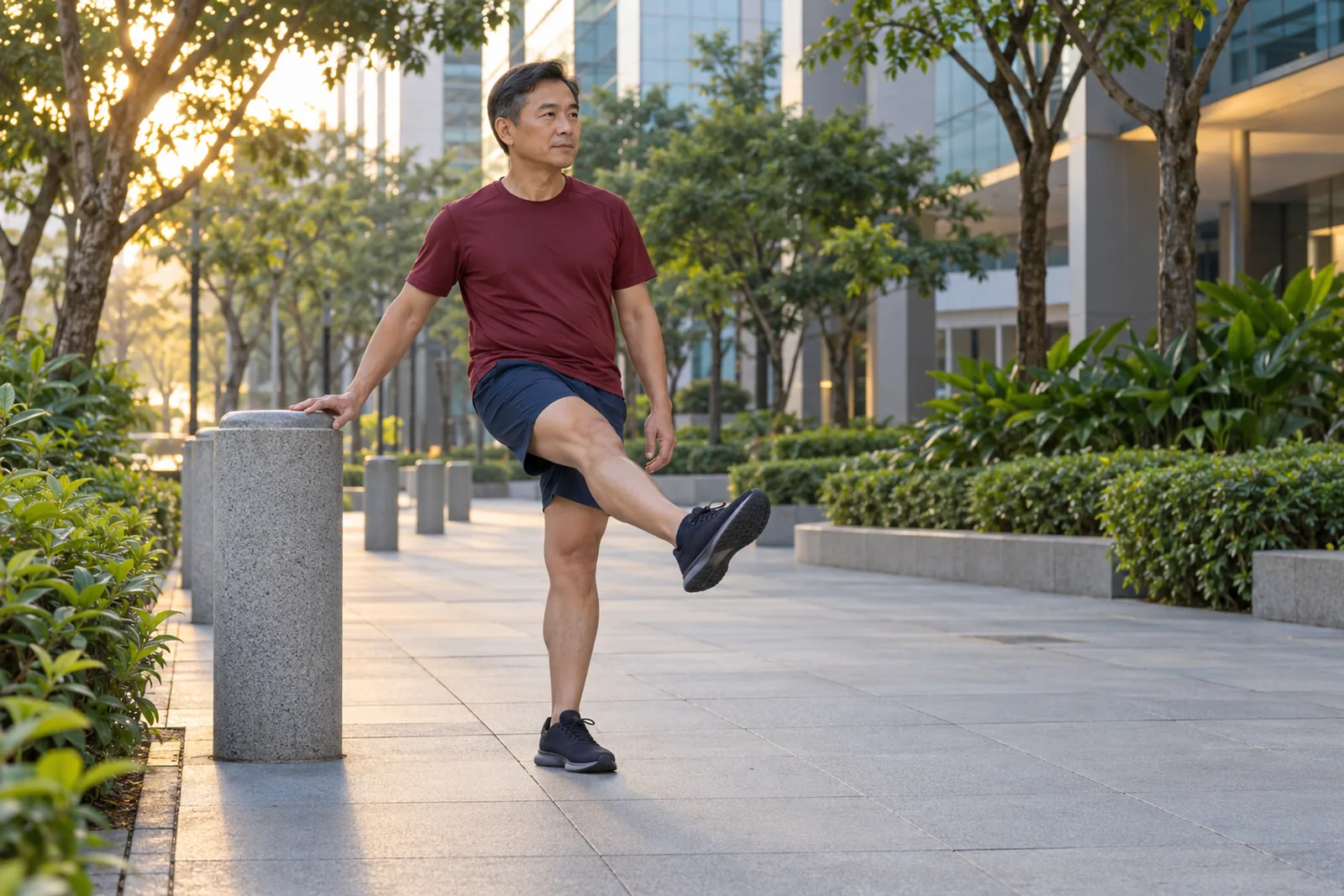
Build up gradually, and return gradually after time off or injury.
Build up gradually, and return gradually after time off or injury.
Build up gradually, and return gradually after time off or injury.
The most common mistake is doing too much too soon. Rapid, excessive increases in training load are likely responsible for a large proportion of non-contact soft-tissue injuries. The training itself is not thought to be the cause; an inappropriate training programme, with jumps that are too rapid, is more likely.[3]
So build up gradually, and do not push beyond your current fitness level.[8] Introduce intensity progressively, at a level that suits you.[9] The same applies when you start something new or return after a break or an injury: increase your activity gradually over time.[8]
A previous injury is one of the strongest predictors of a future injury, so it is a reason to be deliberate about how you load that same area.[4] The plan for returning to activity after surgery is covered on the post-surgery recovery page.
How to tell if you are progressing too quickly
Researchers compare how much you have done recently (your “acute” load) against your recent average (your “chronic” load). A recent load far above your recent average marks a sudden jump, and that jump is where injury risk rises.[3] You do not need to calculate anything. The practical version is to avoid sudden large jumps in what you do, week to week.[3][8]
Strength and balance training are the best-evidenced ways to lower injury risk.
Strength and balance training are the best-evidenced ways to lower injury risk.
Strength and balance training are the best-evidenced ways to lower injury risk.
Structured exercise programmes reduce sports injuries. Of the types studied, strength training is the most effective. Across the trials reviewed, it reduced injuries by roughly two-thirds, and no adverse events were attributed to it in the studies.[1][2] That is a finding across groups of people, not a promise for any one person.
Balance training (work on balance and coordination, which researchers call proprioception or neuromuscular training) and programmes that combine several types of exercise also reduce injuries, though to a lesser degree than strength training.[1][2]
This does not mean only strength training matters, or that you must follow one specific programme to benefit. The right mix depends on your sport, your body and your goals, and it is worth planning with a qualified trainer, coach or clinician.[8]
What the research covers
One review covered 25 trials and 26,610 participants.[1] A later review of six strength-training trials in people aged 12 to 40 found that higher strength-training volume and intensity were associated with lower injury risk.[2] Most included studies were in football (soccer) players. The authors note that broader research would be useful.[2]
Use good technique and the right equipment for your sport.
Use good technique and the right equipment for your sport.
Use good technique and the right equipment for your sport.
Poor technique is a recognised contributor to injury, and getting coaching to learn the right technique is recommended, especially when you start a new sport or activity.[8]
Equipment matters too. Use equipment that suits the activity, including protective gear where it applies, such as shin guards for football or a gum shield for rugby.[8][7] Footwear should be right for the activity, such as running shoes for running.[8]
Gear does not replace technique or fitness, so treat it as one part of preparing well.

Rest and sleep are part of staying injury-resilient.
Rest and sleep are part of staying injury-resilient.
Rest and sleep are part of staying injury-resilient.
Research links poor sleep with injury: insufficient sleep is associated with a higher risk of injury, and poor sleep is a recognised predictor of injury and concussion.[5]
This is an association seen in studies, which is not the same as proof that lack of sleep causes injury. Sleep is something you can change, so it is a sensible part of staying resilient. It is not a guarantee against injury.[5]
In Singapore’s heat, build up gradually and drink regularly.
In Singapore’s heat, build up gradually and drink regularly.
In Singapore’s heat, build up gradually and drink regularly.
Singapore’s climate changes how you prepare. The Sport Singapore heat plan advises getting used to the heat and local climate gradually, and introducing intensity progressively at a level that suits you.[9] Drink regularly during activity.[9]
What the Singapore guideline says
The Sport Singapore Heat Stress Management Plan for organised sport advises drinking at least 250 ml of water every 30 minutes during activity. It also suggests checking that your urine colour is clear or light yellow. Darker yellow than usual may suggest early signs of dehydration.[9] This is a guideline written for organised sport, not a personal medical prescription.[9]

Pain during activity is a signal to stop, not to push through.
Pain during activity is a signal to stop, not to push through.
Pain during activity is a signal to stop, not to push through.
Do not try to “work through” the pain of an injury, whether it came on suddenly or built up gradually. When pain appears with a particular movement or activity, stop.[7][8] Carrying on may cause further damage and slow your recovery.[7][8]
Pain that stops you is a reason to be assessed, not a reason to push harder. Which signs need urgent care depends on the area involved, and the urgent-signs guidance is in the Final next step at the end of this page.
Safety note: This webpage is not an emergency service. No page can rule out a serious problem remotely.
Video · Dr Sean Leo
Is Post-Workout Pain a Good Thing?
- Explains the difference between normal muscle soreness and joint pain.
- Covers why pushing through joint pain can make a problem worse.

Structure / Patient / Goal
Structure / Patient / Goal
Deciding together
Make prevention fit you.
General advice works best when it is applied to you. Structure, Patient and Goal are three ways of thinking about that.
S
Structure: what does your sport ask of your body?
Structure is the parts of your body that your sport or activity loads most, its demands on your joints, muscles and tendons. A runner and a swimmer ask different things of different parts of the body.
P
Patient: who is preparing?
Patient means you as a whole person: your fitness, your general health, your circumstances and your injury history. A previous injury changes where you take extra care.[4]
G
Goal: what are you building towards?
Goal is what you are working towards, whether that is staying active, returning to your sport or starting something new. A good plan starts from a clear purpose.
Your plan
The same habits are applied differently to each person, and no single factor decides how you prepare.
When prevention is not enough.
When prevention is not enough.
When prevention is not enough.
Prevention lowers your risk. It cannot remove it, and an injury can still happen.[6][8] If one does, that is not a failure on your part.
The next step is assessment, not self-diagnosis and not pushing through.[7][8] Assessment brings together the history, an examination where needed and any useful tests, so you and your clinician can decide what to do next.
- The sports injury hub explains how a sports injury is assessed.
- Broken bone (fracture) or sprain? explains how the two differ.
- Post-surgery recovery covers the return to activity after surgery.
- Recovery after surgery, by type of operation shows where to find recovery information for your type of operation.
Video · Dr Sean Leo
Sports Injury Mistakes That Delay Healing (And How to Avoid Them)
- Explains common mistakes people make after a sports injury.
- Describes how assessment and a structured plan support recovery.


OrthoKinetics Recovery Reflection
Recovery reflection
If no amount of preparation removes every risk, why prepare at all?
Looking after your body is closer to tending a garden than to buying a policy. A policy is a transaction: you pay in, and you expect a payout if something goes wrong. Care has no such contract. You water and prune because you want to keep enjoying what grows, and you know that weather will still arrive. Preparing well is a way of taking your body seriously, whatever the season brings.
What does it mean to train with the long game in mind, not the fear of every setback?
Fear asks you to remove all risk, and that is a task with no end. Stewardship asks something smaller and more lasting: to prepare sensibly, to keep moving, and to accept what remains. The benefits of being active far outweigh the risks.[8] Seen this way, a good habit is a way of staying in the game, not a bet against ever being hurt.
Preparation is care for the body you want to keep using, not a guarantee against injury.
Illustrative image

 With you through the seasons
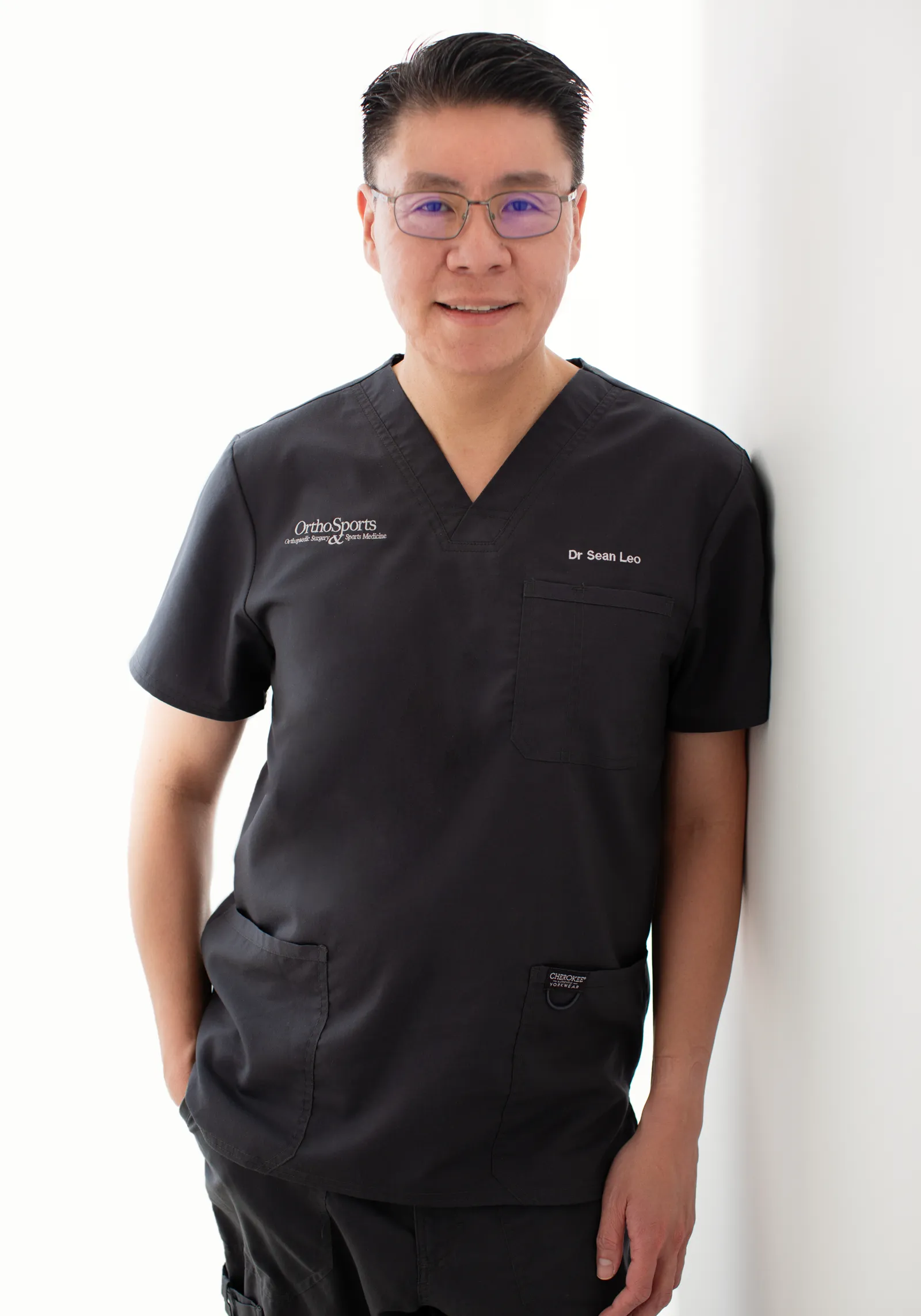
Meet Dr Sean Leo
Meet Dr Sean Leo
A consultant orthopaedic surgeon whose clinical focus is the knee, sports injuries and the lower limb.
- Dr Sean Leo is a consultant orthopaedic surgeon. OrthoKinetics is his professional brand; clinical services are provided through OrthoSports Orthopaedic & Sports Surgery at Mount Elizabeth Novena Specialist Centre and Connexion, Farrer Park Hospital.
- His clinical interests include sports injuries, including those in adolescent athletes; ligament reconstruction; realignment surgery; cartilage repair and joint-preservation approaches; knee replacement; and technology-assisted hip and knee surgery.
- The consistent aim is to return people to meaningful function and activity while avoiding unnecessary downtime.
- Qualifications: MBBS, MRCS (Ed), MMed (Ortho), FRCSEd (Ortho).
More detail: Meet Dr Sean Leo
- Training and career: Dr Leo trained in medicine at the National University of Singapore and served in the Singapore Armed Forces Medical Corps from 2000 to 2012, where his work included the care of soldiers in physically demanding roles. He completed postgraduate orthopaedic training in 2009 and a one-year clinical fellowship at Royal North Shore Hospital in Sydney, Australia, before joining Changi General Hospital as an orthopaedic consultant in 2012, where he later held the positions of Senior Consultant and Director of the Hip and Knee Service. With seniority, his educational contribution has evolved towards mentorship and support for junior doctors.
Questions people often ask
Common injury prevention questions
Common injury prevention questions
How do I prevent sports injuries?
You cannot remove the risk, but you can lower it. Structured strength training has the strongest evidence, balance and combined programmes also help, and building up gradually is central. A warm-up, good technique and suitable equipment are sensible additions. No measure is a guarantee, and not every injury can be prevented.[1][2][3][6][8]
How much should I increase my training each week?
Progress gradually and avoid sudden large jumps in training load. Rapid, excessive increases in load are likely responsible for a large proportion of non-contact soft-tissue injuries. Do not push beyond your current fitness level. The right pace depends on you, your sport and your history, and is worth planning with a coach or clinician.[3][8][9]
Is warming up before exercise really necessary?
Not warming up is a common contributor to injury, and warming up before exercise is standard advice. It is a general measure, not the same as a structured strength or balance programme, which has the stronger evidence.[1][2][6][8]
Does stretching prevent injury?
Stretching on its own has not been shown to prevent injury. A large review of trials found no beneficial effect for stretching alone. You may still stretch for flexibility and comfort, but do not rely on it to lower your injury risk. Strength and balance training have the better evidence.[1]
How much do sleep and recovery matter?
Insufficient sleep is associated with a higher risk of injury, and poor sleep is a recognised predictor of injury and concussion. That is an association seen in studies, not proof of cause. Sleep is something you can change, so it is a sensible part of staying resilient, but it is not a guarantee.[5]
Should I stop exercising if I feel pain?
Yes. Do not try to work through the pain of an injury. When pain comes with a particular movement or activity, stop. Continuing may cause further damage and slow your recovery. Pain that stops you is a reason to be assessed. Some signs need urgent care, so see the guidance at the end of this page.[7][8]
How do I avoid injury when starting a new sport?
Start at a level that suits your current fitness and build up gradually. Get advice and training from a qualified fitness trainer or sports coach, learn the right technique and use equipment suited to the activity.[8][9]
How should I drink in Singapore’s heat?
The Sport Singapore heat plan for organised sport advises getting used to the heat gradually, introducing intensity progressively, and drinking at least 250 ml of water every 30 minutes during activity. It also suggests checking that your urine is clear or light yellow. It is a guideline, not a personal prescription.[9]
What should I do if I get injured during sport?
Stop the activity rather than pushing through, and arrange an assessment. An injury can still happen despite good preparation, and it does not mean you failed. See the sports injury hub for how assessment works, and the guidance at the end of this page for urgent signs.[6][7][8]
How do I prevent re-injury after recovering?
A previous injury is one of the strongest predictors of a future injury, so take extra care with that same area. When you return, increase your activity gradually over time and do not do too much too soon. Your clinician sets the plan for your own return.[4][8]
Costs and insurance
Costs and insurance
Practicalities
Cost, MediSave and insurance

Ask the clinic team for current information about fees, panel status, pre-authorisation and expected payment arrangements. Insurance coverage and out-of-pocket costs depend on the individual policy and the insurer’s decision; no coverage is guaranteed.
A cost estimate for surgery can be given only after a consultation and assessment, once a surgical plan has been developed. Each individual condition is unique — implants used, time taken, and other factors contribute to the overall estimate. The estimate will be provided to you by the clinic should you decide on surgical management, and will also be used to assist in obtaining pre-authorisation from insurance where applicable.
Insurance panels. Dr Sean Leo, Orthopaedic Surgeon, is on the specialist panels of Great Eastern (GE Panel), HSBC Life (HSBC Life Shield) and Singlife (Singlife Shield), and on the Prudential Panel. AXA Insurance Singapore became part of HSBC Life in 2023, and former AXA Shield plans are now HSBC Life Shield plans.
Corporate health plans. Dr Leo is on the panels of both Alliance Medinet and iXchange, which administer medical benefits for many company health plans. If your company plan uses either panel, you can see Dr Leo as a panel doctor.
If your company uses a different panel. Some company plans still let you see a doctor of your choice outside their panel, then claim reimbursement. This varies from plan to plan, as may the co-payment, so please check your benefits with your company’s HR department.
Panel arrangements change from time to time, so please confirm with your insurer or your company’s plan administrator before your appointment.
Dr Leo is on the panels shown. If your insurer is not listed, you may ask whether co-management with an Orthosports surgeon partner on that panel is clinically and administratively appropriate. Orthosports surgeon partners are collectively on the panels of all Shield plans.
Specific benefits, pre-authorisation, reimbursement and cashless treatment depend on the individual policy and insurer approval and are not guaranteed.
Arrange a consultation: the appointment section is further down this page.
Sources
References
References
- Lauersen JB, Bertelsen DM, Andersen LB. The effectiveness of exercise interventions to prevent sports injuries: a systematic review and meta-analysis of randomised controlled trials. Br J Sports Med. 2014;48(11):871-877. doi:10.1136/bjsports-2013-092538. PMID 24100287.
- Lauersen JB, Andersen TE, Andersen LB. Strength training as superior, dose-dependent and safe prevention of acute and overuse sports injuries: a systematic review, qualitative analysis and meta-analysis. Br J Sports Med. 2018;52(24):1557-1563. doi:10.1136/bjsports-2018-099078. PMID 30131332.
- Gabbett TJ. The training-injury prevention paradox: should athletes be training smarter and harder? Br J Sports Med. 2016;50(5):273-280. doi:10.1136/bjsports-2015-095788. PMID 26758673.
- Green B, Bourne MN, van Dyk N, Pizzari T. Recalibrating the risk of hamstring strain injury (HSI): A 2020 systematic review and meta-analysis of risk factors for index and recurrent hamstring strain injury in sport. Br J Sports Med. 2020;54(18):1081-1088. doi:10.1136/bjsports-2019-100983. PMID 32299793.
- Charest J, Grandner MA. Sleep and Athletic Performance: Impacts on Physical Performance, Mental Performance, Injury Risk and Recovery, and Mental Health. Sleep Med Clin. 2020;15(1):41-57. doi:10.1016/j.jsmc.2019.11.005. PMID 32005349. PMCID PMC9960533.
- NHS. Sprains and strains. Available at: https://www.nhs.uk/conditions/sprains-and-strains/
- National Institute of Arthritis and Musculoskeletal and Skin Diseases (NIAMS), US National Institutes of Health. Sports Injuries: Diagnosis, Treatment, and Steps to Take. Available at: https://www.niams.nih.gov/health-topics/sports-injuries/diagnosis-treatment-and-steps-to-take
- nidirect (Northern Ireland Government Services). Sports injuries. Available at: https://www.nidirect.gov.uk/conditions/sports-injuries
- Sport Singapore (SportSG). Heat Stress Management Plan for Sport Fraternity. Ref SHW/02/2023, revised 24 April 2024. Available at: https://isomer-user-content.by.gov.sg/46/d2bc4095-5241-424c-9fb4-8512fdef0216/Heat_Stress_Mgmt_Plan_26_Apr_24_730am_Website.pdf
Final next step
Final next step
Next step
Final next step
Reading about a problem is a starting point. An assessment brings together the history, an examination where needed and any useful tests, and helps you and your clinician decide what to do next. How much physical examination is needed is a matter of clinical judgement. It may be limited when pain makes an examination unreliable, or when imaging clearly shows a problem that matches the symptoms, such as a fracture seen on an X-ray or an MRI scan that clearly shows an injury consistent with the symptoms. The Singapore Medical Council and the UK General Medical Council both allow remote medical consultations, where a physical examination is not possible, with safeguards: the doctor must be clear about the limits of an opinion formed without an examination, and whether an in-person examination is needed, or referral to other services, is left to the clinical judgement of the attending doctor.
If an injury may need urgent attention, use the urgent-signs list for the area involved. For a knee injury, use the knee urgent-signs list; for a foot or ankle injury, use the foot and ankle urgent-signs list; for a shoulder injury, use the shoulder urgent-signs list.
Arrange a consultation
Appointments are arranged through the OrthoSports clinic team. Send your details below, or message or call the clinic.
Leave your details and the clinic team will reply to arrange a time.
Message the clinic on WhatsApp
-
38 Irrawaddy Road, #10-41 Mount Elizabeth Novena Specialist Centre, Singapore 329563 Map for Orthosports@Novena (opens Google Maps)
-
1 Farrer Park Station Road, #15-17 Connexion, Singapore 217562 Map for Orthosports@Connexion (opens Google Maps)
WhatsApp is for clinic enquiries only. It is not an emergency service and is not monitored for urgent care. Website or messaging contact is not an emergency-response service. For a medical emergency, use your local emergency service.
- OrthoKinetics does not provide emergency or urgent care through this webpage or its WhatsApp contact.