
Introduction
Sports injuries · Injury basics
Broken Bone (Fracture) or Sprain? How to Tell the Difference
Specialist orthopaedic surgeon · sports injuries

Dr Sean LeoOrthopaedic Surgeon, Singapore
Clinic enquiries · Not an emergency service
Illustrative image

A break injures bone; a sprain injures the ligament.
A break injures bone; a sprain injures the ligament.
A break injures bone; a sprain injures the ligament.
- A broken bone (fracture) is a crack or break in the bone itself. A sprain is a stretch or tear of a ligament, the strong band of tissue that connects one bone to another and supports a joint.[1][2]
- The two can look and feel alike, so how an injury feels cannot tell you which one you have. An assessment, usually an examination and an X-ray, is what decides.[1][6]
- Injuries to a particular joint have their own pages, such as ankle sprain, ankle fracture and ankle ligament tear, and the sports injury hub gathers the wider picture. This page explains the difference in general terms. It cannot tell you which injury you have.
- Dr Sean Leo is a specialist orthopaedic surgeon who cares for sports injuries. OrthoKinetics is Dr Sean Leo’s professional brand. Clinical consultations and treatment are provided through OrthoSports Orthopaedic & Sports Surgery. Seeing a specialist orthopaedic surgeon about a sports injury does not mean surgery has already been decided.
What’s covered on this webpage
Follow the route in order, or jump to the stop you need. Stops you have read are marked.
Bones hold you up; ligaments hold a joint together.
Bones hold you up; ligaments hold a joint together.
Bones hold you up; ligaments hold a joint together.
Bones are rigid, and they are what holds you up. A fracture is a broken bone, the same as a crack or a break. Doctors use the words “break” and “fracture” interchangeably. A bone can be partly or completely broken, and a complete break can run through the bone in several pieces.[1]
A ligament is a strong band of connective tissue that connects the end of one bone with another. Ligaments stabilise and support the body’s joints.[2] A sprain is a stretch and/or tear of a ligament. It is an injury to soft tissue, not to bone.[2]
| Broken bone (fracture) | Sprain | |
|---|---|---|
| What is injured | The bone | A ligament, which is soft tissue |
| What it is | A crack or break in the bone | A stretch and/or tear of the ligament |
You may also hear the word strain. A strain is a different injury, to a muscle or tendon rather than a ligament.[2]

A break needs force; a sprain needs a joint stretched too far.
A break needs force; a sprain needs a joint stretched too far.
A break needs force; a sprain needs a joint stretched too far.
Bones are rigid, but they do bend, or give, somewhat when an outside force is applied. If the force is too great, the bone breaks, just as a plastic ruler breaks when it is bent too far. If the bone’s breaking point is exceeded only slightly, it may crack rather than break all the way through.[1]
A sprain happens when a joint is pushed beyond its usual range and the ligament stretches or tears.[2]
The two are not always cleanly separate. A single injury can involve both bone and ligament, which is one more reason an assessment matters more than a guess.[1][2]
Two special situations: stress fractures and children’s growth plates
Stress fractures. Not every break comes from one blow. A stress fracture is a tiny crack that builds up over time from repeated loading, rather than from a single injury. Stress fractures are common in athletes who do repetitive, high-impact sports, and in runners.[4][8]
Children’s growth plates. The long bones of a growing child have growth plates, which are areas of cartilage near the ends of the bones. They are the last part of a child’s bones to harden, so they are particularly vulnerable to injury. Because the growth plate helps determine the future length and shape of the mature bone, this type of fracture usually requires prompt attention.[3][9]

Pain, swelling and bruising happen with both.
Pain, swelling and bruising happen with both.
Pain, swelling and bruising happen with both.
Many fractures are very painful and may prevent you from moving the injured area. Swelling and tenderness, bruising and sometimes deformity, where a limb looks out of place, are other common signs.[1] In a sprain, the intensity varies, but pain, bruising, swelling and inflammation are common in sprains of every severity.[2]
So pain, swelling and bruising belong to both injuries. That overlap is real and expected, and it is the reason these signs cannot, on their own, separate a break from a sprain.[1][2][6]
Two signs lean towards a fracture without settling it:
- Deformity. A limb that looks out of place points towards a fracture, but a subtle crack may show no deformity at all, so its absence does not rule a fracture out.[1]
- Not being able to put weight on the injury. This also points towards a fracture. It is not present in every fracture, and being able to put some weight on an injured limb does not rule one out.[1][6]
Treat these signs as clues to describe to a clinician, not as proof either way.
When should an injury be assessed?
When should an injury be assessed?
When should an injury be assessed?
Many people start with basic self-care after an injury. It is worth arranging an assessment if:[5][6]
- the injury is very painful, or the pain is getting worse;
- there is a large amount of swelling or bruising, or it is increasing;
- you cannot put any weight on it, or cannot use it normally;
- it is not settling with simple care.
A child’s injury near a joint should be assessed promptly, because growing bones are vulnerable.[3]
If you think a bone anywhere in the body may be broken, it needs assessment. See a doctor or urgent care.[6]
Some signs need urgent care rather than a routine assessment. The urgent-signs guidance is in the Final next step at the end of this page.
Safety note: This webpage is not an emergency service. No page can rule out a serious problem remotely.
Assessment, not feel, tells a break from a sprain.
Assessment, not feel, tells a break from a sprain.
Assessment, not feel, tells a break from a sprain.
It can be hard to tell whether an injury is a break, a dislocation or a badly sprained joint from how it looks and feels. You will probably need an X-ray.[6] An assessment combines a clinician’s examination with imaging used selectively.[1][6]
An X-ray gives clear images of bone, which is why it is the most common way to evaluate a fracture. It is used to see whether there is a break and how bad the break is.[1][6]
Not every injury needs an X-ray. For some injuries, such as ankle and midfoot injuries, doctors use a validated rule to decide whether an X-ray is needed. For the ankle this is known as the Ottawa ankle rules: a short set of checks that a clinician carries out during the examination of an injured ankle or foot, to decide whether an X-ray is needed. When these rules were tested, they were 100% sensitive for fractures, which means they were designed to miss essentially none, and they allowed doctors to safely reduce the number of ankle X-rays ordered by about one third.[7] They are a clinician’s tool, not a checklist to score yourself. The ankle sprain page goes into more depth.
A normal X-ray does not always settle the question. In the early stages of a stress fracture the X-ray may look normal, because bone swelling cannot be seen on an X-ray, and an MRI may be ordered to show it.[4] Some growth-plate fractures in children also cannot be seen on an X-ray, which is why the clinical examination is key.[3] So if symptoms continue after a normal X-ray, further assessment may be needed.
What other scans can show
If greater detail is needed, the doctor may order other tests that can better show the soft tissues, or give a cross-sectional view of the injured area. These include magnetic resonance imaging (MRI) scans and computed tomography (CT) scans.[3]
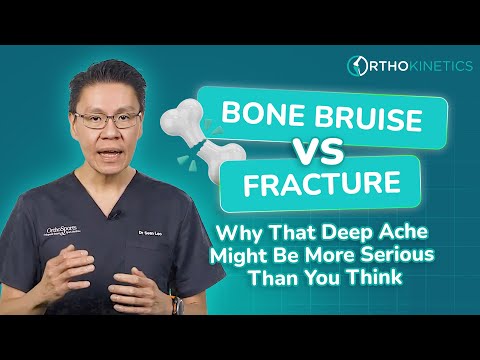
Video · Dr Sean Leo
Bone Bruise vs. Fracture: Why That Deep Ache Might Be More Serious Than You Think
- Explains why a normal X-ray does not always explain ongoing bone pain.
- Describes how an MRI can show a bone bruise that X-rays miss.

Most sprains settle with simple measures; some breaks need support.
Most sprains settle with simple measures; some breaks need support.
Most sprains settle with simple measures; some breaks need support.
The general aim in the first days is to protect the injured area and limit swelling. First aid is protection, not treatment.
For a sprain or strain, the NHS describes five steps, known as PRICE, for the first 2 to 3 days:[5]
- Protection: protect the injury, for example with a support.
- Rest: stop exercise and activity, and try not to put any weight on the injury.
- Ice: apply an ice pack, wrapped in a tea towel, for up to 20 minutes every 2 to 3 hours.
- Compression: wrap a bandage around the injury to support it during the day.
- Elevate: keep it raised on a pillow as much as possible.
For a possible broken bone, the aim is to support and protect the area while you get help:[6]
- use a towel as a sling to support an injured arm;
- hold an ice pack, wrapped in a tea towel, to the injured area for up to 20 minutes every 2 to 3 hours;
- do not try to use the injured limb;
- do not eat or drink anything, in case you need surgery to fix the bone.
If you cannot tell which one you have, and many people cannot, arrange an assessment rather than guessing.[6]
What happens next depends on which bone or joint is injured and how badly, and it is decided at assessment. Some broken bones need surgery to fix the bone, and many sprains feel better within about 2 weeks.[5][6]
Video · Dr Sean Leo
Should I Use Heat And Ice On An Injury?
- Explains why ice is useful when a fresh injury is still swollen.
- Describes how heat can ease the muscles around the area later on.

Structure / Patient / Goal
Structure / Patient / Goal
Deciding together
Structure / Patient / Goal
S
Structure: what is affected?
Structure is which tissue and which joint may be injured: bone or ligament, and where. It includes what the assessment shows and what a test adds when testing is useful.
P
Patient: how does it affect you?
Patient means you as a whole person. Your symptoms, how active you are, your general health, your preferences and your circumstances all shape which options are reasonable.
G
Goal: what are you hoping to return to?
Goal is what matters to you, whether that is daily tasks, work or sport. A useful plan starts from a clear purpose.
Your plan
No single factor decides the plan alone. A scan, a symptom or motivation does not settle it by itself.
A bone and a sprain heal on different scales.
A bone and a sprain heal on different scales.
A bone and a sprain heal on different scales.
A broken bone. How long a bone takes to heal varies widely. Some fractures, for example in the fingers, take 3 to 4 weeks to heal. Others take 6 to 8 weeks, several months (3 to 6 months on average), or even longer.[1] A broken arm or wrist usually takes around 6 to 8 weeks to recover, and it can take longer if the arm or wrist was severely damaged.[6] Pain usually stops long before the fracture is solid enough to handle the stresses of normal activity.[1]
A sprain. Most sprains and strains feel better after 2 weeks. Severe ones can take months to get back to normal, and strenuous exercise such as running may need to be avoided for up to 8 weeks, as there is a risk of further damage.[5]
These are ranges, and recovery varies from person to person. They are not predictions for you. The two also measure different things: a sprain “feels better”, while a bone needs to be solid enough for normal activity. The figures should not be set side by side as a direct comparison.[1][5]


OrthoKinetics Recovery Reflection
Recovery reflection
Why can an injury feel better before it is ready for more?
Pain is the body’s loudest message, and it is easy to treat it as the only one. When it eases, the natural conclusion is that the work is done. A bone, though, can go on strengthening after the pain has eased,[1] a little like concrete that looks set within a day and keeps gaining strength for weeks. Nothing has gone wrong in the gap between the two. They run on different clocks.
What changes when you let strength, rather than comfort, decide what comes next?
Comfort is a useful signal, and it deserves attention. It answers a different question from “is this ready to carry load?” Leaving that second question to the assessment frees you to use comfort for what it does well, which is telling you how the injury is treating you today. Keeping the two apart is less a matter of willpower than of knowing which question each one answers.
Comfort tells you how today feels; strength is what tells you how much the injury can be asked to do.
Illustrative image

 With you through the seasons
Meet Dr Sean Leo
Meet Dr Sean Leo
A consultant orthopaedic surgeon whose clinical focus is the knee, sports injuries and the lower limb.
- Dr Sean Leo is a consultant orthopaedic surgeon. OrthoKinetics is his professional brand; clinical services are provided through OrthoSports Orthopaedic & Sports Surgery at Mount Elizabeth Novena Specialist Centre and Connexion, Farrer Park Hospital.
- His clinical interests include sports injuries, including those in adolescent athletes; ligament reconstruction; realignment surgery; cartilage repair and joint-preservation approaches; knee replacement; and technology-assisted hip and knee surgery.
- The consistent aim is to return people to meaningful function and activity while avoiding unnecessary downtime.
- Qualifications: MBBS, MRCS (Ed), MMed (Ortho), FRCSEd (Ortho).
More detail: Meet Dr Sean Leo
- Training and career: Dr Leo trained in medicine at the National University of Singapore and served in the Singapore Armed Forces Medical Corps from 2000 to 2012, where his work included the care of soldiers in physically demanding roles. He completed postgraduate orthopaedic training in 2009 and a one-year clinical fellowship at Royal North Shore Hospital in Sydney, Australia, before joining Changi General Hospital as an orthopaedic consultant in 2012, where he later held the positions of Senior Consultant and Director of the Hip and Knee Service. With seniority, his educational contribution has evolved towards mentorship and support for junior doctors.

Questions people often ask
Common questions about breaks and sprains
Common questions about breaks and sprains
What is the difference between a fracture and a sprain?
A broken bone (fracture) is a crack or break in the bone itself. A sprain is a stretch or tear of a ligament, the strong band of tissue that connects one bone to another and supports a joint. One injures bone and the other injures soft tissue. Sometimes a single injury involves both.[1][2]
How do I know if I broke a bone or just sprained it?
You usually cannot tell by how it looks or feels, because the signs overlap. An assessment decides: a clinician examines the injury, and an X-ray, which shows bone clearly, is usually needed to confirm a break. If you are unsure, arrange an assessment rather than guessing.[1][6]
Is a sprain the same as a strain?
No. A sprain is a stretch or tear of a ligament, which connects one bone to another. A strain is an injury to a muscle or tendon. Both are soft-tissue injuries, and both are different from a broken bone (fracture), which is an injury to the bone itself.[2]
What does a broken bone feel like?
Many fractures are very painful and may stop you moving the injured area. Swelling, tenderness and bruising are common, and sometimes a limb looks out of place. Not every fracture shows a deformity, and a subtle crack may show none, so how it feels cannot settle the question.[1][6]
Can I walk on a broken bone or a sprain?
Sometimes, yes. Not being able to put weight on an injury points towards a fracture, but it is not present in every fracture, and being able to put some weight on it does not rule one out. If you cannot put any weight on it, arrange an assessment.[1][5][6]
Do I need an X-ray to tell if it’s broken or sprained?
An X-ray is usually needed to confirm a break, but not every injury needs one. For some injuries, such as ankle and midfoot injuries, doctors use a validated rule to decide whether an X-ray is needed. A clinician makes that decision during examination. It is not a checklist to score yourself.[6][7]
How long does a fracture take to heal compared with a sprain?
It varies. Some broken bones, such as those in the fingers, heal in 3 to 4 weeks, while others take 6 to 8 weeks, several months or longer. Most sprains feel better within about 2 weeks, though severe ones can take months. These are ranges that vary, not predictions, and they measure different things.[1][5]
When should I see a doctor for a possible break or sprain?
Arrange an assessment if the injury is very painful or getting worse, swelling or bruising is large or increasing, you cannot put weight on it or use it normally, or it is not settling. A child’s injury near a joint should be assessed promptly. Some signs need urgent care, so see the guidance at the end of this page.[3][5][6]
Is my wrist (or ankle) broken or just sprained?
It can be hard to tell whether a wrist is broken, dislocated or badly sprained, and you will probably need an X-ray.[6] If you think a bone may be broken, it needs assessment, so see a doctor or urgent care. For the ankle, see the ankle sprain, ankle fracture and ankle ligament tear pages.
Costs and insurance
Costs and insurance
Practicalities
Cost, MediSave and insurance

Ask the clinic team for current information about fees, panel status, pre-authorisation and expected payment arrangements. Insurance coverage and out-of-pocket costs depend on the individual policy and the insurer’s decision; no coverage is guaranteed.
A cost estimate for surgery can be given only after a consultation and assessment, once a surgical plan has been developed. Each individual condition is unique — implants used, time taken, and other factors contribute to the overall estimate. The estimate will be provided to you by the clinic should you decide on surgical management, and will also be used to assist in obtaining pre-authorisation from insurance where applicable.
Insurance panels. Dr Sean Leo, Orthopaedic Surgeon, is on the specialist panels of Great Eastern (GE Panel), HSBC Life (HSBC Life Shield) and Singlife (Singlife Shield), and on the Prudential Panel. AXA Insurance Singapore became part of HSBC Life in 2023, and former AXA Shield plans are now HSBC Life Shield plans.
Corporate health plans. Dr Leo is on the panels of both Alliance Medinet and iXchange, which administer medical benefits for many company health plans. If your company plan uses either panel, you can see Dr Leo as a panel doctor.
If your company uses a different panel. Some company plans still let you see a doctor of your choice outside their panel, then claim reimbursement. This varies from plan to plan, as may the co-payment, so please check your benefits with your company’s HR department.
Panel arrangements change from time to time, so please confirm with your insurer or your company’s plan administrator before your appointment.
Dr Leo is on the panels shown. If your insurer is not listed, you may ask whether co-management with an Orthosports surgeon partner on that panel is clinically and administratively appropriate. Orthosports surgeon partners are collectively on the panels of all Shield plans.
Specific benefits, pre-authorisation, reimbursement and cashless treatment depend on the individual policy and insurer approval and are not guaranteed.
Arrange a consultation: the appointment section is further down this page.
Sources
References
References
- American Academy of Orthopaedic Surgeons (AAOS). Fractures (Broken Bones). OrthoInfo. Available at: https://orthoinfo.org/en/diseases–conditions/fractures-broken-bones
- American Academy of Orthopaedic Surgeons (AAOS). Sprains, Strains, and Other Soft-Tissue Injuries. OrthoInfo. Available at: https://orthoinfo.org/en/diseases–conditions/sprains-strains-and-other-soft-tissue-injuries
- American Academy of Orthopaedic Surgeons (AAOS). Growth Plate Fractures. OrthoInfo. Available at: https://orthoinfo.org/en/diseases–conditions/growth-plate-fractures
- American Academy of Orthopaedic Surgeons (AAOS). Stress Fractures. OrthoInfo. Available at: https://orthoinfo.org/en/diseases–conditions/stress-fractures
- NHS. Sprains and strains. Available at: https://www.nhs.uk/conditions/sprains-and-strains/
- NHS. Broken arm or wrist. Available at: https://www.nhs.uk/conditions/broken-arm-or-wrist/
- Stiell IG, Greenberg GH, McKnight RD, et al. Decision rules for the use of radiography in acute ankle injuries. Refinement and prospective validation. JAMA. 1993;269(9):1127-1132. doi:10.1001/jama.269.9.1127. PMID 8433468.
- May T, Marappa-Ganeshan R. Stress Fractures. [Updated 2023 Jul 10]. In: StatPearls [Internet]. Treasure Island (FL): StatPearls Publishing. NBK554538. Available at: https://www.ncbi.nlm.nih.gov/books/NBK554538/
- Levine RH, Thomas A, Nezwek TA, Waseem M. Salter-Harris Fracture. [Updated 2023 Aug 10]. In: StatPearls [Internet]. Treasure Island (FL): StatPearls Publishing. NBK430688. Available at: https://www.ncbi.nlm.nih.gov/books/NBK430688/
Final next step
Final next step
Next step
Final next step
Reading about a problem is a starting point. An assessment brings together the history, an examination where needed and any useful tests, and helps you and your clinician decide what to do next. How much physical examination is needed is a matter of clinical judgement. It may be limited when pain makes an examination unreliable, or when imaging clearly shows a problem that matches the symptoms, such as a fracture seen on an X-ray or an MRI scan that clearly shows an injury consistent with the symptoms. The Singapore Medical Council and the UK General Medical Council both allow remote medical consultations, where a physical examination is not possible, with safeguards: the doctor must be clear about the limits of an opinion formed without an examination, and whether an in-person examination is needed, or referral to other services, is left to the clinical judgement of the attending doctor.
If an injury may need urgent attention, use the urgent-signs list for the area involved. For a knee injury, use the knee urgent-signs list; for a foot or ankle injury, use the foot and ankle urgent-signs list; for a shoulder injury, use the shoulder urgent-signs list.
Was this page helpful?
Arrange a consultation
Appointments are arranged through the OrthoSports clinic team. Send your details below, or message or call the clinic.
Leave your details and the clinic team will reply to arrange a time.
Message the clinic on WhatsApp
-
38 Irrawaddy Road, #10-41 Mount Elizabeth Novena Specialist Centre, Singapore 329563 Map for Orthosports@Novena (opens Google Maps)
-
1 Farrer Park Station Road, #15-17 Connexion, Singapore 217562 Map for Orthosports@Connexion (opens Google Maps)
WhatsApp is for clinic enquiries only. It is not an emergency service and is not monitored for urgent care. Website or messaging contact is not an emergency-response service. For a medical emergency, use your local emergency service.
- OrthoKinetics does not provide emergency or urgent care through this webpage or its WhatsApp contact.