
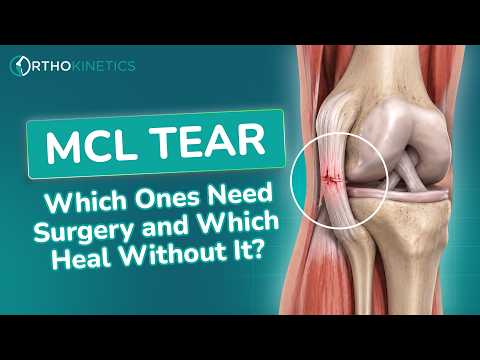
About this video
Last updated: 18 November 2026
Most isolated medial collateral ligament (MCL) tears in adults can heal without surgery, including selected upper (proximal) complete Grade III injuries. In this video, consultant orthopaedic surgeon Dr Sean Leo explains that grading from Grade I to Grade III measures how much of the ligament is torn rather than deciding surgery on its own. Outcomes for complete Grade III tears are less uniform and depend on tear location, knee stability, and whether another knee ligament such as the ACL or PCL is injured, so every knee needs an individual clinical assessment.
Key points
- Grades 1 to 3 measure tear severity, not a surgical verdict: Grade I is a mild stretch with fibres intact, Grade II is a partial tear, and Grade III is a complete tear where the inner knee opens under valgus stress. The grade tells your doctor how much tissue is damaged, not whether you must have an operation.
- Most isolated MCL injuries heal without an operation: Isolated Grade I and II tears, and certain Grade III tears involving the upper (proximal) superficial MCL, are typically treated without surgery. Long periods of complete immobilisation are not usually needed; in studies that used it, the thigh muscles weakened, and early protected movement is the usual approach. In comparative studies of isolated Grade II and III injuries, non-surgical care showed similar valgus stability to surgery and faster early thigh-strength recovery, though Grade III outcomes remain less uniform and need close assessment.
- Protected early movement, weight bearing, and bracing: Non-surgical care typically combines protected early movement and gradual strengthening after any brief initial bracing period (often the first two weeks where prescribed). Your doctor sets how much weight you put through the leg by tear grade and knee alignment: mild or moderate (Grade I and II) tears with a straight or varus-aligned knee often allow full weight bearing as tolerated, whereas partial weight bearing is advised for valgus-aligned knees and has been recommended for up to four weeks in complete (Grade III) tears. Your specialist will advise whether a hinged knee brace is needed and for how long (commonly around six weeks, or two to three weeks for a mild Grade I sprain), tailored to your injury and stability.
- When MCL surgery may be considered: Your specialist may consider MCL surgery in situations such as a knee that stays unstable after structured non-surgical rehabilitation, a complete Grade III tear with ongoing instability, or an acute displaced lower (distal) tear, tibial avulsion folded into the joint, or Stener-like tear where interposed tissue prevents the ligament healing back in position. When another ligament such as the ACL is also injured, ACL surgery may be needed while a mild-to-moderate (and sometimes selected Grade III) MCL tear is still managed without medial surgery unless valgus or rotational instability persists or the distal MCL is displaced.
- What to ask at your appointment: Because group statistics cannot replace examining your own knee, a helpful question to bring to your consultation is: “Which grade is it, and what does that usually mean for my treatment?”
Questions this video answers
Do all MCL tears heal without surgery?
Most isolated MCL injuries in adults, particularly Grade I and II tears and selected upper (proximal) Grade III tears, heal well with non-surgical rehabilitation. However, outcomes in complete Grade III tears are less uniform, and acute displaced lower (distal), tibial-avulsion, or Stener-like tears or knees that remain unstable may require surgical repair or reconstruction.
What does non-surgical treatment for an MCL tear involve?
Non-surgical treatment typically combines protected early knee movement and gradual strengthening after any short initial bracing period, because long periods of complete immobilisation are not usually needed and weakened the thigh muscles in studies that used them. Your doctor sets how much weight you may put through the leg based on your tear grade and knee alignment: mild or moderate tears with straight or varus alignment often allow weight bearing as tolerated, while valgus-aligned knees and complete (Grade III) tears often use partial weight bearing (up to four weeks for Grade III). Some programmes use a hinged knee brace (commonly around six weeks, or shorter for mild tears), tailored to your injury and stability.
When is surgery considered for an MCL tear?
Surgery is not limited to one fixed list and is mainly considered in situations such as a knee that stays unstable after structured non-surgical care, a complete Grade III tear with ongoing instability, or an acute displaced lower (distal) tear, tibial avulsion, or Stener-like tear unlikely to heal in position. When another ligament such as the ACL is also injured, that ligament may need surgery while a coexisting MCL tear is often still treated without medial surgery unless instability persists or the distal tear is displaced.