

Hip strengthening means working the muscles around the hip joint with simple, repeatable movements. NHS guidance recommends strengthening all the major muscle groups, including the hips, on at least 2 days a week.[3] This page sets out hip exercises with doses from published sources, how to start safely, and the hip pain signs that need medical attention.
What’s covered on this page
- Why strengthen the hips?
- Which hip exercises can I do at home?
- How do I start safely?
- When should I seek help for hip pain?
- Where can I read more?
- References
- Final next step
Why strengthen the hips?
National guidance asks adults to strengthen all the major muscle groups, hips included, at least twice a week. When hip pain is the problem, the advice is to keep moving if you can, without overdoing it.
The NHS guideline for adults aged 19 to 64 asks for strengthening activities that work all the major muscle groups (legs, hips, back, abdomen, chest, shoulders and arms) on at least 2 days a week.[3] Singapore guidance for adults aged 18 to 64 asks for at least 150 to 300 minutes of moderate-intensity aerobic physical activity per week.[4]
The two guidelines side by side
| Guideline | What it recommends | Source |
|---|---|---|
| NHS, adults aged 19 to 64 | Strengthening activities that work all the major muscle groups, including the hips, on at least 2 days a week | NHS [3] |
| Health Promotion Board (HPB), Singapore, adults aged 18 to 64 | At least 150 to 300 minutes of moderate-intensity aerobic physical activity per week | HPB [4] |
If your hip already hurts, the NHS advice is to try to avoid putting too much strain on the hip. Keep moving if you can, but try not to overdo things.[1] The same page suggests gentle hip stretching exercises as something to try.[1]
 Owner clinical review required · not a release asset
Which hip exercises can I do at home?
Eight moves are listed below, each with the dose its source gives. All are done seated, holding a chair or work surface, or lying down. Start low and build gradually.
The first five moves come from the NHS. The last three come from Arthritis UK’s exercises for the hips, which are written for people with hip problems.[8] Hold a chair or a work surface for support where the source says so.
- Seated hip marching. Lift your left leg with your knee bent as far as is comfortable. Place your foot down with control. Do 5 lifts with each leg. The NHS says this exercise will strengthen hips and thighs.[5]
- Sideways leg lift (holding a chair). Raise your right leg to the side as far as is comfortable, keeping your back and hips straight, and avoid tilting to the right. Raise and lower each leg 5 times.[6]
- Leg extension backwards (holding a chair). Standing upright, raise your left leg backwards, keeping it straight, and avoid arching your back. You should feel the effort in the back of your thigh and bottom. Hold the lift for up to 5 seconds and repeat 5 times with each leg.[6]
- Mini-squat (hands on the back of a chair). Slowly bend your knees as far as is comfortable, keeping them facing forwards, with your back straight at all times. The NHS says to aim to get your knees over your big toe. Repeat 5 times.[6]
- Sit-to-stand. Stand up slowly using your legs, not your arms, and keep looking forward. Aim for 5 repetitions. The slower the repetitions, the better.[6]
- Standing hip abduction (hand on a chair back or work surface). Lift your leg straight up to the side. Hold for five seconds, then slowly lower it. Try to keep your body straight. Repeat five times on each side.[8]
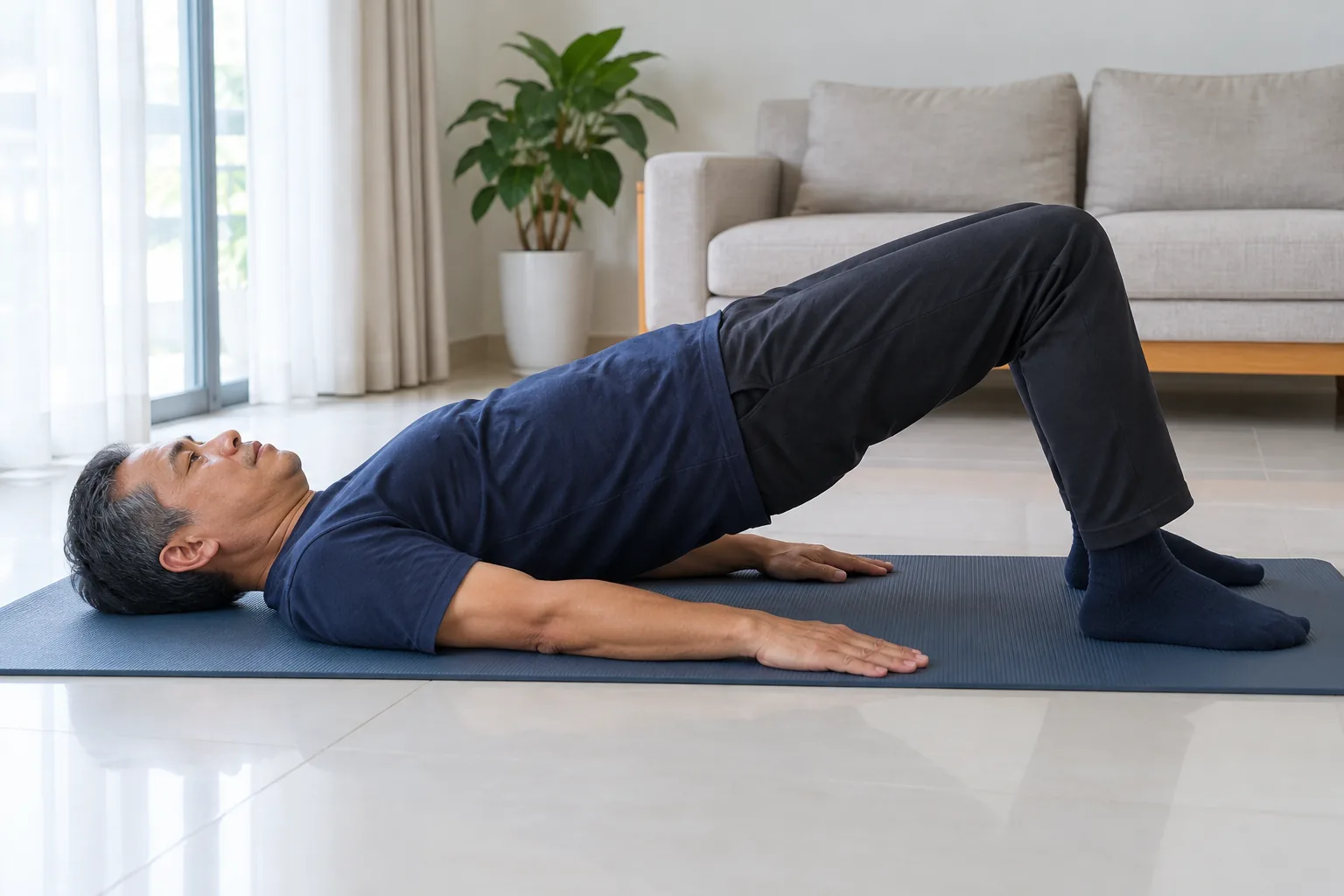
- Bridging (lying on your back). With knees bent and feet flat on the floor or bed, lift your pelvis and lower back off the floor. Hold the position for five seconds, then lower down slowly.[8]
- Lying leg raise (lying face down). Tighten your stomach and buttock muscles to lift one leg slightly off the floor while keeping your hips flat on the ground. Hold for 5 to 10 seconds and repeat 3 times.[8]
Walking and the pool
If you are not very active but are able to walk, increase your walking distance gradually.[7]
If your joints are a problem, the NHS suggests checking whether your local swimming pool holds exercise classes. The water helps to support your joints while you move and can help you strengthen your muscles.[7]
How do I start safely?
Start slowly and build up. Speak to a healthcare professional first if you have not exercised for some time, have medical conditions, or have had recent hip surgery.
Arthritis UK advises starting slowly and building up gradually if you are new to exercise. It also advises getting advice and support from a healthcare professional or fitness instructor if you have any concerns about starting a new exercise plan.[8]
The NHS says to speak to your GP first if you have not exercised for some time, or if you have medical conditions or concerns. It adds that your activity and its intensity should be appropriate for your fitness.[3]
After hip surgery, take particular care. Arthritis UK notes that its seated external hip rotation exercise may not be suitable if you have had recent hip surgery, and that you should speak to a healthcare professional if you are unsure.[8]
When should I seek help for hip pain?
Some hip pain needs urgent care. Severe pain after a fall, or not being able to put weight on your leg, is an emergency. Do not try to diagnose the cause of hip pain yourself.[1]
A broken hip (hip fracture) is serious. Severe hip pain after a fall or injury, or being unable to walk or put weight on your leg, needs urgent attention, because a broken hip needs treatment in hospital straight away.[1][2]
Seek urgent medical care if:
- you have severe hip pain after a fall or injury
- you are unable to walk or put weight on your leg
- you have any tingling or loss of feeling in your hip or leg after an injury
Arrange an urgent medical assessment, without waiting for a routine appointment, if:
- you have severe hip pain that started suddenly, but you have not had a fall or injured your hip
- your hip is swollen and feels hot
- you have hip pain, feel generally unwell and have a high temperature (or feel hot, cold or shivery)
See a doctor if:
- hip pain is stopping you doing normal activities or affecting your sleep
- the pain is getting worse or keeps coming back
- the pain has not improved after treating it at home for 2 weeks
All of these signs come from NHS guidance.[1][2]
Where can I read more?
- The hip care overview explains the common hip conditions and how they are assessed.
- Persistent pain on the outside of the hip is covered on the outer hip pain page.
- Weekly activity doses for each age group are on the daily physical activity by age guide.
- See also stretches to do while sitting at your desk.
- See also a full body workout at home.
References
- NHS. Hip pain in adults. Available at: https://www.nhs.uk/symptoms/hip-pain/ (last reviewed 20 November 2025)
- NHS. Broken hip. Available at: https://www.nhs.uk/conditions/broken-hip/
- NHS. Physical activity guidelines for adults aged 19 to 64. Available at: https://www.nhs.uk/live-well/exercise/physical-activity-guidelines-for-adults-aged-19-to-64/ (last reviewed 22 May 2024)
- HealthHub / Health Promotion Board. Singapore Physical Activity Guidelines for Adults (18-64 years) leaflet. Available at: https://ch-api.healthhub.sg/api/public/content/a0254274ebdd40ab95c7c630a59acc31?v=dab36f97
- NHS. Sitting exercises. Available at: https://www.nhs.uk/live-well/exercise/sitting-exercises/ (last reviewed 18 January 2024)
- NHS. Strength exercises. Available at: https://www.nhs.uk/live-well/exercise/strength-exercises/ (last reviewed 28 February 2024)
- NHS. Walking for health. Available at: https://www.nhs.uk/live-well/exercise/walking-for-health/ (last reviewed 15 December 2022)
- Arthritis UK (Versus Arthritis). Exercises for the hips. Available at: https://versusarthritis.org/about-arthritis/exercising-with-arthritis/exercises-for-healthy-joints/exercises-for-the-hips/
- NHS. How to warm up before exercising. Available at: https://www.nhs.uk/live-well/exercise/how-to-warm-up-before-exercising/ (last reviewed 24 June 2026)
Final next step
Reading about a problem is a starting point. Hip pain that keeps coming back or is not settling deserves an assessment rather than guesswork. An assessment brings together the history, an examination where needed and any useful tests, and helps you and your clinician decide what to do next.
If a hip problem may need urgent attention, such as after a fall or if you cannot bear weight, seek urgent medical care.[1]
Was this page helpful?