
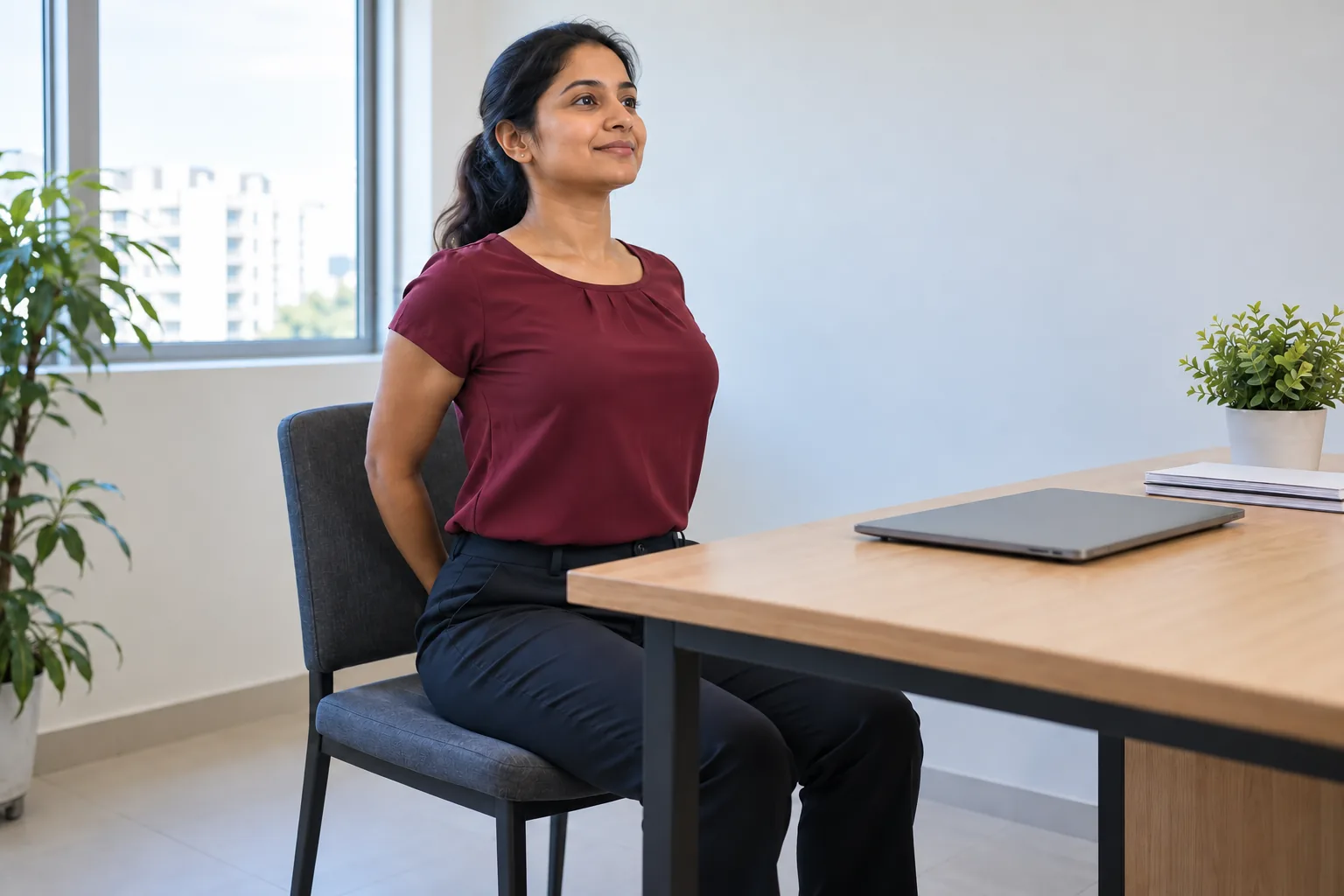
You can stretch at your desk with simple seated movements. Singapore physical activity guidance for adults advises breaking up sitting periods of 90 minutes or more with 5 to 10 minutes of physical activity.[5] This page gives four movements with doses from published sources, how often to move, and ways to stay active when working from home.
What’s covered on this page
- Why does sitting for long periods matter?
- How often should I move during desk work?
- What stretches and moves can I do at my desk?
- What can I do when working from home?
- What else helps me stay active at home?
- When should I stop, and when should I get advice?
- References
- Final next step
Why does sitting for long periods matter?
Research suggests many adults sit for more than seven hours a day. The NHS says evidence is emerging that sitting or lying down for long periods is bad for your health. Meeting a weekly exercise target does not cancel out the rest of the day spent sitting.
The NHS reports that research suggests many adults spend more than 7 hours a day sitting down, at work, on transport or in their leisure time. People aged over 65 spend 10 hours or more each day sitting or lying down, which makes them the most sedentary age group.[1]
The NHS also says that you can hit your weekly activity target but still be at risk of ill health if you spend the rest of the time sitting or lying down.[1]
The World Health Organization (WHO) reports that higher amounts of sedentary behaviour are associated with poorer health outcomes. This is an association found in studies. It does not show that sitting on its own causes them.[3]
The outcomes the WHO links to higher amounts of sedentary behaviour in adults
The WHO fact sheet lists these outcomes as associated with higher amounts of sedentary behaviour in adults:[3]
- higher death rates from any cause
- higher death rates from cardiovascular disease and from cancer
- more cardiovascular disease, cancer and type 2 diabetes
How often should I move during desk work?
Singapore guidance advises breaking up sitting periods of 90 minutes or more with 5 to 10 minutes of physical activity. Weekly activity targets still apply.
The Health Promotion Board (HPB) guideline for adults aged 18 to 64 says: “Break up sedentary periods of 90+ minutes with 5-10 minutes of physical activity.”[5] It adds that, where possible, adults should break up prolonged sedentary periods with light physical activity, and that any level of physical activity is better than none.[5]
The WHO 2020 guidelines recommend reducing sedentary behaviour across all age groups and abilities. They note that the evidence was insufficient to quantify a sedentary behaviour threshold.[4] For a break figure, this page therefore uses the Singapore guideline above.
Weekly activity targets in three guidelines
| Guideline | Weekly recommendation for adults | Source |
|---|---|---|
| NHS, adults aged 19 to 64 | At least 150 minutes of moderate intensity activity a week, or 75 minutes of vigorous intensity activity a week. Strengthening activities that work all the major muscle groups on at least 2 days a week. Reduce time spent sitting or lying down, and break up long periods of not moving with some activity. | [2] |
| HPB, Singapore, adults aged 18 to 64 | At least 150 to 300 minutes of moderate-intensity aerobic physical activity per week | [5] |
| WHO 2020 | 150 to 300 minutes of moderate-intensity, or 75 to 150 minutes of vigorous-intensity, aerobic physical activity per week (or an equivalent combination). Regular muscle-strengthening activity for all age groups. | [4] |
What stretches and moves can I do at my desk?
Four movements are listed below: a chest stretch, hip marching, sit-to-stand and shoulder rolls. Each has the dose its source gives. Move slowly and stay within what is comfortable.
- Chest stretch (seated). Sit upright and away from the back of the chair. Pull your shoulders back and down. Extend your arms out to the side. Gently push your chest forward and up until you feel a stretch across your chest. Hold for 5 to 10 seconds and repeat 5 times. The NHS says this stretch is good for posture.[6]
- Hip marching (seated). Lift your left leg with your knee bent as far as is comfortable. Place your foot down with control. Do 5 lifts with each leg. The NHS says this exercise will strengthen hips and thighs.[6]
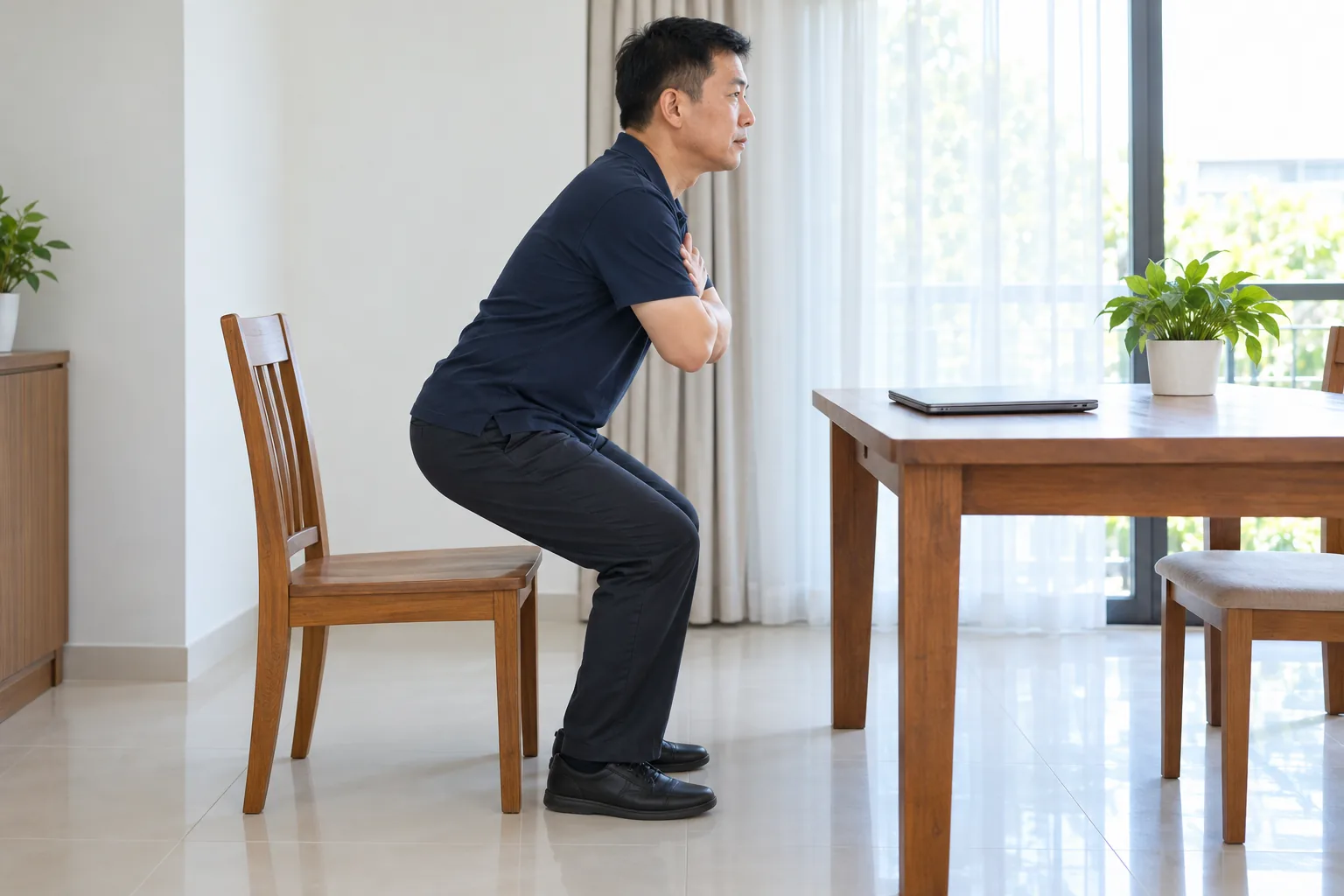
- Sit-to-stand. Stand up slowly using your legs, not your arms. Keep looking forward. Aim for 5 repetitions. The slower the repetitions, the better.[7]
- Shoulder rolls. Roll your shoulders forwards 5 times and backwards 5 times, and let your arms hang loose by your sides. The NHS dose is 2 sets of 10 repetitions. In the NHS warm-up this is done while marching on the spot.[8]
 Owner clinical review required · not a release asset
What can I do when working from home?
Small changes are a sound place to start, and the Singapore guideline gives an example.
HPB advises: “Start with small changes like taking the stairs instead of the lift, as better beats perfect.”[5] The NHS adds that as well as raising your own activity levels, you should reduce the amount of time you and your family spend sitting down.[1]
What else helps me stay active at home?
Weekly activity doses for each age group are on a separate guide. A standing, whole-body routine is another option.
- The daily physical activity by age guide sets out the weekly activity doses by age group.
- The full body workout at home page gives a standing routine that needs no equipment.
- If you want a hip-focused routine, see how to strengthen your hip joints.
- For hip conditions and how they are assessed, see the hip care hub.
When should I stop, and when should I get advice?
Stop any movement that causes pain or makes you feel unwell. If you are unsure these movements suit you, check with a healthcare professional first.
The NHS advice is to stop the exercise immediately if you feel any pain or become unwell.[8] The NHS sitting exercises page adds that if you are not sure the exercises are suitable for you, you should check with a GP or a health professional involved with your care.[6]
References
- NHS. Benefits of exercise. Available at: https://www.nhs.uk/live-well/exercise/exercise-health-benefits/ (last reviewed 15 August 2024)
- NHS. Physical activity guidelines for adults aged 19 to 64. Available at: https://www.nhs.uk/live-well/exercise/physical-activity-guidelines-for-adults-aged-19-to-64/ (last reviewed 22 May 2024)
- World Health Organization. Physical activity (fact sheet). Available at: https://www.who.int/news-room/fact-sheets/detail/physical-activity (26 June 2024)
- Bull FC et al. World Health Organization 2020 guidelines on physical activity and sedentary behaviour. Br J Sports Med. 2020;54(24):1451-1462. PMID 33239350. Available at: https://bjsm.bmj.com/content/54/24/1451
- HealthHub / Health Promotion Board. Singapore Physical Activity Guidelines for Adults (18-64 years) leaflet. Available at: https://ch-api.healthhub.sg/api/public/content/a0254274ebdd40ab95c7c630a59acc31?v=dab36f97
- NHS. Sitting exercises. Available at: https://www.nhs.uk/live-well/exercise/sitting-exercises/ (last reviewed 18 January 2024)
- NHS. Strength exercises. Available at: https://www.nhs.uk/live-well/exercise/strength-exercises/ (last reviewed 28 February 2024)
- NHS. How to warm up before exercising. Available at: https://www.nhs.uk/live-well/exercise/how-to-warm-up-before-exercising/ (last reviewed 24 June 2026)
Final next step
Keep moving in small amounts. The Singapore guideline’s message is that any level of physical activity is better than none.[5] The guides linked above cover weekly activity doses by age and a standing whole-body routine.
Was this page helpful?