
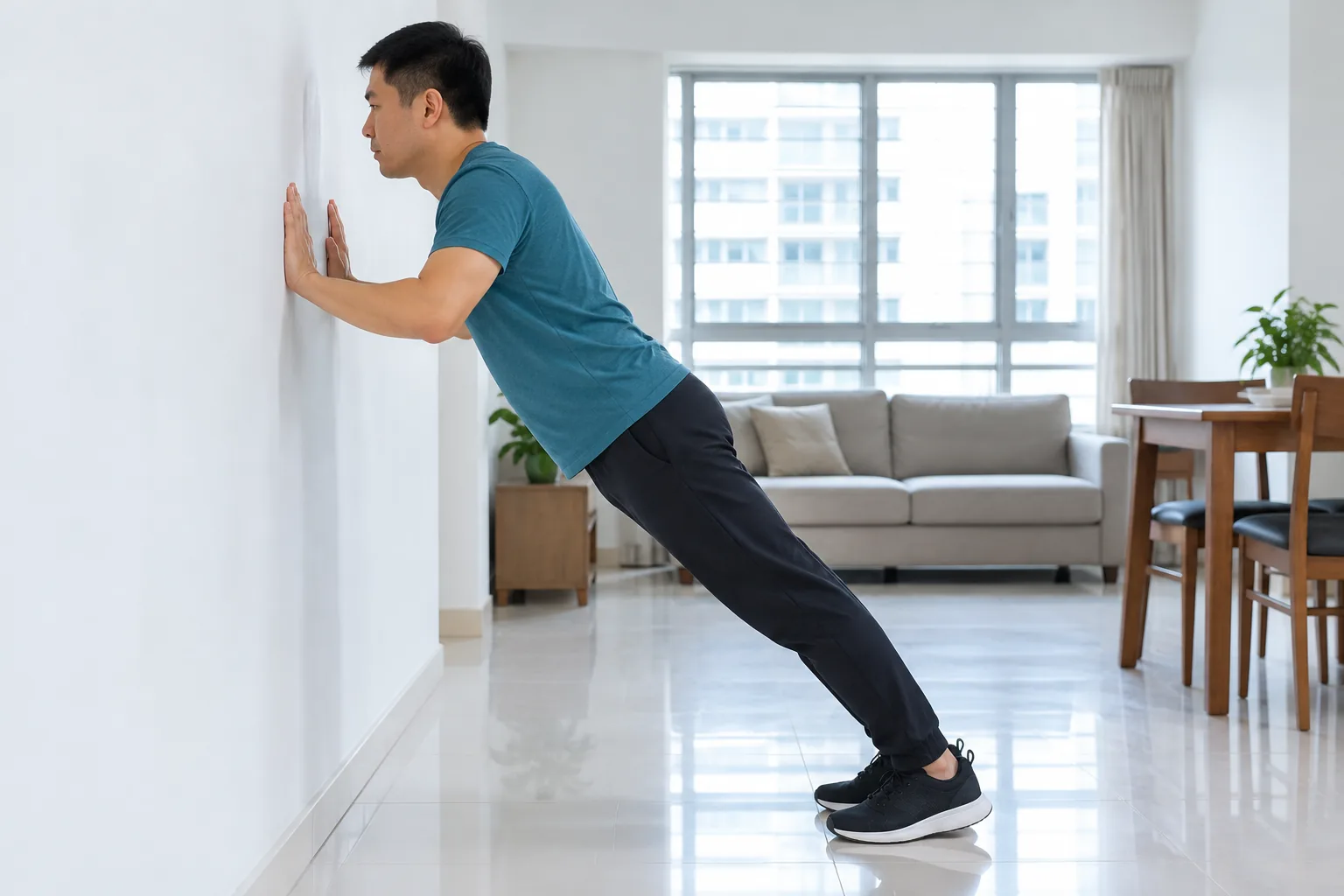
A full body workout at home needs only a wall and a solid chair: a short warm-up, then simple strength moves such as wall push-ups, sit-to-stands and calf raises. NHS guidance gives each move a dose and suggests doing them at least twice a week.[2] This page is for general adults and covers how to start safely.
What’s covered on this page
- Who is this workout for?
- How do I warm up?
- What exercises does the workout include?
- How much activity should I aim for each week?
- When should I stop or get advice first?
- Where can I read more?
- References
- Final next step
Who is this workout for?
This routine is for general adults. The NHS says its exercises are suitable for most people in good health with a reasonable level of fitness. If you have a health problem, an injury, symptoms or a recent operation, get advice first.
The NHS advice is to get advice from a healthcare professional (such as a GP) before trying these exercises if any of the following applies:[1]
- you have a health problem
- you have an injury
- you have any symptoms
- you are feeling unwell
- you have had a recent health event, such as a heart attack or an operation
The World Health Organization (WHO) adds a point for people who are not currently active. It says pre-exercise medical clearance is generally unnecessary, and that people who are not currently regularly active and have no contraindications (medical reasons to avoid exercise) can start and gradually increase their activity without a medical clearance. It adds that those who develop new symptoms when increasing their levels of activity should consult a healthcare provider.[4]
How do I warm up?
A proper warm-up takes at least six minutes. The NHS warm-up has five moves in its written routine: marching on the spot, heel digs, knee lifts, shoulder rolls and knee bends.
The NHS advises warming up properly before exercising, to prevent injury and make your workouts more effective. The routine should take at least 6 minutes, and you can warm up for longer if you feel the need.[1]
- March on the spot. Start by marching on the spot, then march forwards and backwards. Keep going for 3 minutes.[1]
- Heel digs. Place alternate heels to the front, keeping the front foot pointing up, and punch out with each heel dig. Keep a slight bend in the supporting leg. Aim for 60 heel digs in 60 seconds.[1]
- Knee lifts. Aim for 30 knee lifts in 30 seconds.[1]
- Shoulder rolls. Roll your shoulders forwards 5 times and backwards 5 times, and let your arms hang loose by your sides. The dose is 2 sets of 10 repetitions.[1]
- Knee bends. Do 10 repetitions. Lower yourself no more than 10 cm by bending your knees, then come up and repeat.[1]
 Owner clinical review required · not a release asset
What exercises does the workout include?
Six strength moves, all using a wall or a solid chair. Do them at least twice a week and build up slowly.
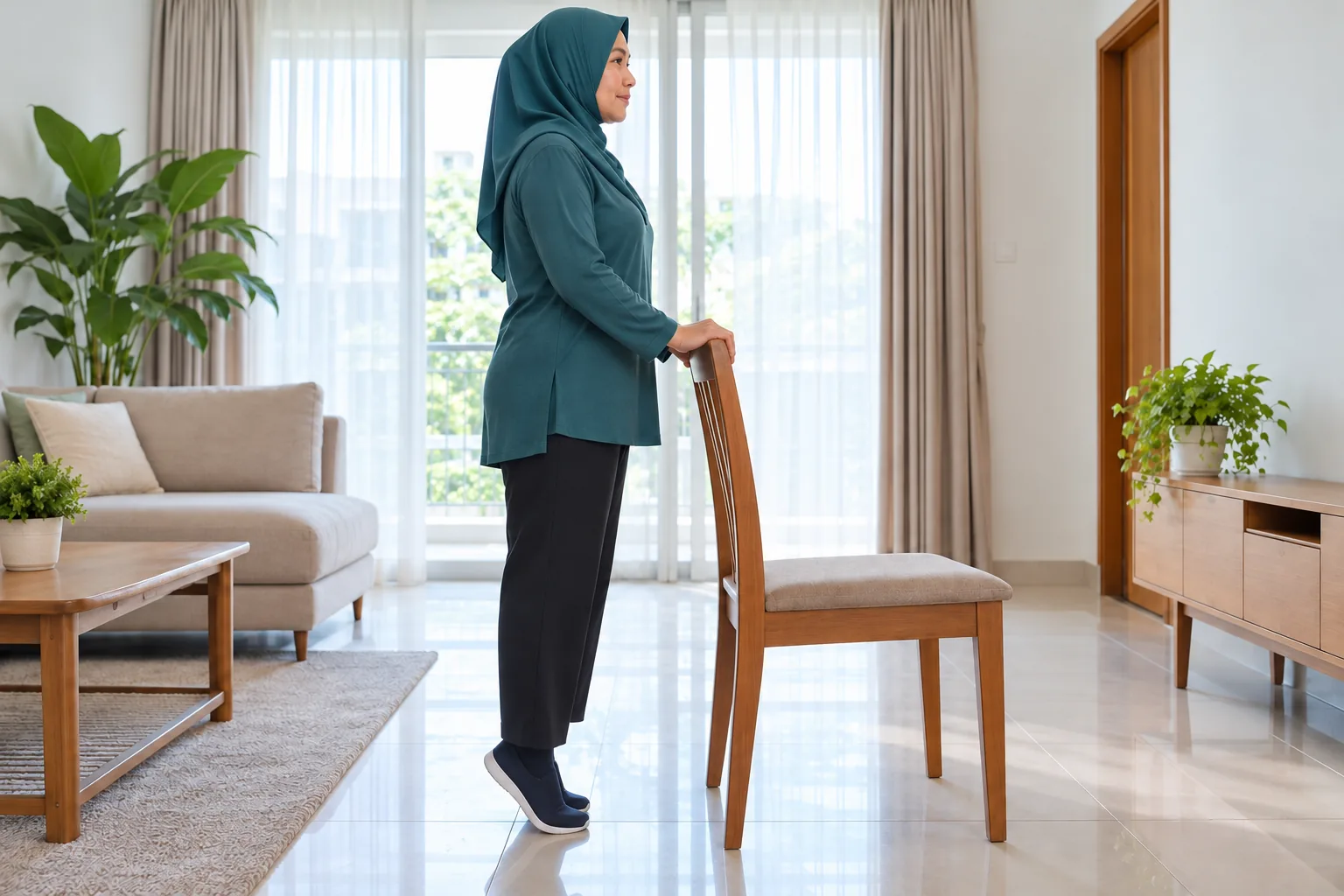
For the chair-based moves, the NHS advises choosing a solid, stable chair that does not have wheels and will not slip on the surface it is on. You should be able to sit with your feet flat on the floor and your knees bent at right angles. Avoid chairs with arms, as these restrict your movement.[2]
- Wall push-up. Stand at arm’s length from the wall. Place your hands flat against the wall at chest level, with your fingers pointing upwards. With your back straight, slowly bend your arms, keeping your elbows by your side. Aim to close the gap between you and the wall as much as you can. Attempt 3 sets of 5 to 10 repetitions.[2]
- Sit-to-stand. Stand up slowly using your legs, not your arms. Keep looking forward. Aim for 5 repetitions. The slower the repetitions, the better.[2]
- Mini-squat. Rest your hands on the back of the chair for stability and stand with your feet hip-width apart. Slowly bend your knees as far as is comfortable, keeping them facing forwards, with your back straight at all times. Repeat 5 times.[2]
- Calf raise. Hold the chair for support. Lift both heels off the floor as far as is comfortable. The movement should be slow and controlled. Repeat 5 times.[2]
- Sideways leg lift. Hold the chair for support. Raise your right leg to the side as far as is comfortable, keeping your back and hips straight, and avoid tilting to the right. Raise and lower each leg 5 times.[2]
- Leg extension backwards. Hold the chair for support. Standing upright, raise your left leg backwards, keeping it straight, and avoid arching your back. Hold the lift for up to 5 seconds and repeat 5 times with each leg.[2]
The NHS says to build up slowly, aim to gradually increase the repetitions of each exercise over time, and try to do these exercises at least twice a week.[2]
How many repetitions?
The NHS doses above start at 5 repetitions for most moves, and the NHS says to increase the repetitions gradually over time.[2]
The Singapore guideline for adults aged 18 to 64 gives a general good practice of completing 8 to 12 repetitions per set to achieve strengthening outcomes.[5]
How much activity should I aim for each week?
Guidelines ask for 150 to 300 minutes of moderate activity a week, plus strengthening on at least two days. Bouts of moderate-to-vigorous activity of any duration count, and some activity is better than none.
Weekly activity targets in three guidelines
| Guideline | Weekly recommendation for adults | Source |
|---|---|---|
| NHS, adults aged 19 to 64 | At least 150 minutes of moderate intensity activity a week, or 75 minutes of vigorous intensity activity a week. Strengthening activities that work all the major muscle groups on at least 2 days a week. | [3] |
| WHO 2020 | 150 to 300 minutes of moderate-intensity, or 75 to 150 minutes of vigorous-intensity, aerobic physical activity per week (or an equivalent combination). Regular muscle-strengthening activity for all age groups. | [4] |
| Health Promotion Board (HPB), Singapore, adults aged 18 to 64 | At least 150 to 300 minutes of moderate-intensity aerobic physical activity per week. Strengthen muscles, bones and joints through activities at moderate or vigorous intensity at least 2 days per week. | [5] |
The WHO 2020 guidelines say moderate-to-vigorous activity bouts of any duration now count towards these recommendations. They also say that if you are not currently meeting the recommendations, doing some physical activity will bring benefits to health, and that you should start with small amounts and gradually increase frequency, intensity and duration over time.[4]
When should I stop or get advice first?
Stop any exercise that causes pain or makes you feel unwell. Get advice before starting if you have a health problem, an injury, symptoms or a recent operation.
The NHS advice is to stop the exercise immediately if you feel any pain or become unwell.[1] It also advises getting advice from a healthcare professional before trying these exercises if you have a health problem, an injury, any symptoms, are feeling unwell, or have had a recent health event such as a heart attack or operation.[1] The WHO adds that people who develop new symptoms when increasing their levels of activity should consult a healthcare provider.[4]
Where can I read more?
- The daily physical activity by age guide sets out weekly activity doses for each age group.
- The page on stretches to do while sitting at your desk gives a seated routine for other days.
- If knee pain is what brought you here, see the knee care hub.
- For sports injuries and how they are assessed, see the sports injury hub.
References
- NHS. How to warm up before exercising. Available at: https://www.nhs.uk/live-well/exercise/how-to-warm-up-before-exercising/ (last reviewed 24 June 2026)
- NHS. Strength exercises. Available at: https://www.nhs.uk/live-well/exercise/strength-exercises/ (last reviewed 28 February 2024)
- NHS. Physical activity guidelines for adults aged 19 to 64. Available at: https://www.nhs.uk/live-well/exercise/physical-activity-guidelines-for-adults-aged-19-to-64/ (last reviewed 22 May 2024)
- Bull FC et al. World Health Organization 2020 guidelines on physical activity and sedentary behaviour. Br J Sports Med. 2020;54(24):1451-1462. PMID 33239350. Available at: https://bjsm.bmj.com/content/54/24/1451
- HealthHub / Health Promotion Board. Singapore Physical Activity Guidelines for Adults (18-64 years) leaflet. Available at: https://ch-api.healthhub.sg/api/public/content/a0254274ebdd40ab95c7c630a59acc31?v=dab36f97
Final next step
Start small and build up gradually. The WHO guidelines say that doing some physical activity brings benefits to health even if you are not yet meeting the recommendations.[4] The guides linked above cover weekly activity doses by age and a seated routine.
Was this page helpful?