
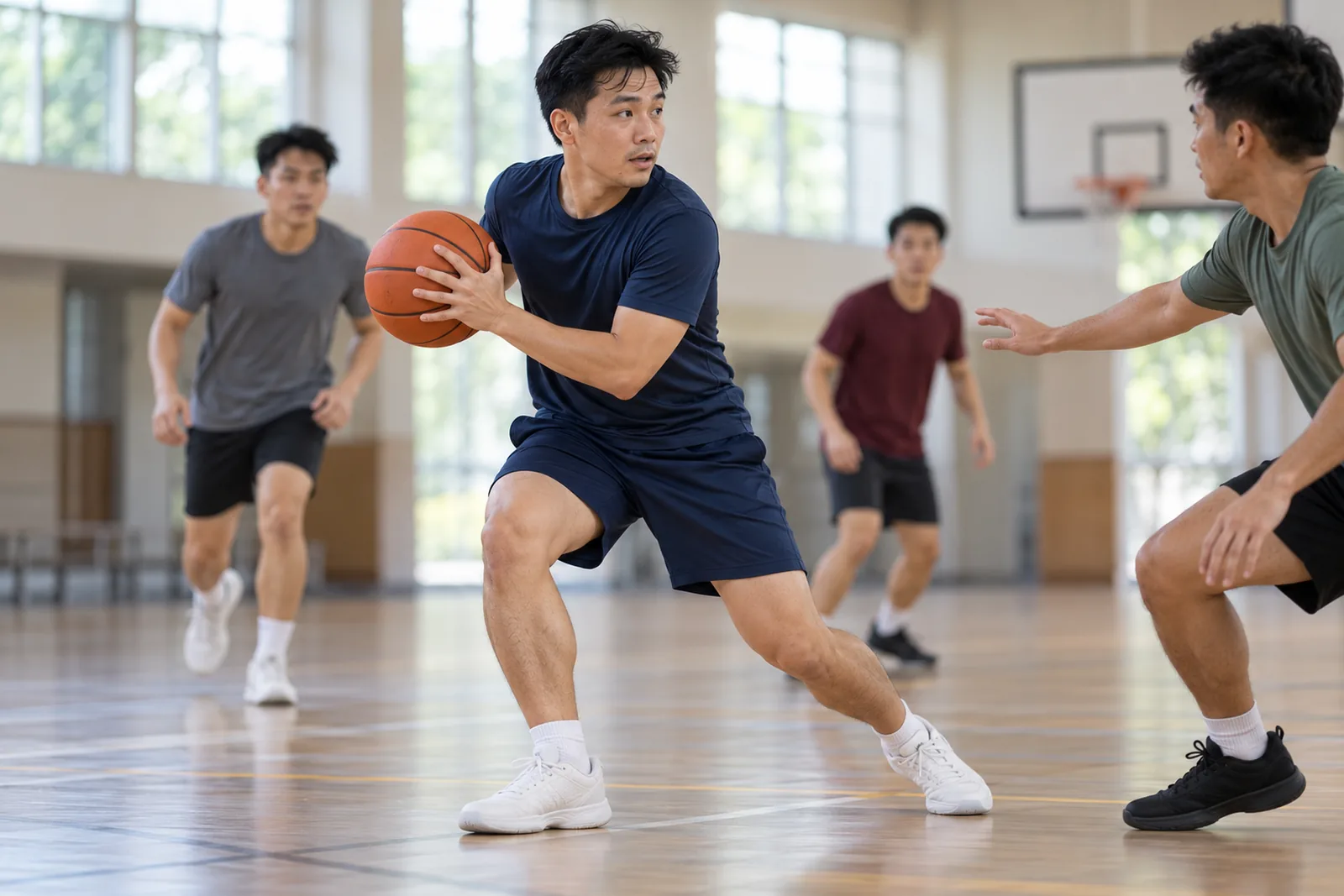
Meniscus injuries are estimated to account for 10 to 20 percent of knee injuries in young athletes, as cited in a 2024 review (Marigi et al., 2024). Some tears are repaired, some trimmed and some managed with exercise therapy. Treatment depends on the type and position of the tear and on the person, not on the scan alone.
How common are meniscus injuries in athletes?
Meniscus injuries are estimated to account for 10 to 20 percent of knee injuries in young athletes, as cited in a 2024 review (Marigi et al., 2024). Some tears are repaired, some trimmed and some managed with exercise therapy.
- The meniscus is the C-shaped cushion of cartilage between the thigh bone and the shin bone. It spreads load across the knee and helps with shock absorption and stability.
- Treatment depends on the type and position of the tear and on the person, not on the scan alone.
- Return to sport is guided by milestones as well as time.
More on where the 10 to 20 percent figure comes from
The figure is an estimate that a 2024 review of meniscus tears in elite athletes cites from earlier sources, and it describes young athletes as a group. It is not a prediction for any one person or sport.
What does this page cover?
- How common are meniscus injuries in athletes?
- What is a meniscus injury?
- What causes a meniscus injury in sport?
- How does a meniscus problem show itself?
- How is a meniscus injury diagnosed?
- Do athletes with a meniscus tear always need surgery?
- What is the difference between meniscus repair and partial meniscectomy?
- Can athletes return to sport after a meniscus injury?
- What else do athletes ask about meniscus injuries?
- When is urgent help needed for a knee problem?
- What should I do next?
What is a meniscus injury?
A meniscus injury is a tear in the meniscus. Each knee has two menisci, a medial (inner) one and a lateral (outer) one. Together they spread the load that passes through the knee with every step, and they contribute to shock absorption and stability (Fox et al., 2015).
- Medial meniscus tears are generally more common than lateral ones, possibly because the medial meniscus is less mobile (StatPearls).
- In athletes with a stable knee, medial meniscus tears are more prevalent than lateral ones, although there are certain notable exceptions (Marigi et al., 2024).
- Only the outer rim of the meniscus has a meaningful blood supply. Because of that limited blood supply, only certain types of tear are feasible to repair (Fox et al., 2015).
What causes a meniscus injury in sport?
A traumatic impact to the knee can result in a meniscus tear, either on its own (an isolated tear, where the meniscus is the only structure injured) or together with damage to a primary stabilising ligament of the knee (one of the main ligaments that hold the knee steady), such as the anterior cruciate ligament (ACL) (StatPearls).
- A traumatic knee injury can damage more than the meniscus, so assessment looks at the whole knee.
- Meniscus tears can occur together with ACL injury. People with ACL-deficient knees (knees without a working ACL) are more at risk of medial meniscus tears, especially if ACL reconstruction is delayed for longer than one year from the time of initial injury (StatPearls). The ACL reconstruction surgery page explains how an ACL injury is assessed.
More on squatting, kneeling and lifting
A 2024 international consensus found that work-related heavy lifting and carrying, kneeling, deep squatting and a high volume of climbing are associated with a higher risk of meniscus injury (Prill et al., 2025; evidence grade A). This is an association. It does not mean that squatting in ordinary exercise causes tears.
How does a meniscus problem show itself?
Pain is typically reported over the joint line, at the front inner or front outer side of the knee. Depending on the type and extent of the tear, there may also be a sensation of catching or a feeling that the knee gives way (StatPearls). Swelling that develops gradually over the course of 24 hours is more indicative of an isolated meniscus tear (StatPearls).
- Catching is the feeling that something is snagging inside the knee as it moves.
- Giving way is a brief loss of control or support, as though the knee lets you down.
A knee that is stuck and will not straighten is on the urgent list further down this page.
How is a meniscus injury diagnosed?
Diagnosis starts with the athlete’s story and an examination of the whole knee. The story covers how the injury happened, which sport was involved and how the knee has behaved since. The examination may include the McMurray test. In the McMurray test, you lie on your back; the doctor bends your knee fully, then straightens it part of the way to a right angle while holding the shin turned in or out.
- The doctor puts the story, the examination and, where needed, imaging together.
- A reference text describes imaging as beginning with X-rays, which are used to assess for other bony problems, loose bodies (loose fragments inside the joint) and osteoarthritis (wear-and-tear arthritis of the joint) (StatPearls).
- MRI (magnetic resonance imaging, a detailed scan of the knee) is described as the best form of imaging to diagnose and characterise meniscus tears (StatPearls).
More on how well MRI and the bedside test perform
In one reference text, MRI was reported to be 93 percent sensitive and 88 percent specific for medial meniscus tears, and 79 percent sensitive and 96 percent specific for lateral meniscus tears, using arthroscopy as the reference standard. The same text reports the McMurray test at 61 percent sensitivity and 84 percent specificity (StatPearls). Sensitivity is how often a test picks up a tear that is there; specificity is how often it correctly stays negative when no tear is there. The bedside test is imperfect, which is why it is read together with the rest of the assessment.
Do athletes with a meniscus tear always need surgery?
No. A 2024 international consensus reported that surgery and exercise therapy are both viable treatment options for traumatic and non-traumatic meniscus tears, based on two studies of self-reported outcomes (Prill et al., 2025; evidence grade A). The statement refers to meniscus tears generally and does not single out athletes.
- Some complex tears in younger patients, such as bucket-handle tears (where a displaced fragment of meniscus can catch in the joint), may call for earlier surgery (Prill et al., 2025; evidence grade D).
- For wear-related (degenerative) meniscus lesions, the consensus recommends non-operative treatment, including physical therapy, as the first approach (Prill et al., 2025; evidence grade A).
- For traumatic tears, a 2019 European consensus regards preserving the meniscus as the first line of treatment (Kopf et al., 2020).
 Owner clinical review required · not a release asset
What is the difference between meniscus repair and partial meniscectomy?
Meniscus repair stitches the torn edges together so that the meniscus can heal. Partial meniscectomy trims away the torn or unstable fragment and leaves as much stable tissue as possible. For traumatic tears, preserving the meniscus is regarded as the first line of treatment (Kopf et al., 2020), but only certain types of tear are feasible to repair because of the limited blood supply (Fox et al., 2015).
| Meniscus repair | Partial meniscectomy | |
|---|---|---|
| What it does | Stitches the torn edges together | Removes the torn or unstable fragment only |
| Return to sport | A 2024 consensus suggests about 6 to 9 months (low-grade evidence, meaning the evidence behind it is limited) | A 2024 consensus suggests about 4 to 12 weeks (low-grade evidence) |
| Tissue kept | The meniscus is preserved | Some load-bearing tissue is removed |
| Repeat arthroscopy (a second keyhole procedure) | Needed more often than after partial meniscectomy | Needed less often than after repair |
More on re-operation and long-term outcomes
In the 2019 European consensus on traumatic tears, repeat arthroscopy was needed in 16.5 percent after repair versus 1.4 percent after partial meniscectomy in the short term, and in 20.7 percent versus 3.9 percent in the long term. The same consensus found worse long-term clinical and X-ray outcomes after partial meniscectomy than after repair, and in some studies repair was followed by less osteoarthritis (wear-and-tear arthritis of the joint) (Kopf et al., 2020). These are group findings and not guarantees for any one person.
For the procedure itself, how the decision is made and what recovery involves, see meniscus repair surgery.
 Owner clinical review required · not a release asset
Can athletes return to sport after a meniscus injury?
Many athletes return to some level of sport, but timing and level vary. In the athlete studies reviewed in a 2019 systematic review, 81% to 88.9% of athletes returned to sport after meniscus repair (Lee et al., 2019). Returning to play is not the same as returning to the previous level, and return to sport is guided by milestones as well as time.
- After partial meniscectomy, the same review reported that most players returned to the preinjury activity level from 7 to 9 weeks.
- After isolated meniscus repair, the same review reported an average time to return to sport of 5.6 months. A 2024 consensus suggests about 6 to 9 months (low-grade evidence).
- Progress may be guided by milestones (reaching set goals rather than fixed dates), and the recommended time varies with the procedure, any other injuries in the knee and the type of sport (Prill et al., 2025).
More on a review of repair outcomes in athletes
A 2024 review summarised a systematic review of 28 studies of isolated meniscus repair (Eberbach and colleagues). It reported return to sport in about 90 percent of mixed-level athletes and 86 percent of professional athletes, on average 4.3 to 6.5 months after surgery (Marigi et al., 2024). These figures describe groups in the studies reviewed. Individual outcomes vary.
For more on getting back to activity after an operation, see post-surgery recovery and the injury prevention tips.
What else do athletes ask about meniscus injuries?
Which meniscus tears can be repaired?
It depends on where the tear sits. Only the outer portion of the meniscus has a meaningful blood supply, so only certain types of tear are feasible to repair (Fox et al., 2015). Whether a tear can be repaired is assessed for each person.
Is meniscus repair better than partial meniscectomy?
Neither is better for everyone. Preserving the meniscus is regarded as the first line of treatment for traumatic tears where the tear can be repaired (Kopf et al., 2020), but repair takes longer to recover from and was followed by repeat arthroscopy more often. The choice is made with the treating surgeon.
Is arthritis linked to how a meniscus tear is treated?
In the 2019 European consensus on traumatic tears, long-term outcomes were reported to be worse after partial meniscectomy than after repair, and in some studies repair was followed by less osteoarthritis (Kopf et al., 2020). This is one reason preserving tissue is favoured where a tear can be repaired. It is an association seen in groups, not a certainty for any one person.
Should I do my own rehabilitation programme?
A general webpage cannot prescribe a rehabilitation programme. Rehabilitation after a meniscus injury or operation depends on the tear, any operation and any other injuries in the knee, and it should come from the treating surgeon and physiotherapist.
When is urgent help needed for a knee problem?
What should I do next?
For an athlete with a knee injury, or anyone thinking about meniscus treatment, an assessment is a sensible next step. It brings together the person’s story, an examination of the whole knee and any tests that help, so that the patient and clinician can decide what to do next. The goal is the activity the person wants to return to. An appointment supports an informed decision. It is not a commitment to surgery.
- Read how the decision is made, and what repair and recovery involve, on the meniscus repair surgery page.
- Learn about cartilage repair surgery for damage to the joint surface.
- Read does running cause knee arthritis? for the wider picture on activity and the joint.
- Browse sports injury care for related articles.
- Read about the symptoms of a torn meniscus.
- Read about what the meniscus does in the knee.
- Read about what knee popping and cracking can mean.
- Arrange a knee assessment when you are ready.
- Read more about Dr Sean Leo, who is named as the author of this page.
This page provides general information and cannot diagnose an individual condition. OrthoKinetics does not provide emergency or urgent care through this webpage or its WhatsApp contact.
References
- Marigi EM, Davies MR, Marx RG, Rodeo SA, Williams RJ 3rd. Meniscus tears in elite athletes: treatment considerations, clinical outcomes, and return to play. Curr Rev Musculoskelet Med. 2024;17(8):313-320. doi:10.1007/s12178-024-09907-w. PMID:38833135. PMC11219605.
- Prill R, Ma CB, Wong SE, et al. The formal EU-US Meniscus Rehabilitation 2024 Consensus, Part II: prevention, non-operative treatment and return to sport. Knee Surg Sports Traumatol Arthrosc. 2025;33(8):3014-3024. doi:10.1002/ksa.12689.
- Kopf S, Beaufils P, Hirschmann MT, et al. Management of traumatic meniscus tears: the 2019 ESSKA meniscus consensus. Knee Surg Sports Traumatol Arthrosc. 2020;28(4):1177-1194. doi:10.1007/s00167-020-05847-3. PMID:32052121. PMC7148286.
- Raj MA, Bubnis MA. Knee Meniscal Tears. StatPearls [Internet]. Treasure Island (FL): StatPearls Publishing. Bookshelf ID NBK431067. https://www.ncbi.nlm.nih.gov/books/NBK431067/
- Fox AJS, Wanivenhaus F, Burge AJ, Warren RF, Rodeo SA. The human meniscus: a review of anatomy, function, injury, and advances in treatment. Clin Anat. 2015;28(2):269-287. doi:10.1002/ca.22456. PMID:25125315.
- Lee YS, Lee OS, Lee SH. Return to sports after athletes undergo meniscal surgery: a systematic review. Clin J Sport Med. 2019;29(1):29-36. doi:10.1097/JSM.0000000000000500. PMID:29023273.
Was this page helpful?