

How long does it take to recover from a meniscus tear?
There is no single answer, and the figures below are milestones from research, not dates. The meniscus is the C-shaped cartilage cushion between the thigh bone and the shin bone.
- For wear-related (degenerative) tears, guidance suggests trying non-operative care, including physiotherapy, first. Separately, an earlier surgical meniscus consensus recommended 3 to 6 months of non-operative treatment before a surgical decision, as cited in the 2024 EU-US consensus [1].
- For tears in general, including traumatic tears, a 2024 international consensus reported, based on two studies of self-reported outcomes, that surgery and exercise therapy are both viable treatment options (evidence grade A). Some complex tears in younger patients, such as bucket-handle tears (where a displaced fragment of meniscus can catch in the joint), may call for earlier surgery (evidence grade D) [1].
- After surgery, the clock depends on the operation. In studies of athletes, most returned to their pre-injury activity level about 7 to 9 weeks after a partial meniscectomy (trimming the torn fragment). After an isolated meniscus repair (stitching the tear), return to sport averaged about 5 to 6 months [5]. A 2024 consensus suggests about 4 to 12 weeks after partial meniscectomy and about 6 to 9 months after repair (low-grade evidence) [1].
- A 2024 consensus suggests progress may be guided by milestones (reaching set goals rather than fixed dates), similar to those used after a meniscus repair operation [1].
More on recovery after surgery
The time to return to sport after meniscus surgery comes mostly from studies of athletes. Recovery after surgery, including what a protected recovery involves, is covered on the meniscus repair surgery page and in post-surgery recovery. How long an exercise-based recovery takes also varies from person to person.
What’s covered on this webpage
- How long does it take to recover from a meniscus tear?
- Can a torn meniscus be treated without surgery?
- Does the location of the tear matter?
- What does exercise-based recovery involve?
- When should a slow recovery be reviewed?
- When is urgent help needed?
- What should I do next?
 Owner clinical review required · not a release asset
Can a torn meniscus be treated without surgery?
For one group, yes, and exercise is the first step. In middle-aged adults with wear-related (degenerative) tears and no arthritis on X-ray, a supervised exercise programme gave a similar change in KOOS4 score (a standard questionnaire about knee symptoms and function) to keyhole surgery at 2 years in one randomised trial (a trial in which people are assigned to a treatment by chance). A 2024 consensus recommends starting with non-operative care for degenerative tears [1][2].
- That finding applies to wear-related tears in middle-aged adults.
- Trying exercise first does not close off surgery later.
More on what the trial studied
The trial followed middle-aged patients with degenerative meniscal tears confirmed by magnetic resonance imaging (MRI, a detailed scan of the knee) and without arthritis on X-ray. At 2 years, 80% of the exercise group and 81% of the surgery group had improved by more than 10.1 points on the KOOS4 score. It was a single trial with 2-year follow-up, so it cannot show long-term results [2].
Does the location of the tear matter?
Yes. Only the outer edge of the meniscus has a meaningful blood supply. Blood vessels reach roughly the outer 10 to 30% of the inner (medial) meniscus and the outer 10 to 25% of the outer (lateral) meniscus. Because of that limited blood supply, only certain types of tear are feasible to repair [4].
- Whether a tear is treated by exercise or surgery is judged individually.
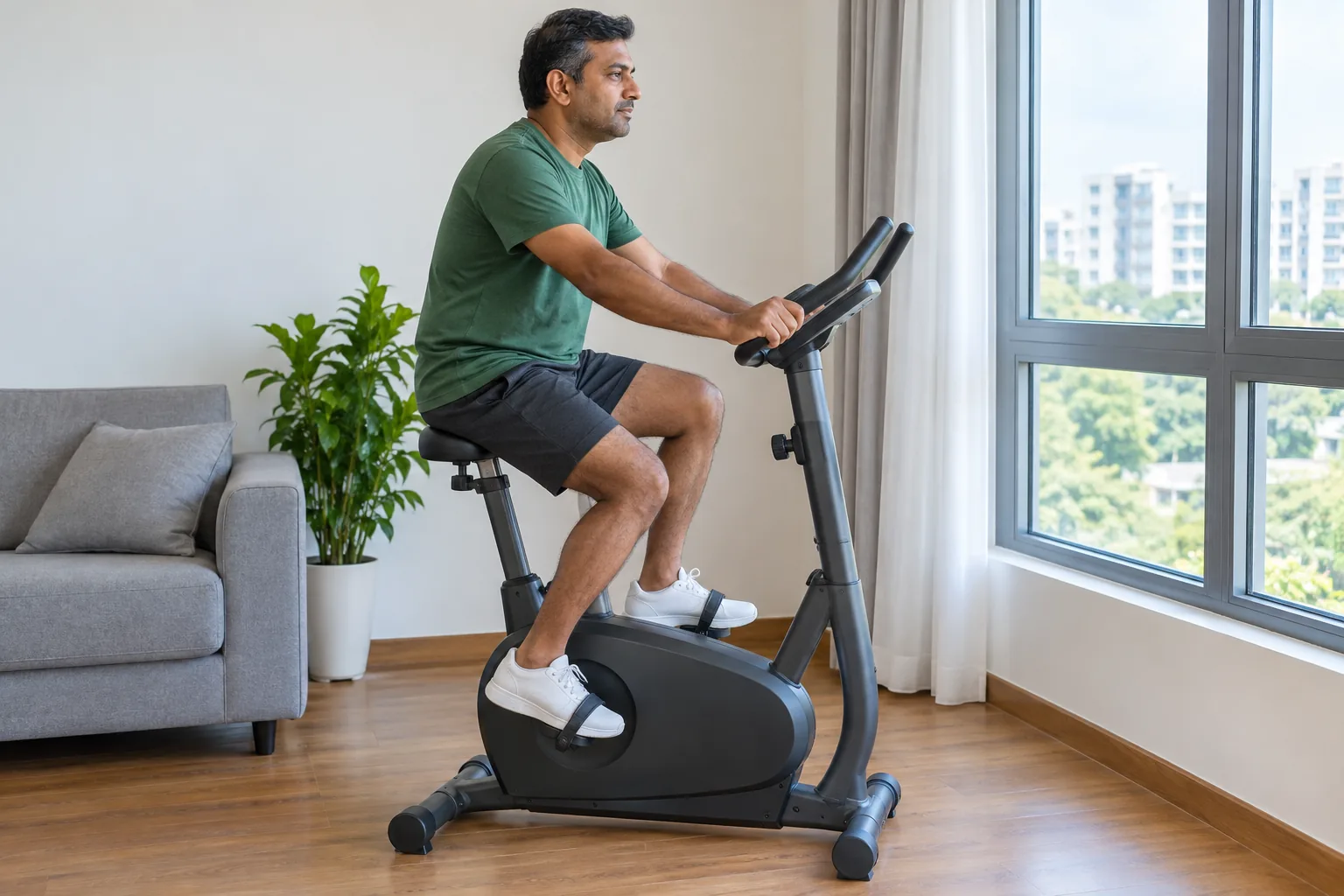
What does exercise-based recovery involve?
It is active, supervised and progressive. Treatment can combine range-of-motion work with progressive knee and hip strengthening and balance training, guided by a physiotherapist, with a home programme added to the supervised sessions [1].
- No current evidence compares one evidence-based treatment protocol with another. A 2024 consensus suggests progress may be guided by milestones (reaching set goals rather than fixed dates), similar to those used after a meniscus repair operation [1].
- A general webpage is not a self-directed exercise prescription. Which exercises, and how many, should come from the treating doctor and physiotherapist.
When should a slow recovery be reviewed?
If pain, swelling, catching or locking continue despite a structured trial of exercise therapy, it is reasonable to ask for an assessment of other options, including surgery [3]. A review looks at the whole picture. It is not a promise that surgery will help.
- Catching or a knee that gives way can go with a meniscus tear [3].
- A knee that will not straighten needs prompt assessment, covered in the next section.

When is urgent help needed?
A knee that is locked, so that it will not fully straighten, needs prompt assessment.
What should I do next?
For anyone recovering from a meniscus tear, or deciding how to treat one, an assessment is a sensible next step. It brings together the patient’s story, an examination and any tests that help, so that the patient and clinician can decide what to do next. An appointment supports an informed decision. It is not a commitment to surgery.
- Read how a meniscus tear is assessed and how the options compare on the meniscus repair surgery page.
- Read about knee arthroscopy and about injury prevention.
- Arrange a knee assessment when you are ready.
- Browse the Knee Hub for other knee problems, or more articles.
- Read more about Dr Sean Leo, who is named as the author of this page.
This page provides general information and cannot diagnose an individual condition. OrthoKinetics does not provide emergency or urgent care through this webpage or its WhatsApp contact.
References
- Prill R, et al. Formal EU-US Meniscus Rehabilitation 2024 Consensus, Part II: prevention, non-operative treatment, return to sport. Knee Surg Sports Traumatol Arthrosc. 2025;33(8):3014-3024. doi:10.1002/ksa.12689.
- Kise NJ, Risberg MA, Stensrud S, Ranstam J, Engebretsen L, Roos EM. Exercise therapy versus arthroscopic partial meniscectomy for degenerative meniscal tear in middle aged patients: randomised controlled trial with two year follow-up. BMJ. 2016;354:i3740. doi:10.1136/bmj.i3740. PMID:27440192. https://pubmed.ncbi.nlm.nih.gov/27440192/
- Raj MA, Bubnis MA. Knee Meniscal Tears. StatPearls [Internet]. Treasure Island (FL): StatPearls Publishing. Bookshelf ID NBK431067. https://www.ncbi.nlm.nih.gov/books/NBK431067/ Last updated: July 17, 2023.
- Fox AJS, Wanivenhaus F, Burge AJ, Warren RF, Rodeo SA. The human meniscus: a review of anatomy, function, injury, and advances in treatment. Clin Anat. 2015;28(2):269-287. doi:10.1002/ca.22456. PMID:25125315.
- Lee YS, Lee OS, Lee SH. Return to Sports After Athletes Undergo Meniscal Surgery: A Systematic Review. Clin J Sport Med. 2019;29(1):29-36. doi:10.1097/JSM.0000000000000500. PMID:29023273.
Was this page helpful?