

Extra body weight puts more load through the knees.[1] When you walk on level ground, the force on your knees is equivalent to 1½ times your body weight.[1] In older adults with overweight or obesity and knee osteoarthritis, each unit of weight lost was associated with about 4 units less load on the knee with each step.[2]
- What counts as excess weight?
- How much force goes through the knee?
- Why does weight matter for joints?
- Does extra weight put more stress on the meniscus?
- What does losing weight change?
- When is urgent help needed?
- What should I do next?
What counts as excess weight?
The World Health Organization (WHO) says overweight or obesity is diagnosed by measuring a person’s weight and height and calculating their body mass index (BMI): weight in kilograms divided by height in metres squared.[3] For adults, WHO defines overweight as a BMI greater than or equal to 25, and obesity as a BMI greater than or equal to 30.[3]
More on BMI
WHO says that other measures, such as waist circumference, can also be used to identify overweight or obesity.[3] It also says that the BMI categories for defining overweight and obesity vary by age and sex for adults, adolescents, children and infants.[3]
How much force goes through the knee?
When you walk across level ground, the force on your knees is equivalent to 1½ times your body weight.[1] As an example of the arithmetic, for a person who weighs 70 kg, 1½ times body weight is 105 kg on your knees with each step.
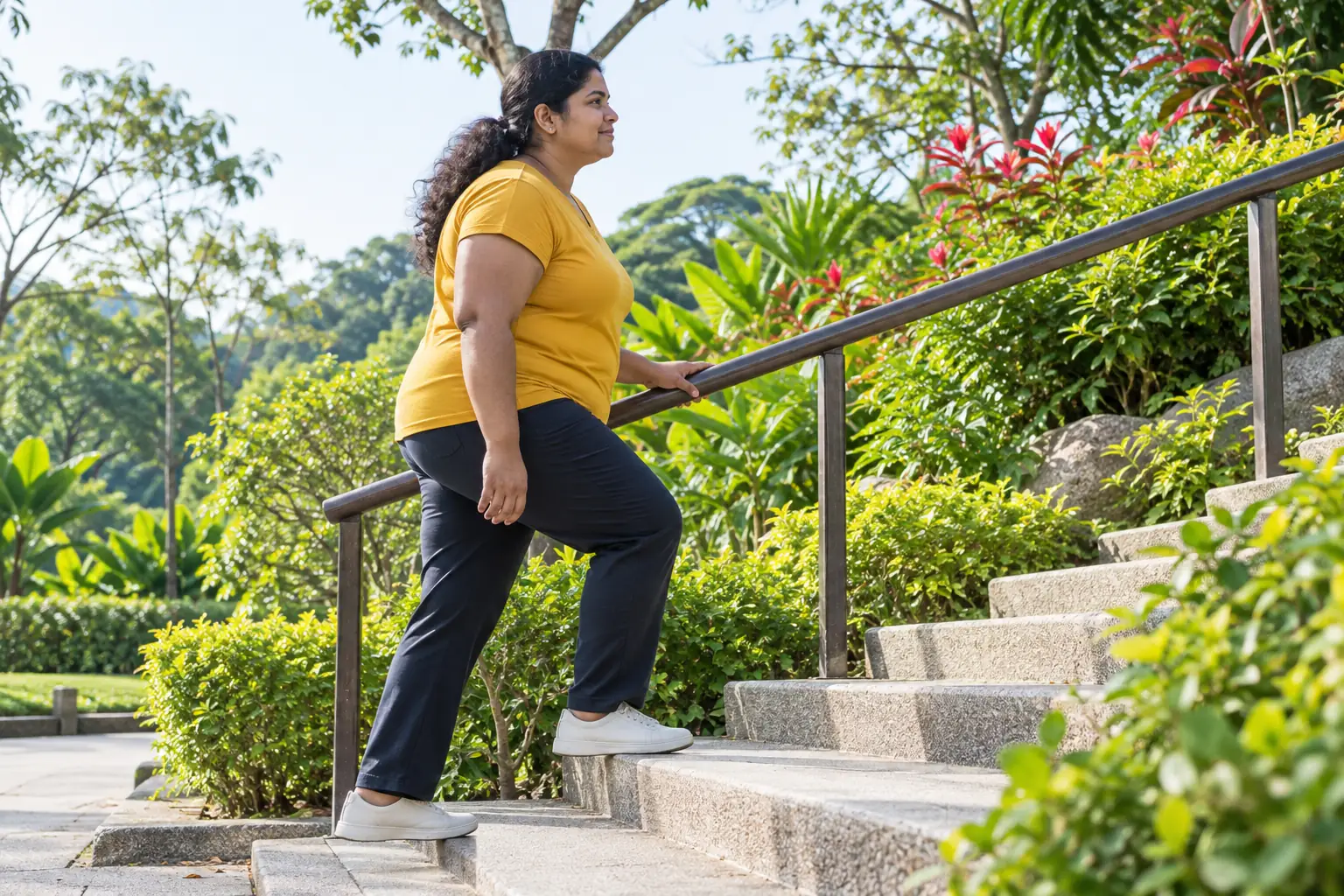
The force is higher on stairs and when squatting.[1]
| Activity | Force on the knees, as a multiple of body weight |
|---|---|
| Walking on level ground | 1½ times [1] |
| Going up and down stairs | 2 to 3 times [1] |
| Squatting to tie a shoelace or pick up something you dropped | 4 to 5 times [1] |
Why does weight matter for joints?
Being overweight raises the risk of developing osteoarthritis in two ways.[1] First, excess weight puts additional stress on weight-bearing joints, the knee for example.[1] Second, inflammatory factors associated with weight gain might contribute to trouble in other joints, the hands for example.[1]
Does extra weight put more stress on the meniscus?
The meniscus is a C-shaped cushion of cartilage between the thigh bone and the shin bone.[4] Its main job is to transmit load across the joint, and it has a secondary role in shock absorption and stability.[4] The load through the knee rises with body weight.[1]
Whether a knee problem involves the meniscus is something an assessment sorts out. The meniscus repair surgery page explains how meniscus problems are assessed and treated.

What does losing weight change?
In a trial that followed 142 sedentary older adults with overweight or obesity and knee osteoarthritis through 18 months of diet and exercise, each unit of weight lost was associated with an approximately 4-unit reduction in knee-joint forces.[2] The authors wrote that, accumulated over thousands of steps a day, a reduction of this magnitude would appear to be clinically meaningful.[2]
A systematic review of seven studies in adults with knee osteoarthritis and obesity found that 5% to 10% weight loss significantly improved pain, self-reported disability and quality of life (physical).[5] The adults in those studies had a mean BMI of 33.6 to 36.4 and mild to moderate knee osteoarthritis.[5] Results for physical function were inconclusive.[5]
A US guideline strongly recommends weight loss for knee and hip osteoarthritis in people who are overweight or obese.[6] The guideline says the benefit of weight loss for symptoms is enhanced by an exercise programme.[6]
More on what these figures describe
For a fuller guide, read the guest article Weight Loss and Knee Osteoarthritis: Why It Can Make A Meaningful Difference, contributed by a consultant endocrinologist. For the wider picture of managing arthritis pain, see how to manage arthritis pain.
When is urgent help needed?
The list below covers the signs that should not wait for a routine appointment.
What should I do next?
If knee pain is not settling, or you are unsure what is causing it, an assessment is a sensible next step. The assessment brings together the patient’s story, an examination and any tests that help, so that the patient and the surgeon can decide together. It looks at the structure involved, the patient as a whole person and the goal they want to return to. An appointment supports an informed decision. It is not a commitment to surgery.
- Learn about cartilage repair surgery for damage to the joint surface.
- Read about the Knee Hub.
- Arrange a knee assessment when you are ready.
This page provides general information and cannot diagnose an individual condition. OrthoKinetics does not provide emergency or urgent care through this webpage or its WhatsApp contact.
References
- Harvard Health Publishing. Why weight matters when it comes to joint pain. 11 December 2019. https://www.health.harvard.edu/pain/why-weight-matters-when-it-comes-to-joint-pain
- Messier SP, Gutekunst DJ, Davis C, DeVita P. Weight loss reduces knee-joint loads in overweight and obese older adults with knee osteoarthritis. Arthritis Rheum. 2005;52(7):2026-2032. doi:10.1002/art.21139. PMID 15986358.
- World Health Organization. Obesity and overweight. Fact sheet. https://www.who.int/news-room/fact-sheets/detail/obesity-and-overweight (page dated 7 October 2026).
- Fox AJS, Wanivenhaus F, Burge AJ, Warren RF, Rodeo SA. The human meniscus: a review of anatomy, function, injury, and advances in treatment. Clin Anat. 2015;28(2):269-287. doi:10.1002/ca.22456. PMID 25125315.
- Chu IJH, Lim AYT, Ng CLW. Effects of meaningful weight loss beyond symptomatic relief in adults with knee osteoarthritis and obesity: a systematic review and meta-analysis. Obes Rev. 2018;19(11):1597-1607. doi:10.1111/obr.12726. PMID 30051952.
- Kolasinski SL, Neogi T, Hochberg MC, et al. 2019 American College of Rheumatology/Arthritis Foundation guideline for the management of osteoarthritis of the hand, hip, and knee. Arthritis Care Res (Hoboken). 2020;72(2):149-162. doi:10.1002/acr.24131. PMID 31908149. PMC11488261.
Was this page helpful?