
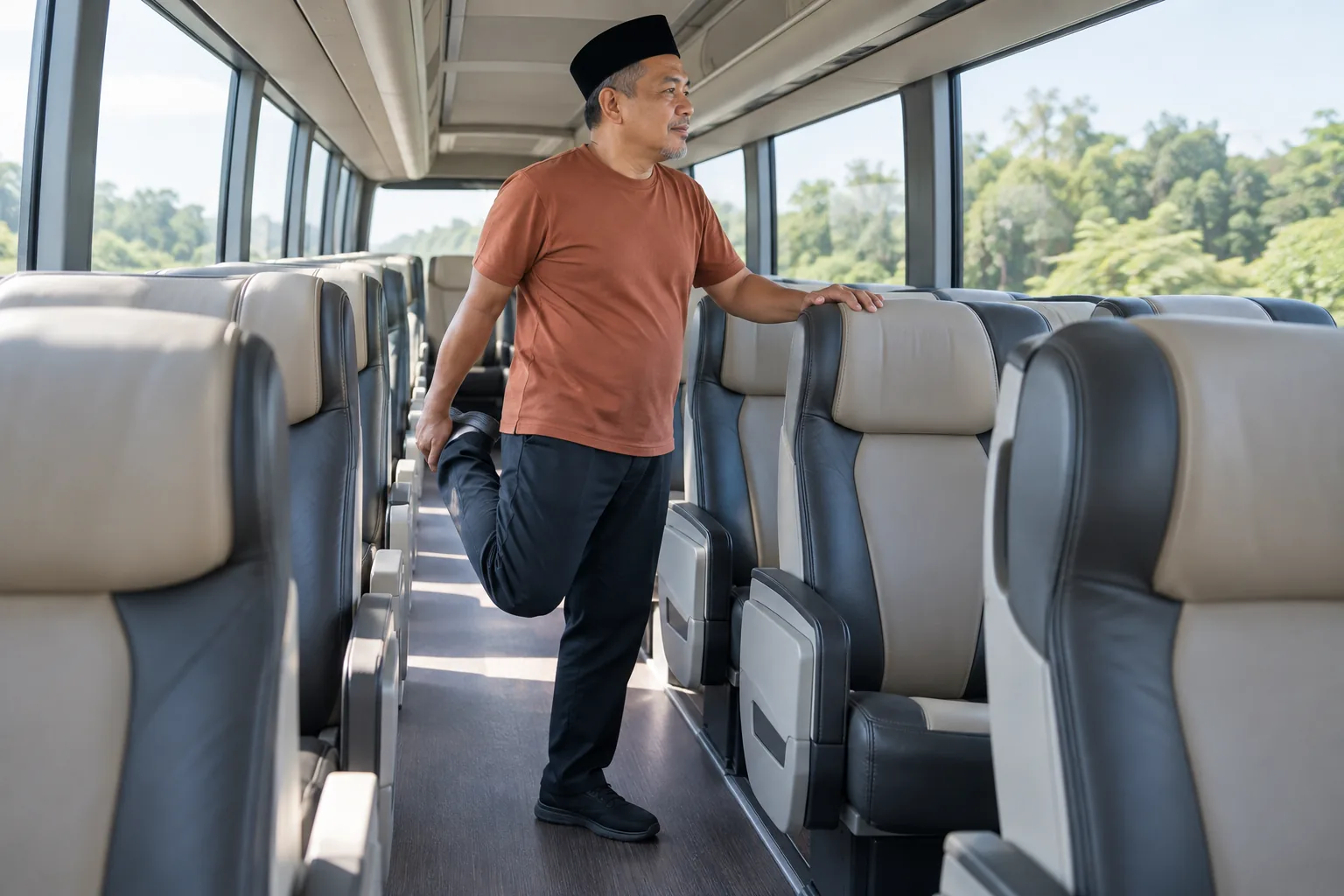
The NHS (the UK’s National Health Service) advises, as general advice to lower the chance of deep vein thrombosis (DVT), that you do not sit still for long periods of time and that you get up and move around every hour or so [1].
The NHS (the UK’s National Health Service) advises, as general advice to lower the chance of deep vein thrombosis (DVT), that you do not sit still for long periods of time and that you get up and move around every hour or so [1]. DVT is a blood clot in a vein, usually in the leg, and a long journey of more than 4 hours is one of the times when the chance of it is higher [1].
- Why do long journeys matter?
- What can I do during the journey?
- Should I speak to my doctor before I start exercising?
- When is urgent help needed?
- What should I do next?
Why do long journeys matter?
A long journey of more than 4 hours by plane, car or train is one of the times when the chance of DVT is higher [1]. The same NHS list includes having, or having had, surgery, and staying in or recently leaving hospital, especially if you cannot move around much [1]. We suggest that if you have had surgery or an injury recently, you ask your doctor or surgical team before you travel.

What can I do during the journey?
- The NHS’s general advice to prevent DVT is not to sit still for long periods of time and to get up and move around every hour or so [1].
- The NHS says that on a journey of 4 hours or more, wearing loose clothing, drinking plenty of water, avoiding alcohol and walking around when possible can lower your chances of DVT [1]. It words the threshold as “more than 4 hours” when listing times of higher chance, and “4 hours or more” for these tips [1].
- The NHS physical activity guidelines for adults aged 19 to 64 say to break up long periods of not moving with some activity [2].
- The NHS sitting exercises page describes an ankle stretch done while seated, and says it can lower the risk of developing a blood clot [3]. If you are not sure the exercises suit you, it advises checking with a GP or a health professional involved with your care [3].
How the NHS describes the ankle stretch
The NHS sitting exercises page describes the ankle stretch like this: “Sit upright, hold on to the side of the chair and straighten your left leg with your foot off the floor.” “With your leg straight and raised, point your toes away from you.” “Point your toes back towards you.” “Try 2 sets of 5 stretches with each foot.” [3]
Should I speak to my doctor before I start exercising?
Speak to your doctor first if you have not exercised for some time, or if you have medical conditions or concerns [2].
When is urgent help needed?
The list below covers the signs that should not wait for a routine appointment.
What should I do next?
If knee pain is not settling, or you are unsure what is causing it, an assessment is a sensible next step. The assessment brings together the patient’s story, an examination and any tests that help, so that the patient and the surgeon can decide together. It looks at the structure involved, the patient as a whole person and the goal they want to return to. An appointment supports an informed decision. It is not a commitment to surgery.
- Read about the Knee Hub.
- Arrange a knee assessment when you are ready.
This page provides general information and cannot diagnose an individual condition. OrthoKinetics does not provide emergency or urgent care through this webpage or its WhatsApp contact.
References
- NHS. DVT (deep vein thrombosis) (last reviewed 30 April 2026). https://www.nhs.uk/conditions/deep-vein-thrombosis-dvt/
- NHS. Physical activity guidelines for adults aged 19 to 64 (last reviewed 22 May 2024). https://www.nhs.uk/live-well/exercise/physical-activity-guidelines-for-adults-aged-19-to-64/
- NHS. Sitting exercises (last reviewed 18 January 2024). https://www.nhs.uk/live-well/exercise/sitting-exercises/
Was this page helpful?