
Dr Sean Leo · Orthopaedic Surgeon, Singapore
Knee replacement consultation in Singapore: total and partial options
Knee replacement is not one operation for everyone. The right procedure depends on which parts of your knee are worn, so this is a suitability question rather than a simple “better or worse” comparison.
Call Orthosports@NovenaCall Orthosports@Connexion

Dr Sean Leo’s qualifications are MBBS, MRCS (Ed), MMed (Ortho) and FRCSEd (Ortho).
Orthosports@Novena, Mount Elizabeth Novena Specialist Centre · Orthosports@Connexion, Connexion, Farrer Park Hospital


Who this page is for
Is this you?
Is this you?
- What people notice is persistent knee pain and stiffness that limit everyday life, along with a loss of function.
- An assessment is worth arranging when knee pain does not settle, when pain limits daily life or the activities you want to do, or when you would like to understand whether a partial replacement could be an option for your knee.
The first visit
Your first consultation
Deciding together
Your first consultation
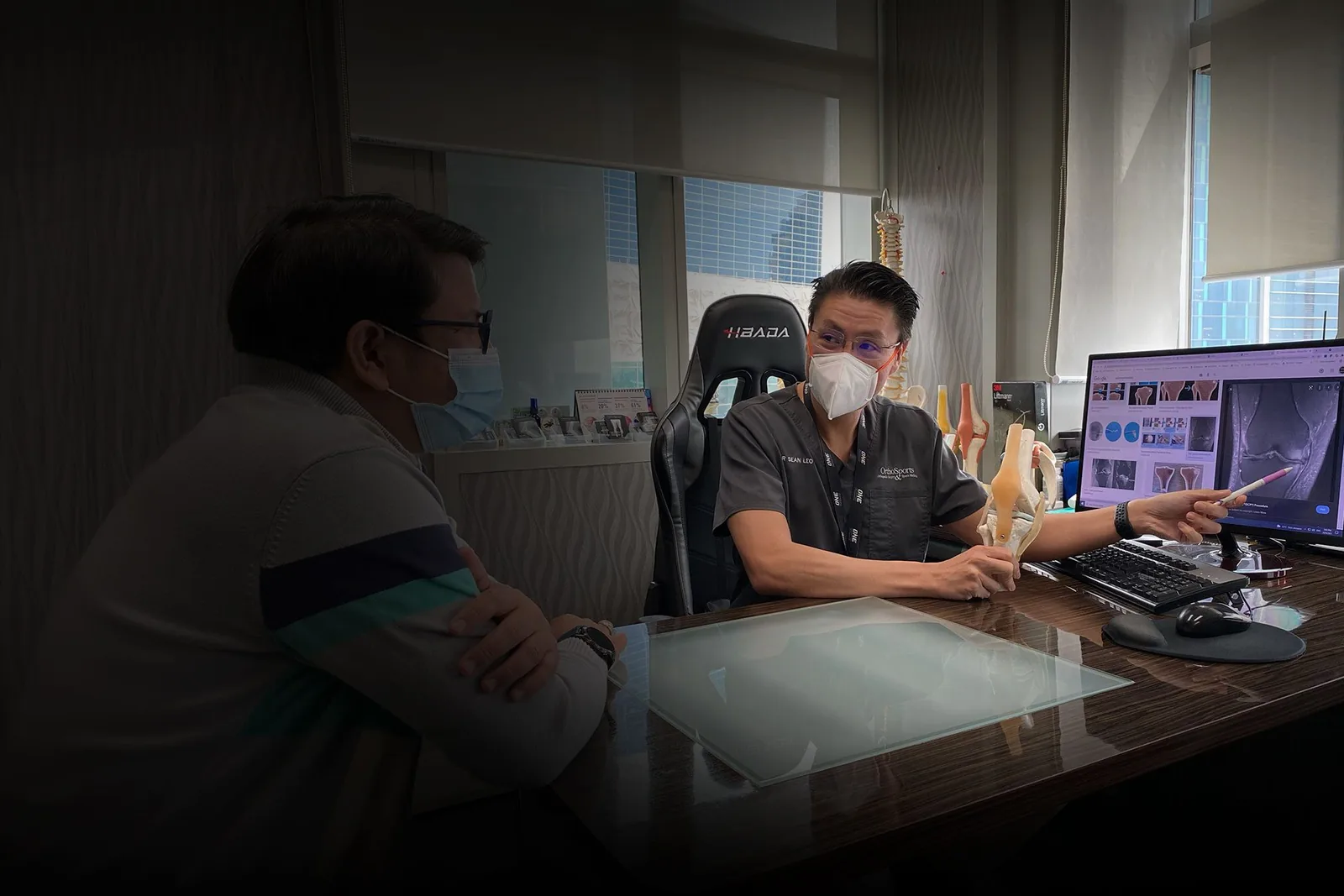
Whether surgery is right for you is a decision made together with your clinician, with balanced information about the benefits, the risks, and what to expect.
An assessment for knee replacement typically brings together several parts:
- Your history — how the knee problem started, how it affects you, and how it has responded to treatment so far.
- Examination — how the knee moves, where it hurts, and how stable and strong it is.
- Imaging — an X-ray (and sometimes other scans) to look at the joint surfaces. This is one part of the picture, not a standalone trigger for surgery.
- Quality-of-life impact — how pain and stiffness affect walking, sleeping, work and everyday activities.
- What has already been tried — the non-surgical measures you have used and how much they helped.
The decision is organised around three questions: the structure, the patient and the goal.
- Structure: what the joint damage actually is.
- Patient: who you are and what you can carry.
- Goal: what you want to return to.
Bring your policy details, any referral or pre-authorisation requirements, and previous reports or imaging.

Options
Treatment options at a glance
Treatment options at a glance
Non-operative care comes first
Before knee replacement is considered, non-surgical treatment comes first. These measures are genuine treatment in their own right, not simply a delay — and for many knees they are enough.
The options your clinician is likely to discuss include:
- Pain relief and medication — simple analgesia and other medicines to help with day-to-day pain and stiffness.
- Physiotherapy and exercise — a structured programme to strengthen the muscles around the knee and keep the joint moving.
- Weight management — reducing load through the knee where body weight is a factor.
- Activity modification — finding ways to stay active while easing strain on the joint.
- Injections, where appropriate — an option some knees benefit from, discussed on its own merits.
What conservative care can achieve is meaningful but not unlimited. It can reduce pain, improve function and help you stay active, which is exactly why it comes first. What it cannot do is regrow cartilage or heal the worn surfaces of end-stage arthritis.
Total and partial knee replacement
Total knee replacement — also called total knee arthroplasty — replaces the worn surfaces of both sides of the knee joint with an artificial implant. It is offered when arthritis has worn the joint’s bearing surfaces enough that pain and stiffness limit everyday life, and non-surgical treatment has not helped enough.
Partial knee replacement resurfaces only the worn compartment of the knee and leaves the healthy bone, the other compartments and your ligaments in place. It is considered only when arthritis is confined to one compartment with intact ligaments. It is not a shortcut and is not suitable for everyone.
Neither option is inherently superior — each suits a different picture of arthritis. Where both a partial and a total replacement are clinically suitable, the choice is offered to you and is made together with your surgeon — it is a shared decision, not something decided for you. Suitability is determined during your clinical assessment and depends on factors such as which compartment is affected, the stability of the knee, and the pattern of arthritis. This page does not determine which option applies to you; that is a matter for your assessment.
Risks to know about
Knee replacement is a major operation, and like any major operation it carries real risks. Infection in the new joint is a recognised and serious risk of any joint replacement, including partial knee replacement. It is uncommon, but when it occurs it is significant and usually needs further treatment, which may include further surgery.
A blood clot in the leg (deep vein thrombosis, or DVT) — or one that travels to the lungs (pulmonary embolism, or PE) — is a recognised risk after knee replacement. It is a real risk, but it is reduced by preventive measures (called prophylaxis), which are a standard part of care after this operation.
Over many years, an implant can loosen where it meets the bone, or its bearing surfaces can wear.
A partial replacement treats only the one compartment that is worn, and it leaves the rest of your knee as it is. Because of this, arthritis can go on to develop or worsen in the parts of the knee that were preserved. If that happens and becomes troublesome, the usual answer is to convert the partial replacement to a total knee replacement.
A minority of patients continue to have pain, or a poor overall result, after knee replacement. Most, but not all, patients improve after knee replacement.
Meet Dr Sean Leo
Meet Dr Sean Leo
A consultant orthopaedic surgeon whose clinical focus is the knee, sports injuries and the lower limb.
- Dr Sean Leo is a consultant orthopaedic surgeon. OrthoKinetics is his professional brand; clinical services are provided through OrthoSports Orthopaedic & Sports Surgery at Mount Elizabeth Novena Specialist Centre and Connexion, Farrer Park Hospital.
- His clinical interests include sports injuries, including those in adolescent athletes; ligament reconstruction; realignment surgery; cartilage repair and joint-preservation approaches; knee replacement; and technology-assisted hip and knee surgery.
- The consistent aim is to return people to meaningful function and activity while avoiding unnecessary downtime.
- Qualifications: MBBS, MRCS (Ed), MMed (Ortho), FRCSEd (Ortho).
More detail: Meet Dr Sean Leo
- Training and career: Dr Leo trained in medicine at the National University of Singapore and served in the Singapore Armed Forces Medical Corps from 2000 to 2012, where his work included the care of soldiers in physically demanding roles. He completed postgraduate orthopaedic training in 2009 and a one-year clinical fellowship at Royal North Shore Hospital in Sydney, Australia, before joining Changi General Hospital as an orthopaedic consultant in 2012, where he later held the positions of Senior Consultant and Director of the Hip and Knee Service. With seniority, his educational contribution has evolved towards mentorship and support for junior doctors.

Costs and insurance
Cost, Medisave and insurance
Practicalities
Cost, Medisave and insurance

A cost estimate for surgery can be given only after a consultation and assessment, once a surgical plan has been developed. Each individual condition is unique — implants used, time taken, and other factors contribute to the overall estimate. The estimate will be provided to you by the clinic should you decide on surgical management, and will also be used to assist in obtaining pre-authorisation from insurance where applicable.
Medisave, MediShield Life, and Integrated Shield Plans are the scheme routes through which a knee replacement may be partly funded in Singapore. Eligibility, claim limits, and the amount actually covered depend on your personal circumstances and policy terms, so this page cannot advise on what any individual will pay or recover.
Benefits, pre-authorisation, letters of guarantee, panel rules and reimbursement depend on your individual policy and the insurer’s decision. Neither panel status nor co-management guarantees coverage, approval or cashless treatment. The clinic team can assist with claim paperwork, but cannot promise the outcome.
Insurance panels. Dr Sean Leo, Orthopaedic Surgeon, is on the specialist panels of Great Eastern (GE Panel), HSBC Life (HSBC Life Shield) and Singlife (Singlife Shield), and on the Prudential Panel. AXA Insurance Singapore became part of HSBC Life in 2023, and former AXA Shield plans are now HSBC Life Shield plans.
Corporate health plans. Dr Leo is on the panels of both Alliance Medinet and iXchange, which administer medical benefits for many company health plans. If your company plan uses either panel, you can see Dr Leo as a panel doctor.
If your company uses a different panel. Some company plans still let you see a doctor of your choice outside their panel, then claim reimbursement. This varies from plan to plan, as may the co-payment, so please check your benefits with your company’s HR department.
Panel arrangements change from time to time, so please confirm with your insurer or your company’s plan administrator before your appointment.
Dr Leo is on the panels shown. If your insurer is not listed, you may ask whether co-management with an Orthosports surgeon partner on that panel is clinically and administratively appropriate. Orthosports surgeon partners are collectively on the panels of all Shield plans.

Questions people often ask
Common knee replacement questions
Common knee replacement questions
Am I a candidate for a knee replacement?
Candidacy is a clinical judgement, not a scan result. The decision is made with you after assessment, not by an X-ray grade or a pain score on its own.
Do I need surgery, or can my arthritis be managed without it?
Many knees are managed well without surgery. Surgery is discussed when these measures have been given a fair trial and are no longer managing the problem.
What is the difference between total and partial knee replacement?
A partial replacement resurfaces one worn compartment; a total replacement resurfaces the whole joint.
Is partial knee replacement better than total?
It depends on your arthritis pattern. Neither is automatically superior, and the deciding factor is your suitability, which your surgeon will assess with you.
Am I a candidate for a partial knee replacement?
Suitability is a clinical judgement, not something you can determine yourself. Not every painful knee qualifies, and the assessment exists to make sure the procedure is right for your knee.
What are the real risks, and how common are they?
Blood clots are a real but reducible risk managed with preventive measures. A minority of patients have persistent pain, and most, but not all, patients improve.
Next step
Arrange a consultation
Appointments are arranged through the OrthoSports clinic team. Send your details below, or message or call the clinic.
Leave your details and the clinic team will reply to arrange a time.
Message the clinic on WhatsApp
-
38 Irrawaddy Road, #10-41 Mount Elizabeth Novena Specialist Centre, Singapore 329563 Map for Orthosports@Novena (opens Google Maps)
-
1 Farrer Park Station Road, #15-17 Connexion, Singapore 217562 Map for Orthosports@Connexion (opens Google Maps)
WhatsApp is for clinic enquiries only. It is not an emergency service and is not monitored for urgent care. Website or messaging contact is not an emergency-response service. For a medical emergency, use your local emergency service.
OrthoKinetics does not provide emergency or urgent care through this webpage or its WhatsApp contact.